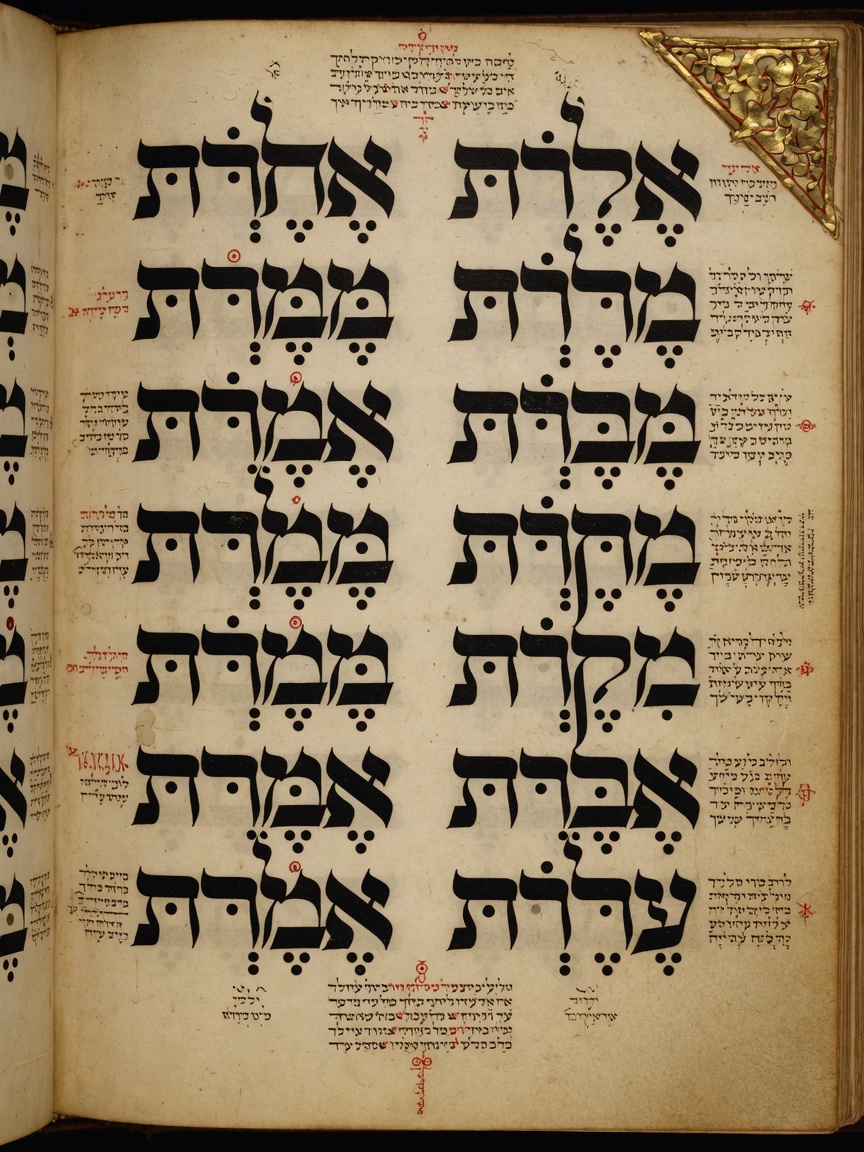
I. The Problem of Consonantal Hebrew
Biblical Hebrew was written as a consonantal script. A string like בראשית could theoretically be divided and vocalized in more than one way until context and oral tradition fixed the reading as בְּרֵאשִׁית ("in the beginning"). For public liturgical reading (qeri'at ha-Torah), every community needed the same vowels, the same stress, and the same melodic phrasing. The Masoretes solved this by developing two interlocking symbol systems and writing them directly around the sacred consonants.
Sheva, ḥolam, kamatz, patach — plus the etnaḥta (֑) dividing the first phrase.
II. Niqqud — Vocalization
The Tiberian system places dots and dashes above, below, and inside letters to encode a specific historical pronunciation — not identical to modern Israeli Hebrew. It distinguishes long and short vowels, uses sheva (ְ) for reduced vowels, and employs dagesh (ּ) for gemination or begadkefat alternation.
Three regional systems developed in parallel: Tiberian (sublinear, most elaborate), Palestinian (often supralinear, simpler), and Babylonian (associated with the Geonic academies). Tiberian pointing won because it combined maximal phonetic precision with a fully developed accentual apparatus. Geoffrey Khan's open-access study reconstructs the Tiberian phonology these dots encode.
III. Te'amim — Cantillation
Accents (te'amim or trope) serve three functions at once: musical notation for synagogue chanting, syntactic punctuation, and guidance for stress and phrasing. The Torah uses 21 disjunctive accents; the Prophets (Haftarah) and the poetic books (Psalms, Proverbs, Job) each have distinct systems.
- ֑ Etnaḥta — major pause (like a semicolon)
- ֖ Tipḥa — secondary division
- ֔ Zaqef qatan — smaller pause
Many of the ~875 differences between Ben Asher and Ben Naphtali involve accent placement — proof that a misplaced etnaḥta can change perceived syntax. Aaron ben Asher's Sefer Dikdukei ha-Te'amim treats these fine points with the same rigor as vowels.
IV. Scroll vs. Codex
A synagogue Torah scroll remains unpointed by ritual law. Pointed codices were study Bibles for scholars, cantors, and students. This dual-track tradition — unpointed ritual scroll plus pointed scholarly codex — explains why Masoretic labor concentrated on codices and why every bar or bat mitzvah today learns from a pointed humash that descends directly from Tiberias.
Kim Phillips's article in Ink magazine offers an accessible introduction to the two-strand model — consonantal text plus inscribed reading tradition — discussed critically on the main page.