I. Why These Projects Matter
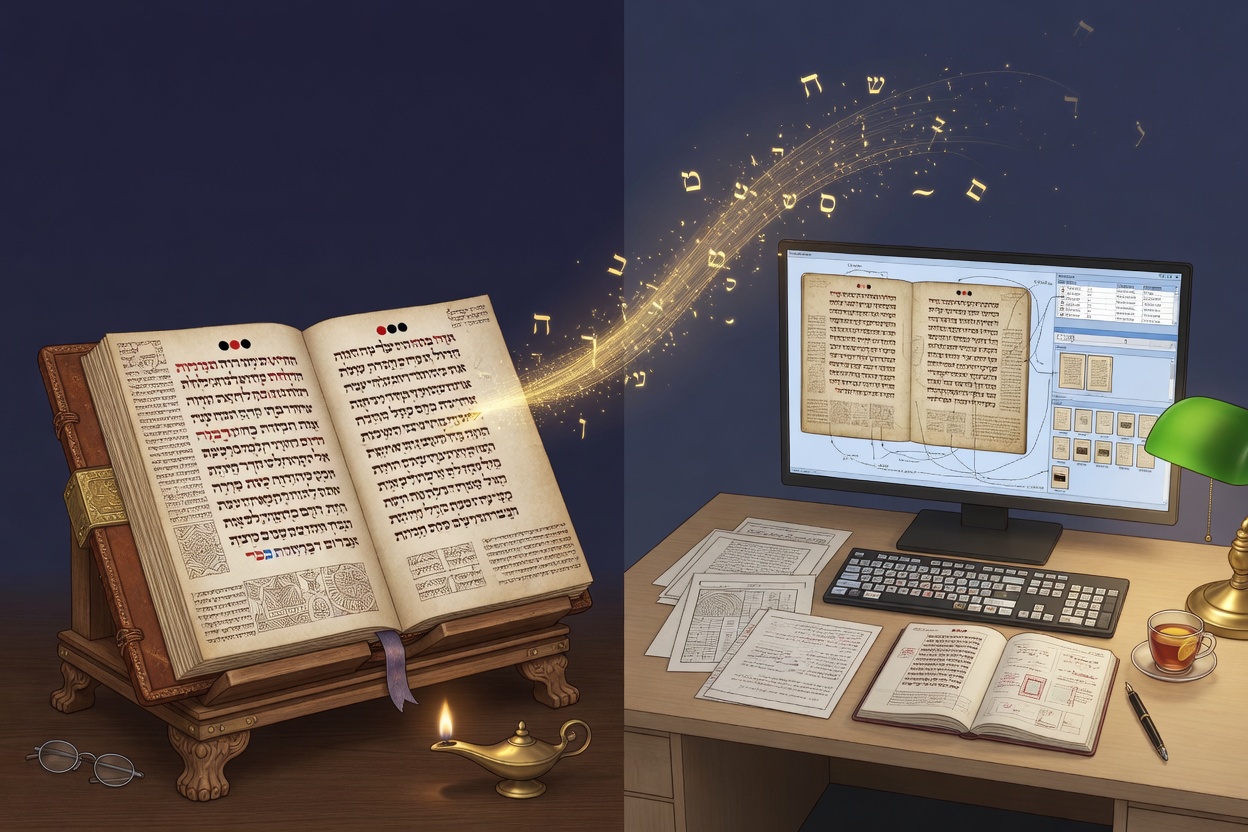
The Masoretic Text is not a single manuscript but a tradition — consonants, vowels, accents, marginal statistics, and liturgical phrasing preserved across great codices, Genizah fragments, and printed editions. Modern projects continue that labor: imaging the Aleppo and Leningrad witnesses, aggregating Cairo Genizah leaves worldwide, encoding the Leningrad Codex for Bible software, and comparing the MT to Dead Sea Scrolls and ancient translations. The links below are the principal gateways — scholarly institutes, digitization portals, machine-readable texts, and open-access research.
II. Landmark Codices — Museums & Digitization
Home of the surviving 294 leaves of the Crown of Aleppo (Keter Aram Tzova). UNESCO Memory of the World; the physical center of Ben Asher's pointing tradition.
The oldest complete pointed Hebrew Bible (1008 CE, Cairo). Base manuscript for BHS and most critical editions. Fully digitized; see also the machine-readable transcriptions below.
Nearly complete 10th-century Bible on permanent display in Tel Aviv. A vital bridge between Qumran witnesses and the standardized medieval text. → Great codices note
Attributed to Moses ben Asher; still kept in the Karaite synagogue in Cairo. → Aleppo & Cairo synagogues note
III. Cairo Genizah & Medieval Fragment Archives
The Cairo Genizah preserves thousands of biblical fragments in Tiberian, Palestinian, and Babylonian pointing — the richest empirical archive for how the MT functioned in daily life.
Taylor-Schechter Collection (~140,000 items). High-resolution images of biblical and documentary fragments. → Schechter note
Aggregates Genizah images and metadata across institutions worldwide — a unified search portal for fragment joins and biblical collation.
Machine-learning approaches to handwriting, documentary texts, and fragment identification across the Genizah corpus.
Major European Genizah holdings including Adolf Neubauer's collection; digitized manuscripts and catalogues.
Principal North American Genizah cache; biblical fragments and documentary texts from Schechter's era and later acquisitions.
Overview of discovery, dispersal, and scholarly significance across ~250,000–400,000 fragments.
IV. Critical Editions & Diplomatic Texts
The standard scholarly edition worldwide, based primarily on the Leningrad Codex with a critical apparatus of variants. Published by the Deutsche Bibelgesellschaft. See also Academic Bible portal.
The successor to BHS — fuller apparatus, revised sigla, ongoing fascicle publication. Read BHQ online →
Ongoing diplomatic edition privileging the Aleppo Codex where it survives, with comprehensive textual apparatus. English project page →
Magnificent printed edition reconstructing lost portions of the Aleppo Codex with a specially designed typeface — the Jewish community's answer to scholarly Leningrad-based editions.
The traditional Jewish format — pointed Hebrew text surrounded by Targumim and classical commentaries (Rashi, Ibn Ezra, Kimhi, and others). The layout that carried the MT into Ashkenazi and Sephardi homes.
V. Machine-Readable Texts & Bible Software
Maintains the Westminster Leningrad Codex (WLC) — the machine-readable transcription of B19a used by Logos, Accordance, BibleWorks successors, and countless websites. Download WLC files →
Christopher Kimball's open-access WLC derivative in Unicode and XML — freely copyable Hebrew text in text, HTML, XML, ODT, and PDF formats.
A living library of Jewish texts online — pointed Hebrew Bible with linked commentaries, translations, and open API for developers building on the Masoretic tradition.
VU Amsterdam's syntactic database of the Hebrew Bible (WIVU) — morphologically and syntactically tagged text for computational analysis of Masoretic Scripture.
Kim Phillips's accessible introduction to the two-strand transmission model (consonants + inscribed reading tradition). → Niqqud & te'amim note
Guide to reading and understanding the base manuscript behind BHS — colophon, Masorah, and scribal conventions.
VI. Pre-Masoretic Witnesses & Textual Criticism
Israel Antiquities Authority — spectral imaging of scroll fragments including the oldest known biblical copies. Essential for comparing proto-MT consonants to medieval codices. → DSS & the MT note
Hebrew University; editor of the DSS publication project. Traces when the consonantal tradition stabilized and how Qumran scribes relate to the MT. → Rabbanites & Karaites note
Single-note overview of proto-MT dominance, Genizah evidence, and the relationship between consonantal substrate and Masoretic superstructure.
Overview of methods, witnesses (MT, DSS, Septuagint, Samaritan Pentateuch), and how critical apparatuses continue the Masoretic impulse to document variants.
VII. Vocalization, Pronunciation & Masoretic Science
Open-access Cambridge study reconstructing the phonology behind niqqud — treating the Masoretes as empirical linguists.
Geoffrey Khan's companion site — ongoing research on Tiberian vocalization, manuscripts, and reconstructed pronunciation.
Technical overview of the sublinear pointing system that won over Palestinian and Babylonian rivals.
The accentual system for synagogue chanting, syntactic parsing, and stress — still heard every Shabbat worldwide.
VIII. Notes on This Site
Companion scholarship from The Masoretes project — each note links to Grokipedia entries and the external projects above.
Aleppo, Leningrad, Sassoon, and Cairo Prophets.
Ben Asher's masterpiece, the 1947 fire, and the Shrine of the Book.
Discovery, biblical fragments, and three vocalization schools.
Proto-MT alignment and notable variants.
The Tiberian rivalry behind the great codices.
Vowels, accents, and the ritual vs. study Bible divide.
Shared text, rival authorities — with Tov bibliography.
Diaspora centers from Spain to Eastern Europe.
Quick Reference — Grokipedia Gateways
Authoritative overviews for the core topics: