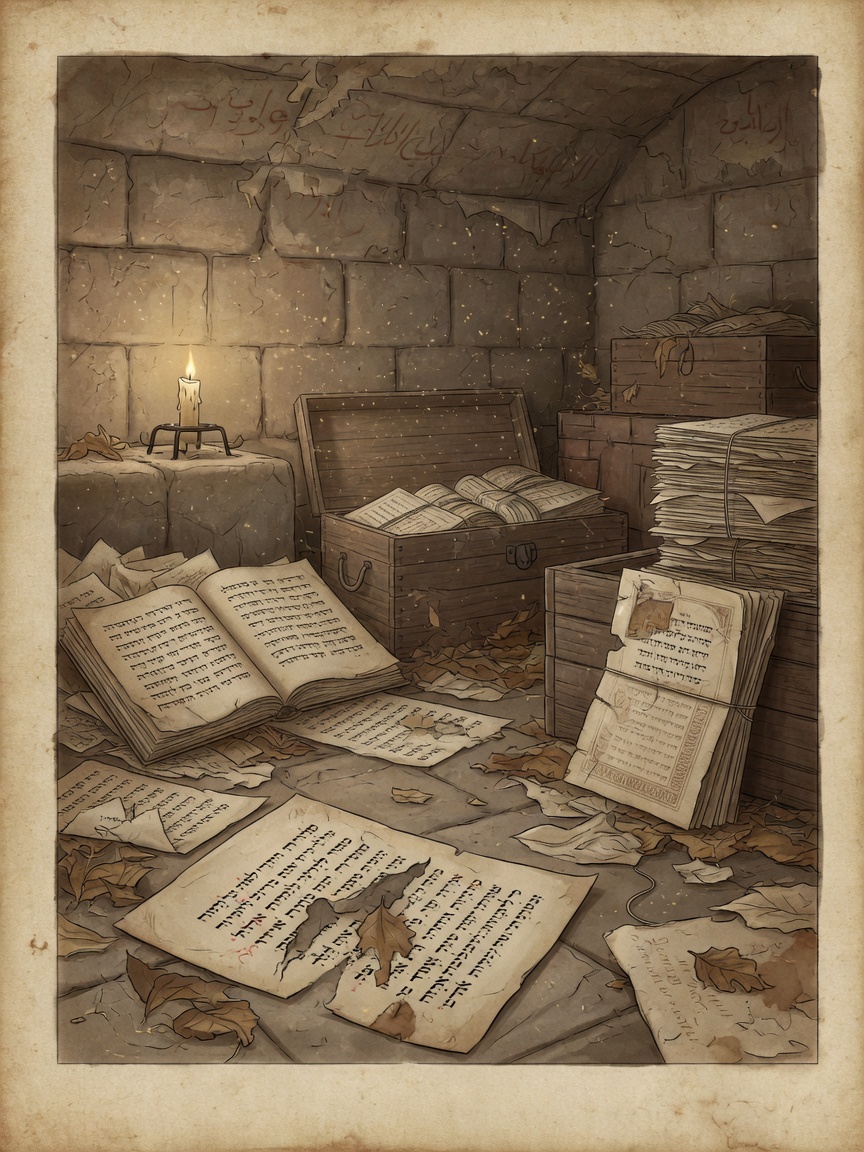
I. The Scholar Before Cairo
Solomon Schechter was born in Focșani, Romania, and trained in rabbinic learning before pursuing academic philology in Vienna and Berlin. By the 1890s he held a lectureship in Talmudic studies at Cambridge, where he worked alongside Charles Taylor, Master of St John's College. Schechter was already known for rigorous textual work — including his recovery and publication of Hebrew fragments of Ecclesiasticus (Ben Sira) — when two Scottish twins, Agnes Smith Lewis and Margaret Gibson, returned from Cairo in 1896 with leaves purchased from a dealer who had been raiding a storeroom in the Ben Ezra Synagogue in Fustat.
Schechter identified one leaf immediately: it was a passage from the lost Hebrew original of Ben Sira, a book known previously only through Greek and Syriac translations. He understood that if dealers were already selling Genizah material piecemeal, the chamber itself might still hold thousands of unrevealed texts — biblical manuscripts, Masoretic fragments, Geonic responsa, and the documentary paperwork of a millennium of Jewish life in Egypt.
II. The Expedition of 1896–1897
In late 1896 Schechter traveled to Egypt. With the cooperation of the Rabbanite community and synagogue officials, he gained access to the Genizah chamber — a walled closet or attic attached to the Ben Ezra Synagogue, where worn writings bearing the divine Name had accumulated for centuries. Schechter did not catalogue delicately; he removed the bulk of the contents in large sacks, shipping them to Cambridge with the financial backing of Charles Taylor and the patronage of Dr Solomon Joel.
Schechter wrote to Taylor that the Genizah would allow Jewish history to be rewritten "from the inside" — not from polemical chronicles or secondary accounts, but from the letters, contracts, and sacred books a community had itself deposited and forgotten.
The result was the Taylor-Schechter Collection at Cambridge University Library — today numbering roughly 140,000 fragments, the largest single Genizah holding in the world. Schechter was not the only buyer: dealers had already dispersed material to Oxford, the Jewish Theological Seminary, the Bodleian, St Petersburg, and private collectors. Estimates for the total worldwide corpus range from 250,000 to 400,000 fragments — but Schechter's Cambridge cache remains the foundation of modern Genizah research.
III. What Schechter Found for Masoretic Studies
For historians of the Masoretes, Schechter's Genizah was decisive. Among the sacks were:
- Thousands of biblical leaves and fragments in Tiberian, Palestinian, and Babylonian pointing — proof that vocalization schools coexisted in medieval Cairo
- Witnesses to the Ben Asher and Ben Naphtali traditions on actual parchment
- School exercises, accent lists, and abbreviated Masorah — evidence of how pointing was taught
- Documents from the milieu that produced the Leningrad Codex (Samuel ben Jacob, Cairo, 1008 CE)
- The Hebrew Ben Sira, revolutionizing the study of Second Temple wisdom literature
Paul Kahle later used Genizah evidence to argue that medieval biblical pointing was far more diverse than printed Bibles suggested. Emanuel Tov drew on the same materials to refine the history of the proto-Masoretic Text. Without Schechter's expedition, much of this evidence would have been lost to humidity, neglect, or the antiquities market.
IV. From Cambridge to New York
Schechter's Genizah work made him the leading candidate to lead the Jewish Theological Seminary in New York. He served as president from 1902 until his death in 1915, shaping what would become the Conservative movement in American Judaism. He brought Genizah fragments to JTS as well, expanding North American access to the archive. His scholarship bridged traditional rabbinic learning and modern university philology — the same combination the Masoretes themselves had embodied in medieval Tiberias.
V. Legacy and Digital Continuation
Cambridge's Taylor-Schechter Genizah Research Unit continues Schechter's project with high-resolution digitization, fragment joins, and cataloguing. The Friedberg Genizah Project links images across institutions; the Princeton Geniza Lab applies machine learning to handwriting and documentary texts. A researcher in any city can now compare a Schechter fragment with the Crown of Aleppo or the Leningrad Codex without traveling to Cambridge — fulfilling, in digital form, Schechter's vision of an archive that rewrites Jewish history from primary evidence.
For the synagogue that housed the Genizah, see The Great Synagogues of Aleppo and Cairo. For the full scholarly treatment of the archive, see The Cairo Genizah and the Masoretic Tradition.