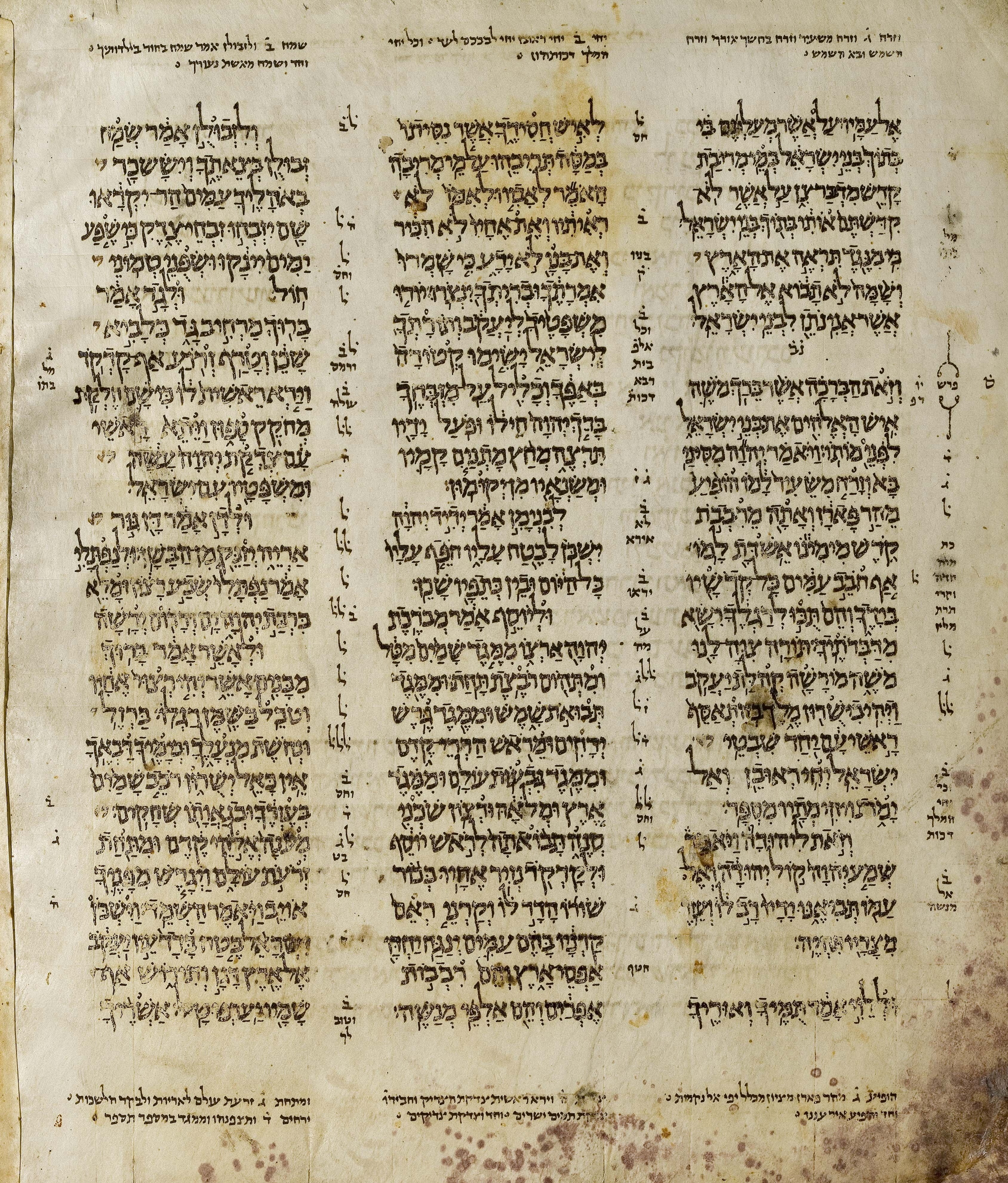
I. Birth in Tiberias
Around 920 CE, in the scriptoria of Tiberias, two masters collaborated on a biblical codex that would outlive empires. The professional scribe Shlomo ben Buya'a penned the consonantal text in beautiful uniform square script. The Masorete Aaron ben Moses ben Asher added the full Tiberian vocalization, cantillation marks, and the vast apparatus of Masorah Parva and Magna. The manuscript originally comprised roughly 487 leaves of parchment — a complete Tanakh in codex form, the laboratory technology of Masoretic science made visible on every page.
This was the finest product of the Ben Asher school at the moment when the Tiberian system reached classical maturity. It embodied everything the Masoretes had built: phonetic precision, syntactic accents, statistical notes, and reverence for the unaltered consonantal ketiv.
II. Journey to Aleppo
How the codex traveled from Galilee to Aleppo (Aram Tzova) is not fully documented. By the 11th century it was treasured in the Jewish community of Syria's great commercial city. Karaite and Rabbanite scholars alike recognized its authority. When Maimonides in Cairo sought a model for Torah scroll layout, he endorsed this codex's tradition — a ruling in Mishneh Torah, Hilkhot Sefer Torah 8:4, that canonized Ben Asher for all subsequent generations. See Maimonides and the Masoretic Tradition.
III. The Crown in the Great Synagogue
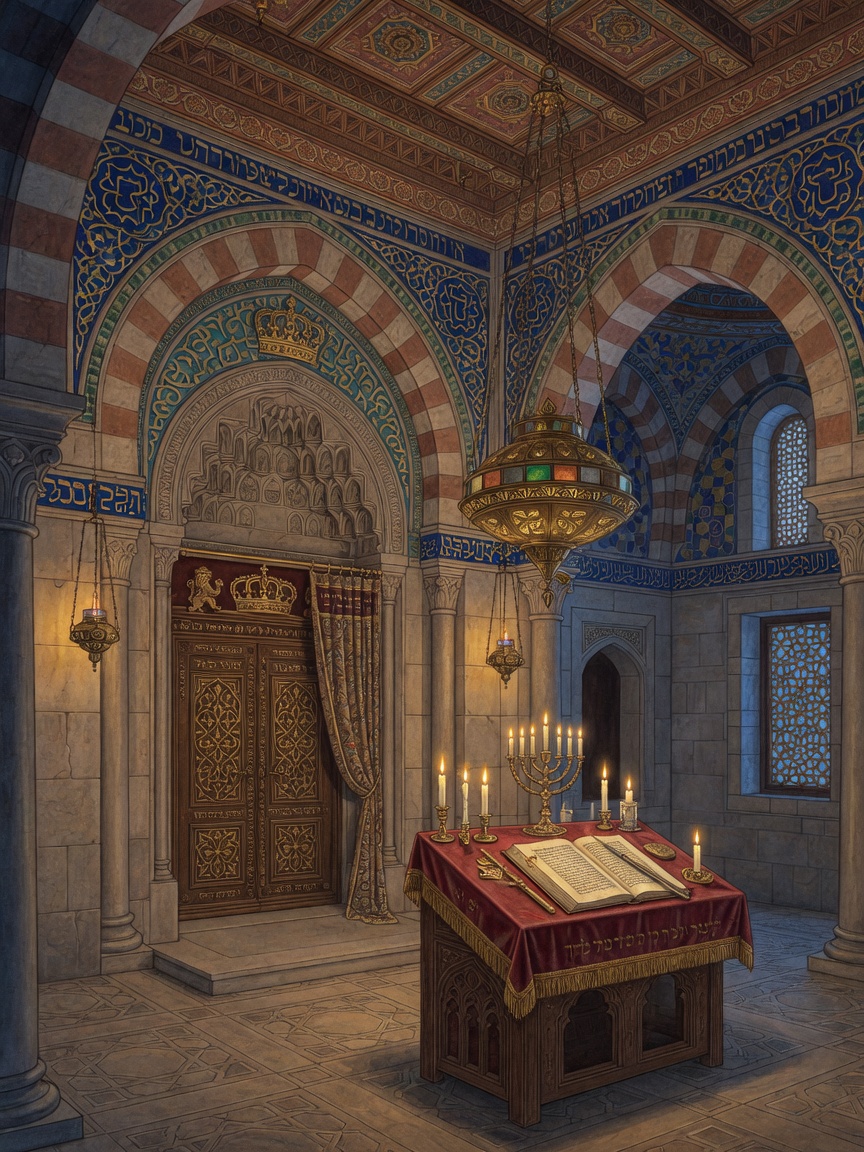
For centuries the codex was housed in the Great Synagogue of Aleppo (the Central Synagogue), in a cave-like shrine called Me'arat Eliyahu (the Cave of Elijah the Prophet). It rested in the ark known as Heichal Eliyahu, alongside other precious codices, inside a locked safe. Community members lit candles there on the eve of Yom Kippur; oaths were sworn before the Crown; women prayed at the shrine. The manuscript was not a museum piece but a living sacred object — the physical center of Aleppan Jewish identity.
"The Crown told the story of the people's connection to God and their land — the five books of Torah at the heart of the religion, read aloud in synagogue week after week in the form the Masoretes had fixed."
IV. The Fire of 1947 and the Missing Pages
On 29 November 1947 the United Nations voted to partition Palestine. The next day, Arab mobs in Aleppo rioted against Jewish homes, schools, and synagogues. The Great Synagogue was set ablaze. The Crown was damaged — and when the smoke cleared, roughly 40 percent of the codex had vanished, including nearly the entire Torah (Pentateuch). Only 294 leaves ultimately reached Israel, smuggled out in 1958 as the Aleppan Jewish community disintegrated.
Scholars and journalists — notably Matti Friedman in The Aleppo Codex (2012) — have investigated what happened to the missing pages: whether they were destroyed in the fire, stolen, or hidden. The mystery remains part of the Crown's modern legend. What is certain is that the survival of the Prophets and Writings sections preserved the Ben Asher pointing tradition for books where the Leningrad Codex could not supply an Aleppan witness.
V. Jerusalem and the Shrine of the Book
Today the surviving leaves are displayed at the Shrine of the Book at the Israel Museum in Jerusalem — a UNESCO Memory of the World treasure. The Jerusalem Crown (Keter Yerushalayim) edition reconstructs the lost portions from other witnesses while privileging Aleppo readings where the manuscript survives. The Hebrew University Bible Project likewise treats Aleppo as the preferred Vorlage when available.
Ironically, the codex that enjoys supreme prestige in Jewish memory is incomplete, while the complete Leningrad Codex supplies the base text for BHS. Together they anchor modern textual criticism. See The Great Masoretic Codices for comparison.
VI. What Scholars Still Study
- Reconstructing the lost Torah portion from Genizah and parallel codices
- Variants between surviving Aleppo leaves and Leningrad
- Relationship to the Codex Sassoon (c. 900 CE)
- Maimonides' actual access to the codex vs. later tradition
- Paleographic analysis of Buya'a's consonantal hand vs. Ben Asher's pointing
- Fire damage and subsequent conservation at the Israel Museum
- Provenance of missing leaves rumored in private collections
- Digital imaging projects and high-resolution collation