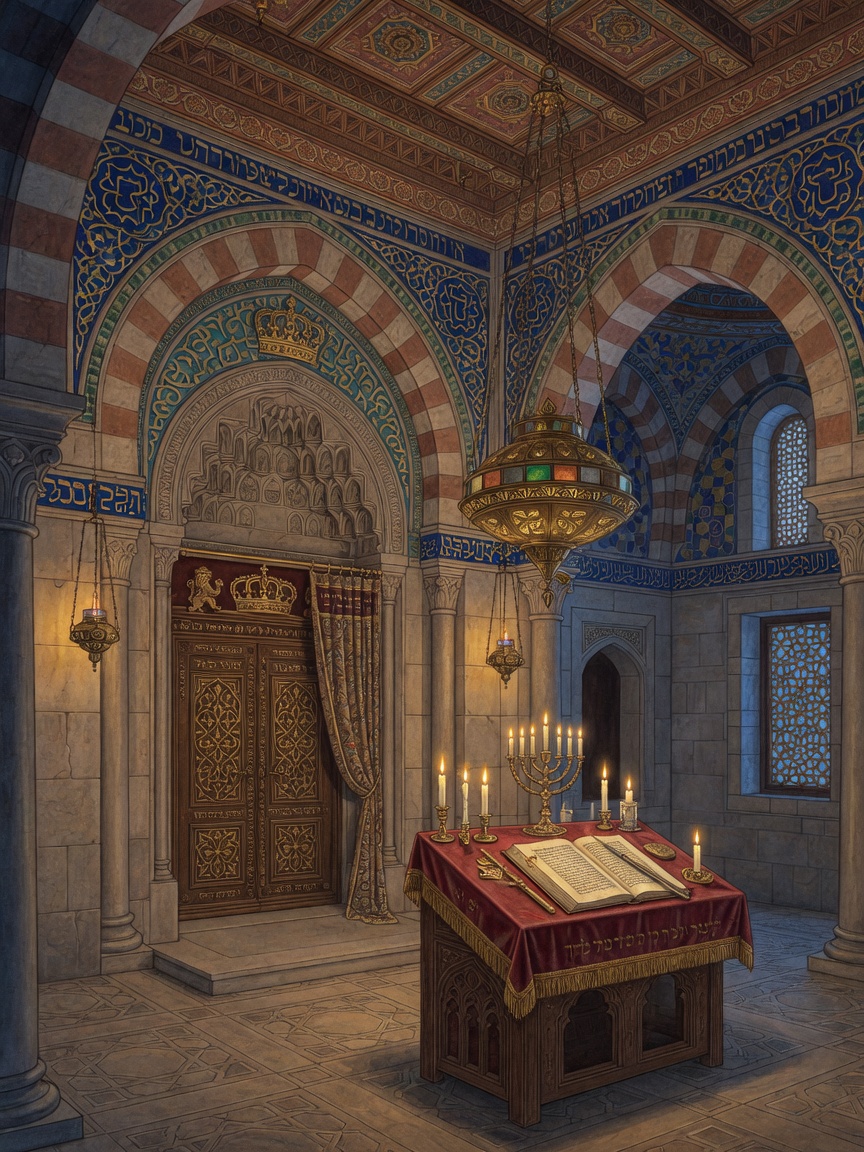
I. Two Cities, Two Sanctuaries
Aleppo and Cairo were not centers of Masoretic production in the same way as Tiberias. They were guardians and consumers — commercial hubs where the greatest codices were treasured, copied, argued over, and embedded in communal law. The Great Synagogue of Aleppo housed the Crown; the Ben Ezra Synagogue in Fustat accumulated the accidental archive that Solomon Schechter would empty in 1896. Together they frame the journey of the Masoretic Text from Galilee scriptorium to Mediterranean shrine to modern museum and digital database.
II. The Great Synagogue of Aleppo
The Great Synagogue (often called the Central Synagogue) stood in the Bahsita quarter of Aleppo's old Jewish neighborhood. Tradition ascribed its origins to antiquity; the structure known to modern observers was rebuilt after Mongol destruction in 1400, renovated in 1418 and again in 1855. Its architecture borrowed from mosque design — the ark resembling a mihrab — while its layout expressed kabbalistic symbolism: seven holy arks for Torah scrolls, seventy-two pillars, and three distinct worship sections.
- Western wing (Musta'ribi): The indigenous Aleppan community; eight windows in unique shapes corresponding to kabbalistic ideas
- Middle section: An open courtyard with pillars, used for outdoor worship in fair weather; housed the great ark Heichal Tekiah with its nine-step platform for circumcisions and shofar blowing
- Eastern wing: Added for Sephardic exiles after 1492; included the cave shrine Me'arat Eliyahu (Cave of Elijah)
Me'arat Eliyahu was the spiritual heart of the complex. In the ark Heichal Eliyahu, a locked safe held precious codices — including the Aleppo Codex (Keter Aram Tzova). Community members lit candles there; oaths were administered before the Crown; women prayed at the shrine on the eve of Yom Kippur. The codex was not displayed like a library treasure but revered as a covenantal object — the physical proof that Aleppan Jewry possessed the truest text of Scripture.
The Riot of 1947
After the UN partition vote of 29 November 1947, anti-Jewish riots swept Aleppo. On 1–2 December, mobs burned Jewish shops, schools, and synagogues. The Great Synagogue was set afire; its roof collapsed. The Crown was damaged and roughly 40 percent of its leaves vanished — most of the Torah. The eastern wing was later partially restored for a dwindling community, but the Jewish population of Aleppo effectively ended. The surviving codex leaves were smuggled to Israel in 1958. The synagogue itself, once the grandest in the Sephardic world, fell into ruin — a casualty of the same convulsion that scattered Aleppan Jewry across the diaspora.
III. The Ben Ezra Synagogue, Cairo
In Fustat (Old Cairo), the Ben Ezra Synagogue (El-Geniza Synagogue) stood on a site traditionally associated with the place where the infant Moses was found among the reeds. The building was rebuilt in the 11th century and served the Rabbanite community of medieval Cairo — a city where Rabbanites and Karaites lived side by side, traded, intermarried under negotiated agreements, and disputed law while sharing biblical codices.
Attached to the synagogue was a genizah — a storeroom where texts bearing the divine Name were deposited rather than destroyed. Over roughly a millennium (c. 9th–19th centuries), the chamber filled with Torah scrolls beyond repair, Talmud folios, liturgical poetry, marriage contracts, business letters, and children's exercises in pointed Hebrew. Because everyday documents in Judeo-Arabic and Arabic routinely invoked God, the deposit grew into the largest accidental Jewish archive in history.
Schechter's Opening of the Chamber
In 1896–1897, Solomon Schechter negotiated access with synagogue officials and removed the bulk of the Genizah to Cambridge — the Taylor-Schechter Collection. The synagogue thus became the most famous address in modern Jewish scholarship, though most visitors today know the story better than the building. The Ben Ezra Synagogue has been restored as a heritage site; the Genizah chamber itself is empty, but its contents reshaped our understanding of Masoretic transmission. See the full treatment in The Cairo Genizah and the Masoretic Tradition.
IV. Cairo's Other Biblical Sanctuaries
Cairo was not limited to Ben Ezra. Medieval sources describe multiple Rabbanite synagogues — including Palestinian and Iraqi rite houses of worship that Benjamin of Tudela recorded in the 1170s. The Karaite synagogue preserved another Masoretic treasure: the Cairo Codex of the Prophets (895 CE), attributed to Moses ben Asher, which remains in Karaite custody to this day. Meanwhile, Samuel ben Jacob completed the Leningrad Codex in Cairo in 1008 — proof that the city was a scribal hub as well as a repository.
Maimonides prayed and taught in this milieu, legislating which codex tradition scribes should follow. S. D. Goitein later mined Genizah letters to reconstruct the Mediterranean society that sustained these synagogues — trade routes linking Syria, Yemen, India, and the Maghreb, with Scripture at the center of every contract and dispute.
V. Aleppo and Cairo in Masoretic History
Guardian of the Crown • Communal oaths and Yom Kippur devotion • Maimonides' endorsed Vorlage • 1947 fire and diaspora
Schechter's Genizah • Leningrad Codex scribal milieu • Karaite Prophets codex • Rabbanite–Karaite shared text
Neither city created the Tiberian pointing system. Both ensured it would never be lost — one by enshrining its finest codex in a cave of Elijah, the other by preserving every worn fragment in a genizah until a Romanian scholar from Cambridge knew what he had found.