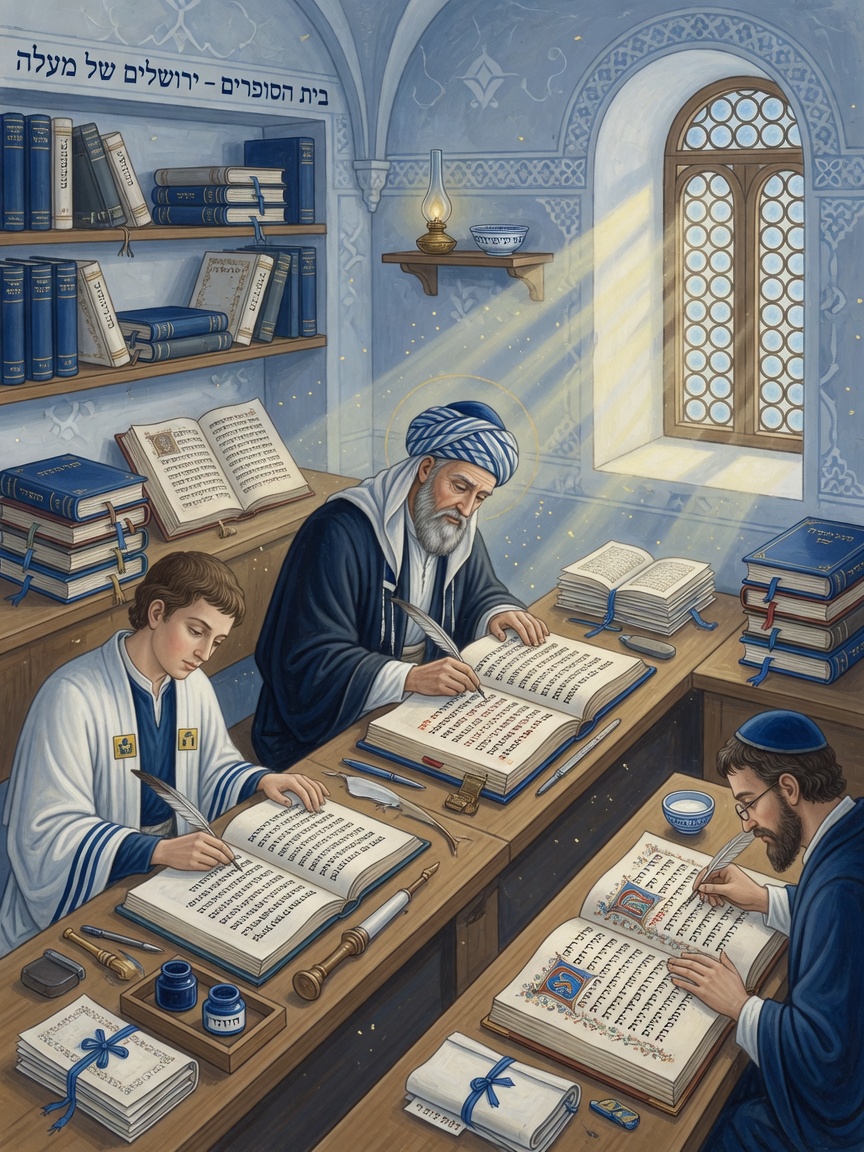
I. The End of Second Temple Sectarianism
Second Temple Judaism was a landscape of competing groups — Pharisees, Sadducees, Essenes, and others — each claiming authentic interpretation of Israel's covenant. The destruction of the Temple in 70 CE removed the central cult that had anchored many of these disputes. Shaye J. D. Cohen (Hebrew Union College Annual, 1984) argues that the rabbis who gathered at Yavneh were motivated less by purging heretics than by ending sectarianism itself: the Mishnah is the first Jewish work to record named authorities who disagree on law yet remain within a single fraternity. Cohen cautions against reading Yavneh as a proto-Nicaea; the tannaim rarely call themselves "Pharisees," even when they preserve disputes in which Pharisees defeat Sadducees.
On Cohen's reading, Jewish sectarianism as such largely disappeared after 70 CE and did not re-emerge until Karaism in the 9th century. The Pharisaic legal culture nonetheless became the seedbed of rabbinic Judaism — the Judaism of the Talmud, the Geonim, and eventually the Masoretes themselves.
II. Proto-Masoretic Text and the Pharisaic Stream
Emanuel Tov (Hebrew University; editor of the Dead Sea Scrolls publication project) locates a decisive textual turning point around the first century CE. Before that date, multiple Hebrew textual traditions circulated; afterward, the consonantal proto-Masoretic text became authoritative for virtually all Jewish streams that survived. Tov writes:
"Before the first century of the Common Era, only the proto-rabbinic (Pharisaic) movement made use of MT, while other streams in Judaism used other Hebrew textual traditions."
His ten-part series on the proto-Masoretic text develops this thesis in detail. Key installments include:
- Socio-Religious Background and Stabilization — when and why the consonantal text unified
- The Scribes of Proto-MT and Their Practices — scribal habits visible at Qumran and beyond
- Key Characteristics of (Proto-) MT — orthography, spacing, and statistical features
- Evaluating (Proto-) MT — how scholars assess its relationship to other traditions
The Masoretes of the 7th–10th centuries therefore did not invent the consonantal Bible; they inherited a Pharisaic-rabbinic stream already dominant for centuries and added the vocalic, accentual, and statistical apparatus that defines the full Masoretic Text as we know it.
III. The Emergence of Karaism
In the 7th–9th centuries, Jewish groups that rejected rabbinic authority coalesced into Karaism (Encyclopaedia Judaica). Anan ben David, once portrayed as Karaism's founder, is now understood as one figure among several in a complex process; Karaism proper emerged around the mid-9th century. Daniel J. Lasker (Ben-Gurion University) reframes the movement as a parallel Judaism — not merely anti-Talmudic reaction but an alternate legal civilization grounded in Scripture.
Karaites accepted roughly twelve of Maimonides' thirteen principles of faith; what they rejected was the Sinaitic status of the Oral Torah. Their own interpretive traditions — סבל הירושה (sevel ha-yerushah, "burden of inheritance") — functioned as a non-rabbinic counterpart to masorah. Lasker demonstrates that halakhic exegesis, not abstract theology, constituted the real boundary: divergent readings of dietary law (milk and meat), calendar (observation vs. calculation), tefillin, and marriage law separated communities that otherwise shared ethnicity, neighborhoods, and — crucially — the same biblical codex.
Recent surveys such as "Karaite Judaism: A Contemporary Perspective" (Religions, MDPI, 2022) and the Encyclopaedia Judaica entry on Karaism document Karaism's "Golden Age" in the Land of Israel (9th–11th centuries), its Byzantine flourishing, and the modern Egyptian-Israeli communities that preserve the tradition today.
IV. Geonic Polemics and the Shared Codex
The Geonic period (7th–11th centuries) saw intense Rabbanite-Karaite debate, especially under Saadia Gaon (882–942), who wrote major polemics against Anan and the Karaites while simultaneously advancing Hebrew philology. Both sides assumed the authority of the consonantal proto-MT; their quarrels concerned exegesis, not alternate Hebrew Vorlagen.
This is why the Masoretes matter to both histories. Karaite emphasis on Scripture raised the stakes of vocalization: without niqqud, a reader had to rely on rabbinic or Karaite tradition to know how consonants sounded. Rabbanites needed the same precision for qeri'at ha-Torah and Talmudic citation. The Tiberian system answered both needs.
Geoffrey Khan's The Tiberian Pronunciation Tradition of Biblical Hebrew (Open Book Publishers, 2020; open access) reconstructs the phonology behind the pointing signs, treating the Masoretes as rigorous empirical linguists. His companion site TiberianHebrew.com publishes ongoing research on the vocalization tradition.
V. Karaite Patronage of Masoretic Masterpieces
One of the great ironies of Jewish intellectual history is that Karaite communities preserved some of the finest Masoretic codices. The Aleppo Codex (Keter Aram Tzova, c. 925) — attributed to Aaron ben Moses ben Asher — was guarded for centuries in the Karaite synagogue of Aleppo. The Cairo Codex of the Prophets (895 CE) remains in Karaite custody. Studies of "Ben Asher's creed" trace how Maimonides' endorsement of the Ben Asher tradition in Hilkhot Sefer Torah (citing the Aleppo Codex) settled Rabbanite practice while vindicating manuscripts Karaite patrons had treasured.
Tov notes that since the first century CE, the MT "was accepted as authoritative by all streams of the Jewish people" and is "the only text quoted in rabbinic literature and Karaite works." The medieval Masoretes thus served both heirs of the Pharisaic textual stream: those who added the Talmud and those who refused it.
VI. What Scholars Still Debate
- Was Anan ben David a founder or a retroactive symbol? (Lasker)
- Why did Karaites and Rabbanites share codices but not calendars? (Lasker)
- Did Ben Asher influence exceed his rivals during his lifetime? (Ben Asher studies)