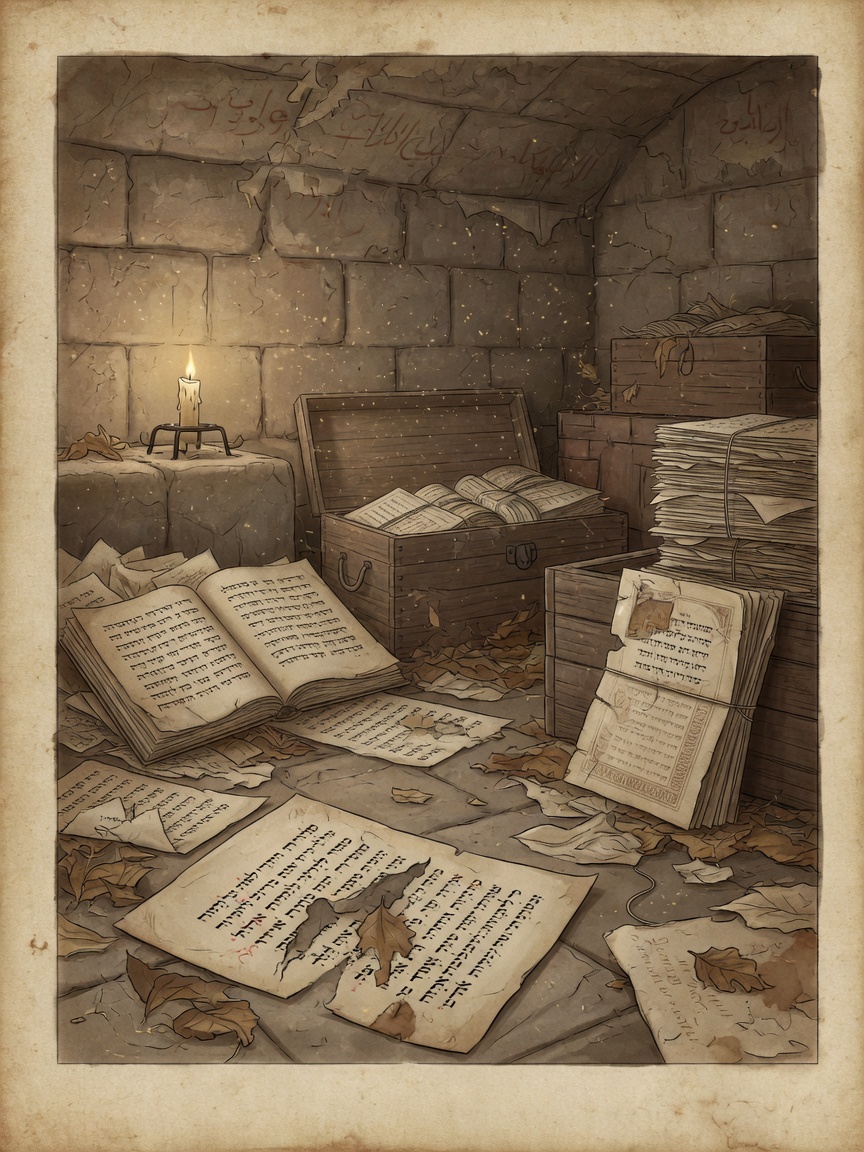
I. What Is a Genizah?
A גְּנִיזָה (genizah, from the root g-n-z, "to hide away") is a storeroom where worn, damaged, or superseded Hebrew writings containing the divine Name are deposited rather than destroyed. Rabbinic law treats such texts as sacred objects: they may not be casually discarded, yet they are no longer fit for liturgical use. Over centuries, synagogues across the Jewish diaspora maintained modest genizot; most held a few dozen or a few hundred items. The repository attached to the Ben Ezra Synagogue in Fustat (Old Cairo) was different. Because it served a major urban community at the crossroads of Mediterranean trade, Geonic scholarship, and Rabbanite–Karaite debate for roughly a millennium, it became the largest accidental archive in Jewish history — and one of the most important manuscript discoveries of the modern era.
For students of the Masoretic Text, the Genizah matters because it preserves not only complete codices and scrolls but thousands of biblical fragments: pages torn from prayer books, school exercises, discarded drafts, and worn liturgical codices. These scraps document how pointing, accentuation, and Masorah were actually applied in daily life — not only in the monumental manuscripts later prized by collectors.
II. Fustat, Ben Ezra, and a Community at the Center
Fustat (medieval Cairo) was founded as a garrison town in the 7th century and quickly became the commercial heart of Egypt under early Islamic rule. Its Jewish quarter housed Rabbanites and Karaites in close proximity — sharing markets, sometimes intermarrying under negotiated agreements, and disputing law while citing the same biblical codex. The Ben Ezra Synagogue, traditionally associated with the site where baby Moses was said to have been found among the reeds, was rebuilt in the 11th century and remained a Rabbanite house of worship for centuries — the building where Schechter would later open the Genizah.
The Genizah chamber was an enclosed space, often described as a sort of attic or walled closet accessible from the synagogue, where community members deposited anything bearing God's name: Torah scrolls beyond repair, Talmud folios, liturgical poetry, marriage contracts, business letters, amulets, and children's writing exercises. Because Hebrew, Aramaic, Judeo-Arabic, and Arabic documents routinely invoked divine epithets, the deposit grew to include the mundane paperwork of an entire civilization — not only Scripture.
This is why Solomon Schechter (1847–1915), the Cambridge scholar who emptied the chamber in 1896–1897, understood immediately that he had found something far larger than a biblical treasure trove. As he wrote to Charles Taylor, his colleague at Cambridge, the Genizah promised to rewrite Jewish history "from the inside."
III. A Millennium of Accumulation
Scholars date Genizah deposits from roughly the 9th century (the early Geonic period) through the 19th century, with the densest concentration in the 10th–13th centuries — precisely when the Masoretes of Tiberias were perfecting Tiberian vocalization and when Cairo scribes such as Samuel ben Jacob were producing authoritative Bibles. The chamber was not systematically curated. Texts were piled, compressed, and occasionally disturbed when the synagogue needed space or repairs. Humidity, insects, and gravity shredded codices into fragments — catastrophic for librarians, providential for paleographers, because a single damaged prayer book might yield leaves from three different biblical manuscripts.
The result is a stratified archive: early Palestinian-pointed lectionaries lie beside fully Tiberian codices; Babylonian supralinear pointing shares a crate with Maimonides' autograph drafts. No other site offers such a continuous cross-section of how one Mediterranean Jewish community read, copied, argued over, and prayed from the Bible across the very centuries when the Masoretic Text became normative.
IV. Solomon Schechter: Discovery, Extraction, and Global Dispersal
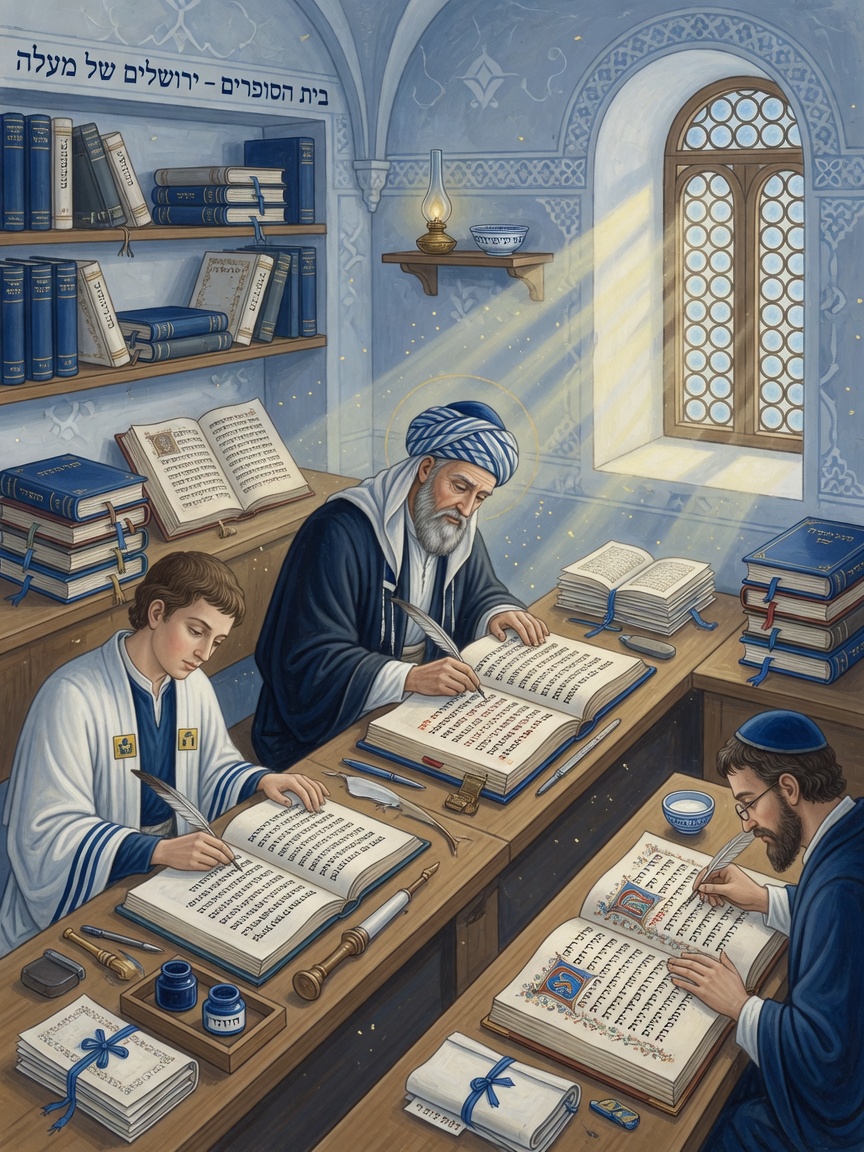
The modern story begins with Solomon Schechter (1847–1915) — Romanian-born rabbinic scholar, Cambridge lecturer, and later president of the Jewish Theological Seminary. In 1896, Scottish twins Agnes Smith Lewis and Margaret Gibson returned from Cairo with Genizah leaves purchased from a dealer who had been raiding the storeroom of the Ben Ezra Synagogue in Fustat. They showed the fragments to Schechter at Cambridge.
Schechter recognized one leaf immediately as Hebrew text from Ecclesiasticus (Ben Sira) — a book known previously only through Greek and Syriac translations. He understood that the chamber itself, not merely the dealer's handful, might hold the largest Jewish archive ever assembled. In late 1896 he traveled to Egypt, negotiated with synagogue officials, and with the financial backing of Charles Taylor and Dr Solomon Joel removed the bulk of the Genizah in large sacks — some 140,000 items now catalogued as the Taylor-Schechter Collection at Cambridge University Library.
Schechter wrote to Taylor that the Genizah promised to rewrite Jewish history "from the inside" — from the sacred books and mundane letters a community had deposited and forgotten, not from polemical chronicles alone.
For Schechter's biography, expedition details, and Masoretic legacy, see the dedicated note Solomon Schechter and the Cairo Genizah. Schechter was not alone: dealers and scholars — including Adolf Neubauer at Oxford, the Jewish Theological Seminary in New York, the Bodleian, the Russian National Library, and various European collectors — acquired additional batches from intermediaries who had sifted the chamber before and after Schechter's expedition. Estimates of the total corpus range from 250,000 to 400,000 fragments, written in more than a dozen languages and scripts, spanning roughly a thousand years.
"There is no parallel in the history of archives to the Cairo Genizah — a single community's paper trail, preserved by sanctity law and physical neglect, rediscovered at the moment when philology, history, and Jewish studies were ready to receive it."
Today the principal collections are digitized and increasingly linked: Cambridge's Cambridge Digital Library — Genizah, Oxford's Hebrew and Judaica collections, JTS, and the Friedberg Genizah Project, which aggregates images and metadata across institutions.
V. The Archive by the Numbers
- ~250,000–400,000 fragments worldwide
- ~1,000 years of deposits (c. 9th–19th centuries)
- 15+ languages: Hebrew, Aramaic, Judeo-Arabic, Arabic, Greek, Latin, and others
- Largest cache: Cambridge Taylor-Schechter (T-S), ~140,000 items
Yet biblical materials constitute only a fraction of the whole. The majority of Genizah texts are documentary: letters, court records, merchant accounts, trousseau lists, synagogue regulations, and private petitions. That imbalance is precisely what makes the collection indispensable — it situates the Masoretic tradition inside a living economy of law, trade, and worship rather than treating it as an isolated scribal art.
VI. Biblical Manuscripts and the Masoretic Tradition
For the history of the Masoretes, the Genizah's foremost contribution is empirical: it shows what texts Jews in Egypt actually used while the great codices of Tiberias were being produced and exported. Several conclusions — once hypotheses — are now securely documented:
- Proto-Masoretic consonantal stability: Biblical consonantal texts in the Genizah overwhelmingly align with the received Masoretic Text, confirming Emanuel Tov's thesis that the proto-MT stream was already dominant before medieval pointing.
- Plural vocalization schools: Fragments preserve Tiberian, Palestinian, and Babylonian systems in contemporaneous use — proof that the Masoretes' final victory was historical, not inevitable.
- Everyday Masorah: Marginal notes, accent lists, and student exercises reveal how Masorah Parva and Magna were taught, copied, and sometimes abbreviated in non-monumental books.
- Cairo as a scribal hub: The Leningrad Codex colophon records that Samuel ben Jacob completed his Bible in Cairo in 1008/9 CE; Genizah fragments from the same milieu show the workshop culture behind such codices.
Paul Kahle, in The Cairo Genizah (2nd ed., 1959) and related studies, used Genizah evidence to challenge oversimplified narratives of a single, uniform Masoretic tradition. Kahle argued that multiplicity of pointing traditions was the medieval norm and that modern printed Bibles flattened that diversity. Later scholars moderated his polemics while retaining his core insight: the Genizah is the laboratory where vocalization history became visible.
VII. The Three Vocalization Traditions in the Genizah
The Masoretes are associated primarily with the elaborate sublinear Tiberian system — the one preserved in the Aleppo, Leningrad, and Sassoon codices. Genizah fragments document the other schools with a granularity complete codices cannot provide:
Sublinear niqqud and te'amim; associated with Aaron ben Moses ben Asher and the Ben Asher dynasty. Genizah copies include full Bibles, prophetic lectionaries, and Pentateuchal fragments used in synagogue reading. Geoffrey Khan's reconstruction of Tiberian phonology draws heavily on Genizah manuscripts alongside the major codices.
Often supralinear, less granular than Tiberian, associated with the Land of Israel. Genizah lectionaries and Psalms fragments are among the principal witnesses. Israel Yeivin (Introduction to the Tiberian Masorah; studies of Palestinian pointing) and Shelomo Morag demonstrated how Palestinian tradition influenced liturgical practice even after Tiberian pointing became the scholarly standard.
The medieval debate between Ben Asher and Ben Naphtali — some 875 recorded differences in accent and vowel placement — also leaves Genizah traces. These micro-variants, once abstractions in Sefer ha-Chilufim, appear on actual parchment, allowing scholars to see which tradition a given community preferred.
VIII. Beyond Scripture: The Documentary Genizah
To treat the Genizah as a biblical archive alone is to misread it. More than half the corpus is non-biblical — and that half revolutionized fields beyond textual criticism. Letters from Maimonides and his circle, petitions to Saadia Gaon, Karaite-Rabbanite polemics, women's wills, pharmacists' formularies, and ships' cargo lists reveal a society that conducted its arguments in the shadow of Scripture. When a merchant writes in Judeo-Arabic that he will sail before Passover, he presupposes a shared liturgical calendar grounded in a biblical text whose consonants and vowels were already standardized — even when the community quarreled over how to calculate the month.
For Masoretic studies, these documents matter indirectly but powerfully: they show who commissioned Bibles, where codices traveled, and how much literate Jews paid for corrected scrolls. A letter complaining about a defective Torah scroll is evidence about scribal standards in the same era as the Aleppo Codex.
IX. Goitein and the Mediterranean World
Shelomo Dov Goitein (1900–1985) spent decades mining the Genizah's documentary material for his magnum opus, A Mediterranean Society (6 vols., 1967–1993). Drawing on thousands of letters and legal deeds, Goitein reconstructed the "portable society" of medieval Jewry: trade partnerships across the Indian Ocean, synagogue politics, education of children, and the interplay of Rabbanite and Karaite households. His work does not focus on niqqud, but it supplies the social history within which Masoretic labor made sense — a world where a corrected Bible was both a liturgical object and a prestige commodity, and where Cairo sat at the center of routes linking Syria, Yemen, India, and the Maghreb.
Goitein's index cards and transcriptions, now partly digitized, remain a model for how to read Genizah fragments as historical evidence rather than curiosities. Modern projects such as the Princeton Geniza Lab extend his methods with machine learning and crowdsourced transcription.
X. Digitization and Twenty-First-Century Research
Genizah scholarship entered a new phase when major repositories began high-resolution digitization. The Cambridge Digital Library publishes Taylor-Schechter images freely; the Friedberg Genizah Project links fragments across libraries and supports identification of joins — physically separate pieces that once formed a single page. The Princeton Geniza Lab applies handwriting analysis and collaborative tagging to documentary texts at scale.
For biblical studies, digital access means a researcher in Tel Aviv or New York can compare a Genizah Pentateuch fragment with the Leningrad Codex and a Qumran scroll without traveling to Cambridge. Projects cataloguing te'amim, orthography, and qere/ketiv variants increasingly treat the Genizah as a database, not a miscellaneous heap.
XI. What Scholars Still Debate
- How rapidly did Tiberian pointing displace Palestinian and Babylonian systems in Egypt?
- Do Genizah variants support or complicate Tov's model of proto-MT uniformity?
- How many fragments remain unidentified or wrongly joined in scattered collections?
- What role did Karaite patrons play in importing Tiberian codices to Cairo?
- How much was lost to dealers and private collectors before systematic cataloguing?
- Can machine learning reliably date and localize hands across the corpus?
- How should museums balance open access with fragment conservation?
- What documentary texts still await edition and translation?