I. The Man and His Journey
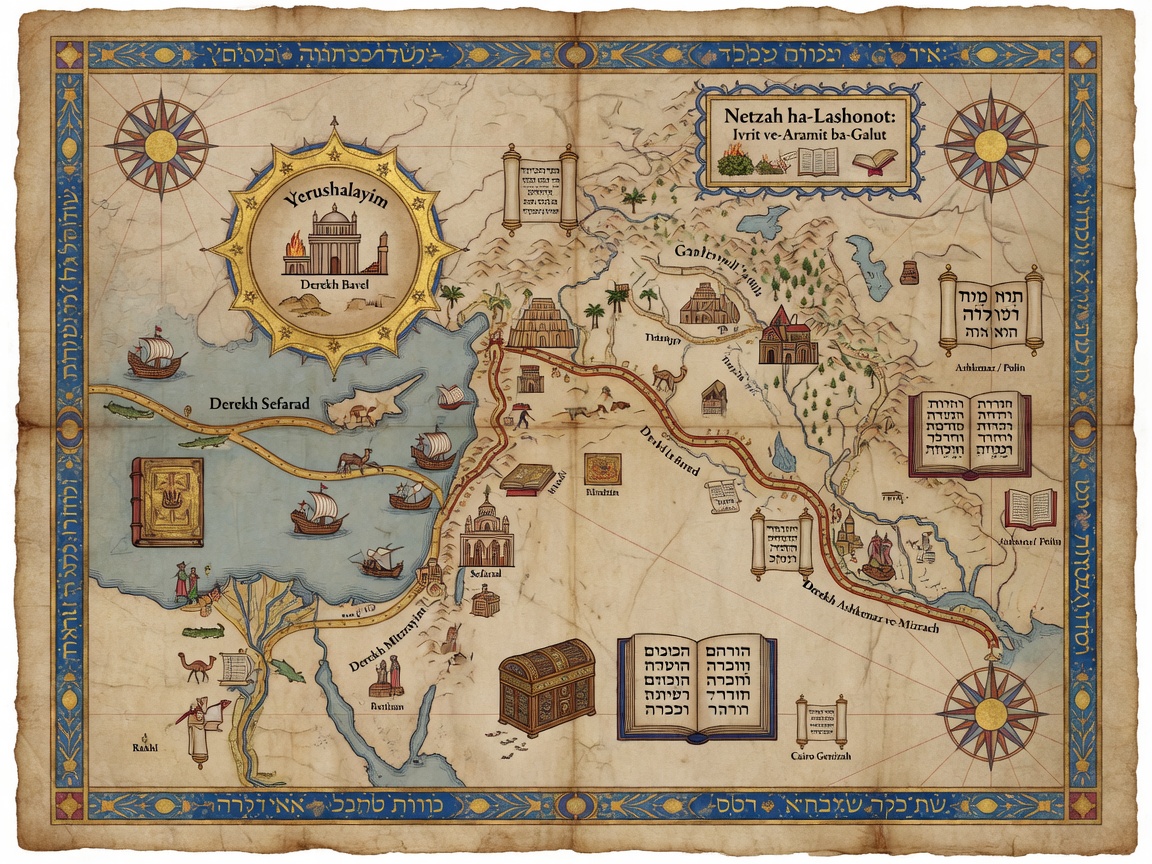
Benjamin of Tudela was a Jewish merchant from Tudela in the Kingdom of Navarre who set out around 1169 on a commercial and observational tour that would carry him across Europe, the eastern Mediterranean, Mesopotamia, and possibly as far as the Indian Ocean. His travelogue — preserved in Hebrew as סֵפֶר מַסָּעוֹת (Sefer ha-Massa'ot, Book of Travels) — records population figures, occupations, communal leaders, and scholars in more than 300 localities.
Benjamin was not a professional Bible scholar, but his account is indispensable for the history of Jewish biblical culture. Wherever he found a significant Jewish community, he noted its scholars (ḥakhamim), its academies (yeshivot or battei midrash), and its relationship to the great centers of learning in Babylonia and the Land of Israel. His itinerary traces the pathways along which Masoretic codices, commentaries, and grammatical treatises traveled in the 12th century.
II. Spain: The Heartland of Hebrew Learning
Benjamin's journey began in the Iberian Peninsula, then the most vibrant center of Jewish biblical scholarship outside Palestine. He visited Saragossa, Barcelona, Gerona, Lerida, and other cities, recording the names of leading scholars and the size of each community. In Toledo — which he describes as a great city with a large Jewish population — he notes the presence of learned men, reflecting the city's role as a crossroads of Christian, Muslim, and Jewish intellectual life.
This was the world that had produced Jonah ibn Janach's Sefer ha-Rikmah (Book of the Thread), Abraham ibn Ezra's biblical commentaries, and the young Maimonides (who had recently fled Cordoba). Benjamin's Spain is a landscape where Hebrew grammar, philosophy, and Masoretic precision were living trades. → Full Spain note
III. Italy, Provence, and the Rhineland
Crossing into Italy, Benjamin visited Rome, Pisa, and other ports — nodes in the manuscript trade that distributed vocalized Bibles northward. In Germany he catalogued the communities of the Rhineland: Speyer, Worms, and Mainz, the cradle of Ashkenazi Tosafist learning. These communities prized Talmud study above all, but their biblical engagement — through Rashi's commentary, liturgical reading, and the copying of Torah scrolls — depended on the same Masoretic Text the Spanish grammarians analyzed with greater philological rigor.
Benjamin's account of Crusade-ravaged Rhineland communities, written just decades after the massacres of 1096, also documents the vulnerability of the libraries and scrolls that embodied biblical scholarship.
IV. Byzantium, the Holy Land, and Egypt
In Constantinople Benjamin marveled at the wealth of Romaniot Jews and their beautiful synagogues. In the Land of Israel he visited Jerusalem, Hebron, Tiberias, and Acre — cities directly linked to the Masoretic tradition. He records that in Jerusalem there were only two Jewish dyers (the community was tiny under Crusader rule), but notes the tombs of biblical figures and the ongoing pilgrimage traffic that kept the land symbolically central to Jewish biblical imagination.
In Egypt, Benjamin describes Fustat (Old Cairo) as a major Jewish center with two synagogues — the Palestinian (Rabbanite) and the Iraqi — and reports that the head of the Babylonian academy in Baghdad, Samuel ben Ali, was the preeminent authority for Egyptian Jewry. This was the milieu in which Maimonides would soon settle and in which the Cairo Genizah was quietly accumulating the biblical fragments that would revolutionize Masoretic studies eight centuries later.
V. Mesopotamia: The Geonic Academies
Benjamin's account of Baghdad is among the most detailed in his entire travelogue. He describes a vast Jewish population, the caliph's regard for the Exilarch (Resh Galuta), and the two great academies — Sura and Pumbedita — where thousands assembled during the two annual kallah months to hear the Geonim lecture on Talmud and law.
Benjamin reports that Daniel ben Azariah was Exilarch, and that Samuel ben Ali headed the academy — and that all Jews, near and far, submitted questions (she'elot) to these authorities. The Geonic responsa literature is itself a major source for how biblical verses were cited, vocalized, and interpreted in law.
The Babylonian academies were the heirs of Saadia Gaon, whose Arabic translation of the Torah (Tafsir) and polemical biblical exegesis had set the standard for the Arabic-speaking Jewish world. → Middle East note
VI. What Benjamin Teaches Us About Biblical Scholarship
Benjamin's world has no single capital of biblical learning. Spain, Babylonia, Egypt, and the Rhineland each nurture distinct scholarly cultures united by a shared Masoretic Text.
Like a modern academic directory, Benjamin names the leading ḥakhamim of each city — evidence that communities measured their prestige partly by the quality of their Torah teaching.
His commercial itinerary follows the same Mediterranean and overland routes that carried codices, commentaries, and genizah deposits between communities.
Benjamin visited Fustat just before Maimonides' arrival — a snapshot of the community that would soon produce the most influential biblical legal rulings of the medieval period.
VII. The Travels as a Historical Source
Modern historians treat Benjamin's population figures with caution — he clearly exaggerates in places — but his geography of scholars, synagogues, and academies is broadly corroborated by Genizah documents, Geonic responsa, and Arabic historiography. Marcus Nathan Adler's English translation (1907) remains the standard entry point; Hebrew editions by Asher and others supply critical notes. For Masoretic studies specifically, Benjamin helps us visualize the human infrastructure — schools, scribes, patrons — that sustained the text the Masoretes had fixed a century earlier.