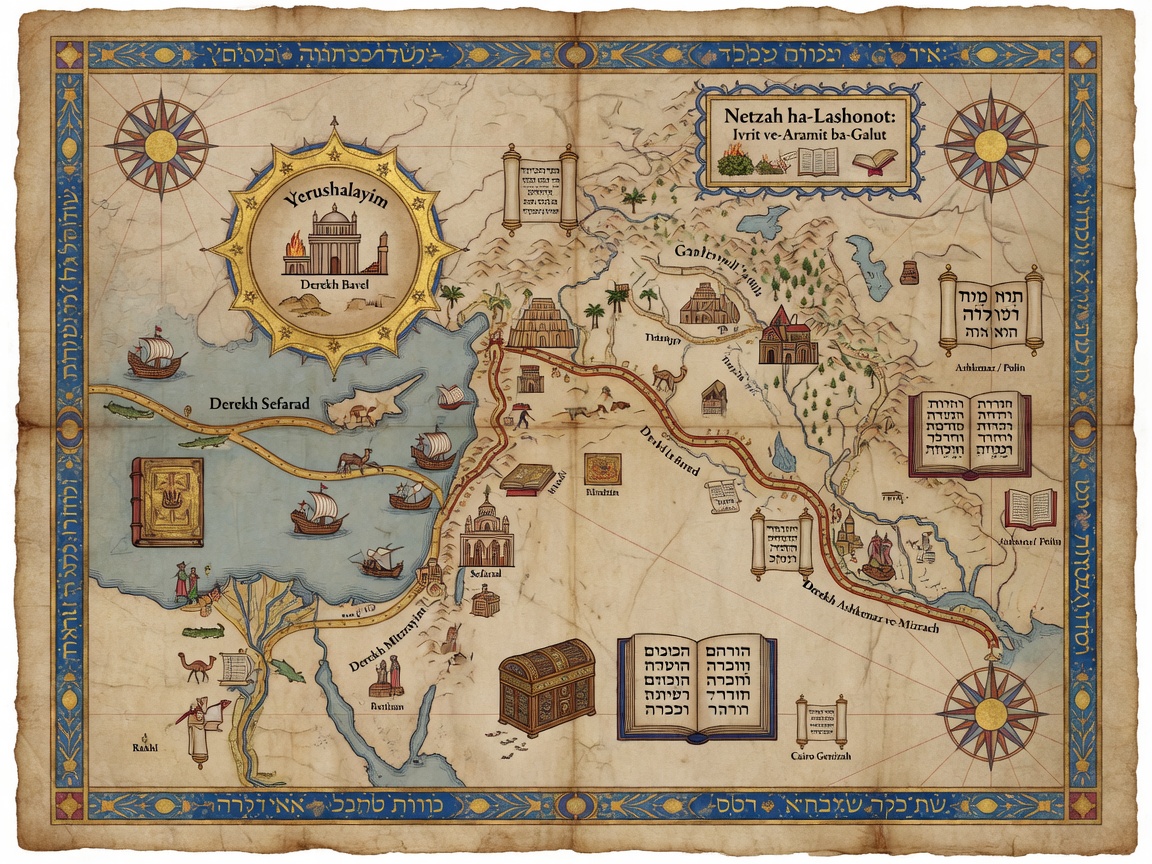
I. Beyond Tiberias: A Global Text
The Masoretes of the 7th–10th centuries worked in Tiberias, but their achievement was never confined to one city. Within a generation, fully vocalized codices bearing the Tiberian system traveled along trade routes to Cairo, Baghdad, Córdoba, and eventually to the Ashkenazi centers of Germany and Poland. What followed was not passive reception but vigorous local scholarship: grammarians in al-Andalus who analyzed every root and particle; Geonim in Babylonia who translated Scripture into flowing Judeo-Arabic; travelers like Benjamin of Tudela who mapped where Torah was taught; and sages like Maimonides who legislated which Masoretic codex should serve as the standard for synagogue scrolls.
Jewish biblical scholarship in the diaspora was always bilingual or multilingual — conducted in Hebrew, Aramaic, Judeo-Arabic, and later in Yiddish and vernacular European languages — yet it remained anchored to the same consonantal Masoretic Text the Masoretes perfected.
II. Regional Centers of Learning
Saadia Gaon, the Geonim, Yemenite liturgical traditions, and the transmission of Tiberian pointing from Palestine to Iraq.
Al-Andalus courts, Bernard Lewis & Martin Gilbert — the Sephardi flowering and the road to 1492.
Ibn Ezra, Ibn Janach, Maimonides, and the revolution in Hebrew grammar and exegesis.
Fustat, the Maghreb, Maimonides in Egypt, and the Cairo Genizah as an archive of biblical manuscripts.
Rashi's legacy, the Vilna Gaon, Mikraot Gedolot, and Polish yeshiva culture.
From Bohemia to Lithuania — Hasidic and Mitnagdic approaches to peshat, midrash, and the printed Bible.
III. MENA Community Chronicles
Fifteen city notes trace Jewish life across the Middle East and North Africa — from Mosul and Aleppo to Casablanca and Tangier.
All 15 MENA city chronicles →IV. Pale of Settlement Community Chronicles
Fourteen city notes trace Ashkenazi life across the Pale of Settlement — from Warsaw and Vilnius to Odessa and Königsberg.
All 14 Pale city chronicles →V. Sages and Travellers
Two figures embody the mobility of medieval Jewish biblical culture: the philosopher-jurist who settled in Cairo and legislated for the entire diaspora, and the merchant-scholar who wandered from Spain to Mesopotamia and recorded what he saw.
His ruling on the Aleppo Codex, biblical exegesis in the Guide for the Perplexed, and the Mishneh Torah's laws of Torah scrolls.
His Travels document Jewish communities from Zaragoza to Baghdad — their scholars, schools, and sacred books.
VI. What "Biblical Scholarship" Meant in Each Age
Jewish biblical scholarship was never a single discipline. It encompassed:
- Masorah and scribal science — copying, vocalizing, and statistically verifying the text (Masoretes, Ben Asher)
- Hebrew grammar (dikduk) — analyzing roots, binyanim, and syntax (Ibn Janach, David Kimhi)
- Exegesis — peshat (plain sense), midrash, and philosophical reading (Rashi, Ibn Ezra, Maimonides)
- Translation — Targumim, Saadia's Arabic Tafsir, and later vernacular Bibles
- Lexicography — dictionaries of biblical Hebrew (Sefer ha-Shorashim, Sefer ha-Shorashim of Kimhi)
- Liturgical reading — cantillation, lectionaries, and public Torah reading
Every diaspora community practiced some combination of these arts. What varied was emphasis: Spain excelled in grammar and philosophy; Babylonia in translation and Geonic responsa; Ashkenaz in talmudic-and-midrashic commentary on Scripture; North Africa in preserving manuscripts and legal codification.
VII. The Shared Masoretic Foundation
Despite extraordinary diversity, virtually all medieval Jewish communities accepted the same consonantal Masoretic Text. Emanuel Tov demonstrated that the proto-Masoretic stream was already dominant by the first century CE; the Masoretes added the vocalic and accentual layer that every community eventually adopted. Rabbanites and Karaites disputed law but shared codices; Sephardim and Ashkenazim developed different commentarial styles but read the same verses. See Rabbanites, Karaites, and the Masoretic Tradition for the communal dimension.