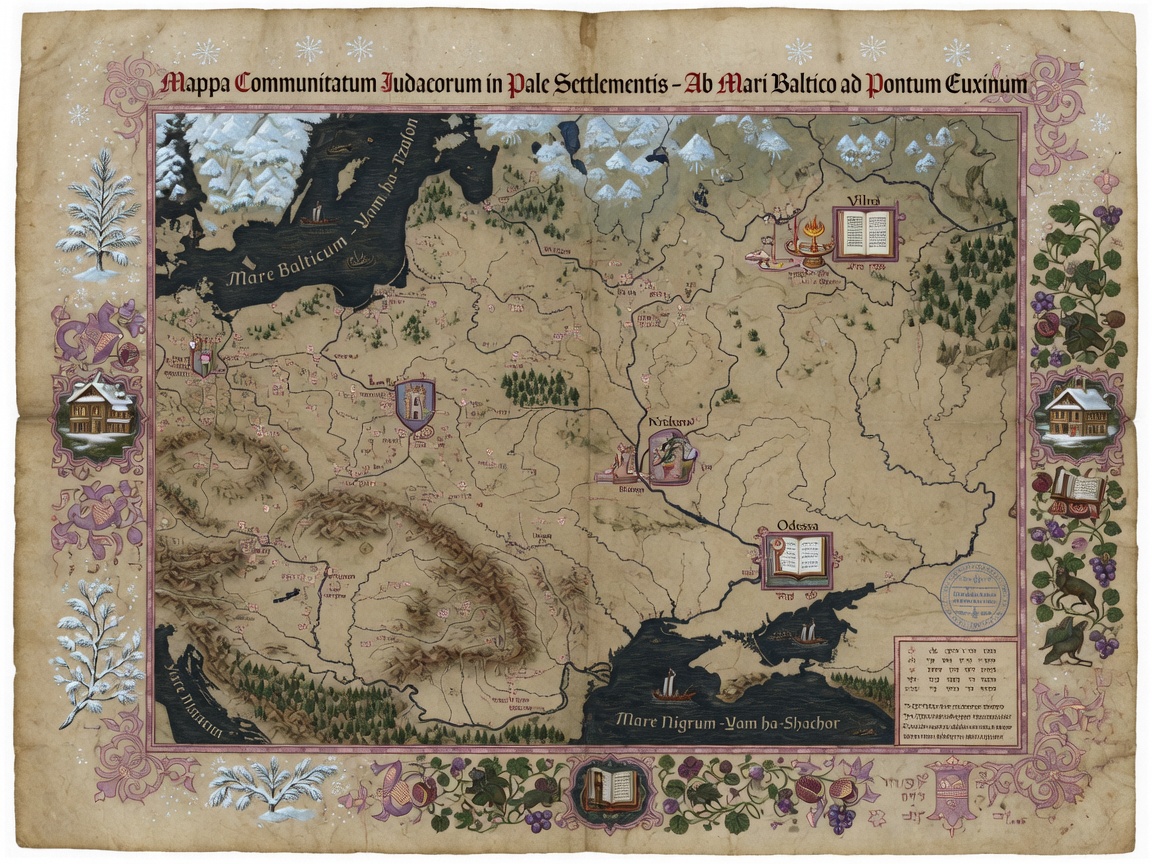
I. The Largest Experiment in Masoretic Literacy
Under Russian rule (1791–1917), the Pale of Settlement confined most Jews to Poland, Lithuania, Ukraine, Belarus, and Bessarabia. Within those borders, the Masoretes' achievement reached its demographic apex: millions of children learned to read pointed Hebrew in cheder; millions of adults heard the weekly Torah portion chanted with Hebrew cantillation; Vilna printers mass-produced codices bearing Tiberian vocalization.
These notes chronicle the great cities of that world — in Yiddish, in Hebrew, and in the Russian and German vernaculars Jews adopted — with links to Grokipedia, academic resources, and related notes on Yiddish, Polish Bible scholarship, and Eastern European scholarship.
II. Poland & the Congress Kingdom
Europe's largest Jewish city — Yiddish culture, Romm print, and the ghetto uprising.
Textile capital — second only to Warsaw, with a ghetto that lasted four years.
Kazimierz — six centuries of synagogues, scribes, and Polish royal charters.
Copernicus's Vistula city — medieval and modern strands of Polish Jewry.
Northeastern textile hub — Hasidim, Zionists, and the 1906 pogrom.