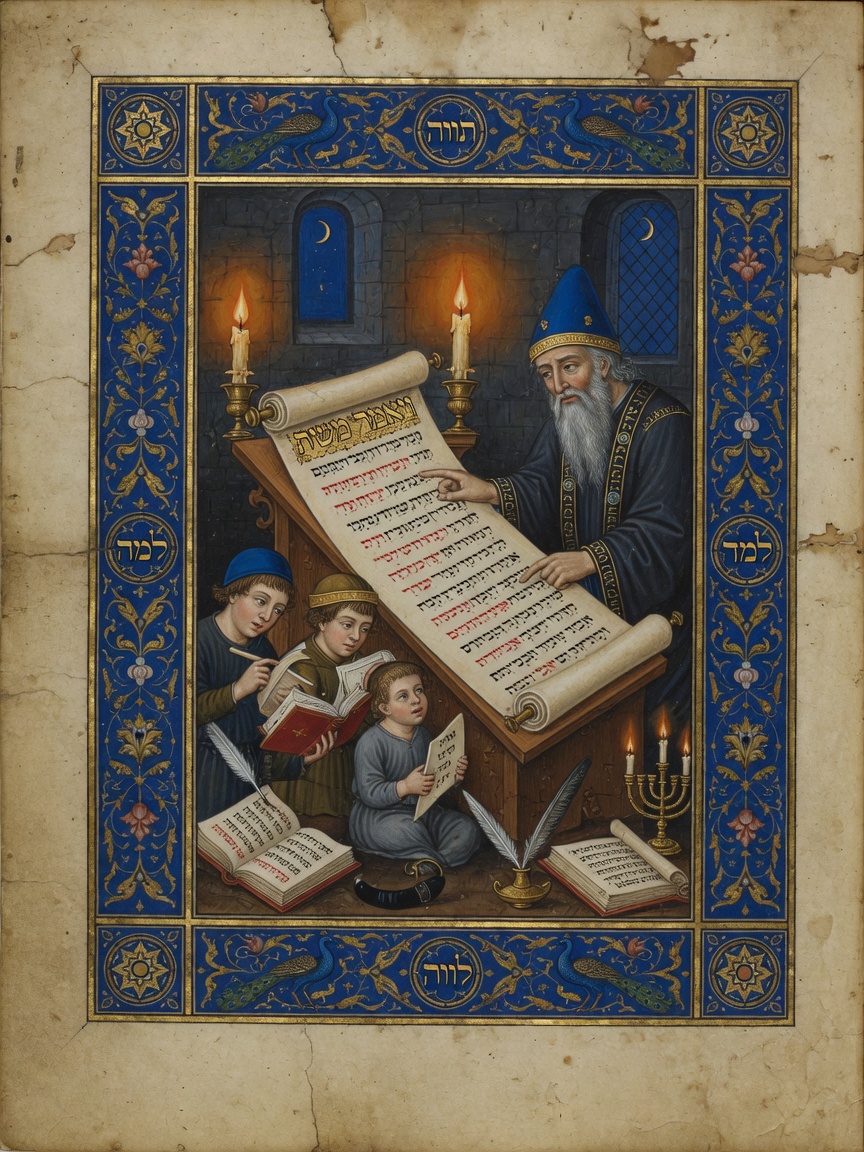
I. Ashkenaz: Talmud First, Bible Always
Medieval Ashkenazi culture, rooted in the Rhineland communities of Mainz, Worms, and Speyer, placed the Talmud at the center of yeshiva study. Yet the Bible was never marginal: every talmudic sugya cites verses; every legal ruling presupposes a specific reading of a biblical text; every synagogue lectionary follows the Masoretic order of Torah portions (parashiyyot) and prophetic haftarot. Ashkenazi biblical scholarship developed as commentary — especially the line from Rashi through the Tosafists — rather than as standalone grammar, though it always assumed the vocalized text the Masoretes had fixed.
II. Rashi: The Commentary That Taught a Continent
Solomon ben Isaac (Rashi, 1040–1105), of Troyes, wrote commentaries on virtually the entire Hebrew Bible and Talmud. His Torah commentary — concise, pedagogical, often midrashic but attentive to Hebrew word choice — became the first text a Jewish child encountered alongside the biblical verse itself. Rashi:
- Explained difficult words by reference to Aramaic Targumim and contemporary French (la'az)
- Reconciled apparent contradictions through careful close reading of the Masoretic wording
- Drew on midrashic collections (Genesis Rabbah, Tanchuma) while sometimes preferring plain contextual sense (peshat)
Every subsequent Ashkenazi — and, through print, Sephardi — Bible edition placed Rashi's commentary in the margin. His work is inseparable from the pointed Masoretic text it glosses.
III. The Tosafists and Dialectical Scripture
The Tosafists (12th–14th centuries) — scholars in northern France and Germany including Rashi's grandsons — extended dialectical method to biblical verses cited in the Talmud. They asked: How does this verse support the law? Does another verse contradict it? How do the rabbis' readings relate to the plain sense? This "talmudic" approach to Scripture differed from the philological peshat of Ibn Ezra in Spain but was equally rigorous within its own framework.
IV. Poland: The Heartland of Ashkenazi Learning
From the 14th century onward, Jewish life shifted eastward into Poland, Lithuania, Bohemia, and Hungary. Polish communities — Kraków, Lublin, Poznań, Vilna — built yeshivot that became the intellectual capitals of Ashkenazi Jewry. Biblical scholarship in Poland expressed itself through:
- Mikraot Gedolot — printed Rabbinic Bibles combining the Masoretic text with Rashi, Ibn Ezra, Radak, and other commentaries; Polish and Lithuanian editions (Kraków, Amsterdam influence) standardized study Bibles
- Humash with commentary — weekly Torah portions with Rashi became the primary vehicle of popular biblical education
- Targum Onkelos — the Aramaic translation printed alongside Hebrew, preserving an ancient interpretive layer
- Scribal and liturgical practice — copying Torah scrolls according to Maimonides' Hilkhot Sefer Torah and the Masoretic layout rules
V. The Vilna Gaon and the Return to Peshat
Elijah ben Solomon Zalman (the Vilna Gaon, 1720–1797) of Vilna (Wilno) championed a return to plain-sense biblical and talmudic study over pilpul (dialectical subtlety). His biblical notes — published posthumously on Torah, Proverbs, and other books — display:
- Emendations of rabbinic readings where they diverged from the plain Masoretic sense
- Geometric and calendrical analysis of Temple passages
- Cross-references across the entire biblical corpus, treating Scripture as a unified text
The Gaon's circle also produced corrected editions of the Talmud and Bible, continuing the Masoretic obsession with textual accuracy in a new key. His students founded the Volozhin yeshiva, which dominated Lithuanian Torah study for a century. → Eastern Europe note
VI. Hasidic and Misnagdic Readings
18th-century Hasidism, founded by the Baal Shem Tov in Poland-Ukraine, developed a devotional-mystical approach to biblical narrative — every story of the patriarchs became a template for the soul's journey. The Mitnagdim ("opponents"), led by the Vilna Gaon, insisted on disciplined textual study. Both camps read the same Masoretic verses; they differed on whether the primary goal was spiritual immediacy or analytical precision.
VII. The Maharal and Philosophical Torah
Judah Loew ben Bezalel (the Maharal of Prague, c. 1520–1609) offered philosophical and symbolic readings of biblical narrative in works such as Gevurot Hashem and Gur Aryeh (his supercommentary on Rashi). The Maharal treated Torah as a layered text whose historical stories encode metaphysical truths — a Central European counterpart to Spanish Kabbalah, anchored to the same consonantal and vocalized text.
VIII. Print Culture and the Standardized Bible
The invention of printing transformed Polish and Ashkenazi access to Scripture. The Soncino family and later Venetian printers produced Hebrew Bibles with Masorah, Rashi, and Targum. Daniel Bomberg's Rabbinic Bible (1517–1525) — edited by Jacob ben Chayyim — assembled the Masoretic notes from multiple codices and became the template for the modern Mikraot Gedolot. Polish Jewish communities were among the largest consumers and copyists of these printed Bibles, which fixed the Masoretic Text in a form identical from Kraków to Vilna to Amsterdam.
IX. Poland and the Masoretic Legacy
Polish Jewry did not originate the Tiberian pointing or the great codices, but it became the largest single population to live inside the Masoretic text — chanting it weekly, commenting on it daily, and printing it for mass study. The Ashkenazi achievement was pedagogical and communal: making the Masoretic Bible the shared inheritance of every household that owned a humash and every child who learned to read Hebrew with niqqud.