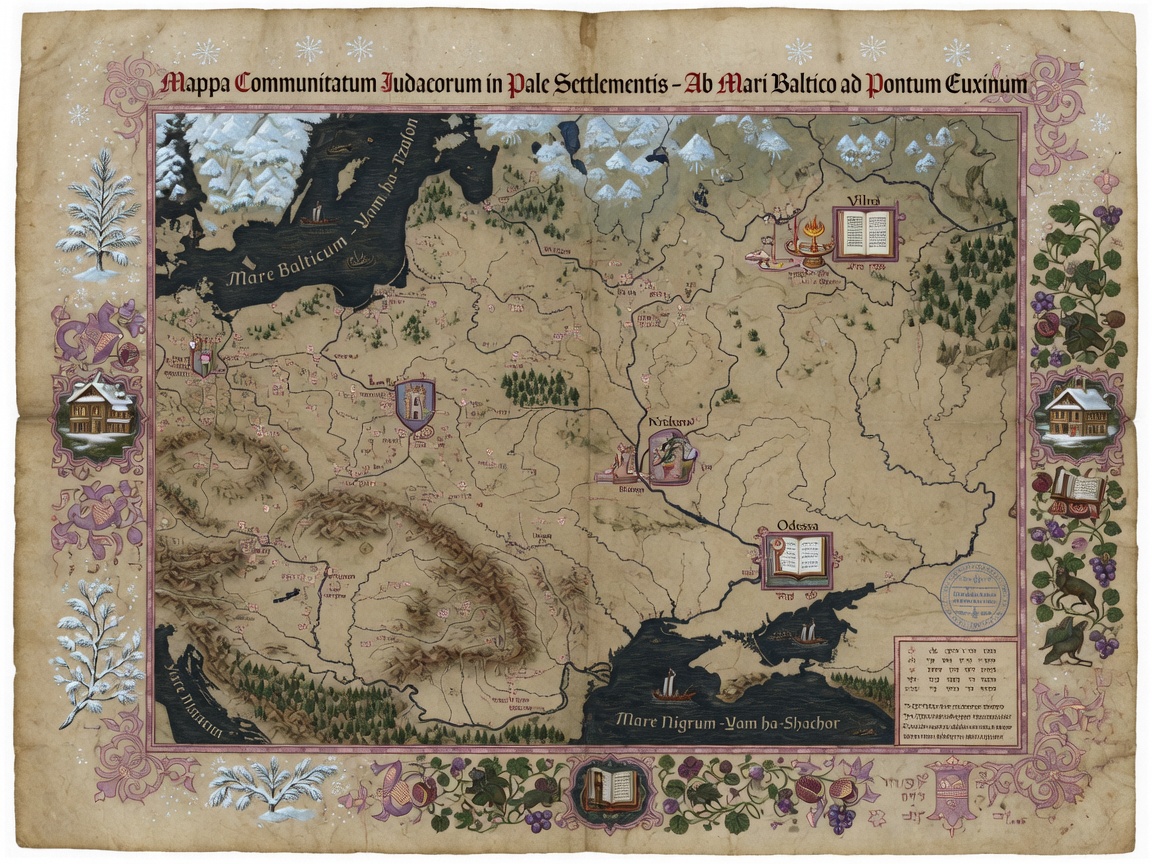
I. The Eastern Migration
From the 13th century onward, Jewish life shifted from Germany into Poland, Lithuania, Ukraine, Hungary, and Romania — the territory that would become the world's largest Jewish population by the 18th century. These communities inherited the Ashkenazi biblical tradition of Rashi and the Tosafists but developed distinctive Eastern European institutions: the cheder, the yeshiva, the ḥevra kaddisha, and eventually the vast print culture of Vilna, Warsaw, and Lemberg (Lviv). Throughout, the pointed Masoretic Bible remained the unchanging substrate of all study.
II. Lithuania: The "Jerusalem of the North"
Vilna (Vilnius) earned the title "Jerusalem of Lithuania" for its concentration of scholars and printing houses. Key developments:
- The Vilna Gaon (1720–1797) — champion of textual precision and peshat; his biblical glosses emend received readings where grammar demanded
- Volozhin yeshiva (founded 1803) — the mother of Lithuanian yeshivot, where Torah and Talmud were studied with the Gaon's emphasis on accuracy
- Romm publishing — the Widow and Brothers Romm press in Vilna produced the standard edition of the Talmud (1880s) and Mikraot Gedolot used worldwide
→ Poland & Ashkenaz note for Rashi, Tosafot, and the Maharal.
III. Hasidism and the Devotional Bible
Hasidism, emerging in 18th-century Podolia and Volhynia (Ukraine), transformed biblical engagement from primarily analytical to devotional-mystical. Masters such as Levi Yitzchak of Berditchev and Nachman of Breslov read biblical narratives as maps of the soul's relationship with God. The ma'amar (discourse) genre expounded weekly Torah portions in Yiddish and Hebrew, always starting from the Masoretic verse as printed in the standard humash.
Hasidic commentaries — collected in anthologies such as Maor va-Shemesh, Noam Elimelech, and Sefat Emet — form a vast Eastern European library of biblical interpretation that complements the Lithuanian analytical tradition.
IV. The Mitnagdim and Textual Rigor
The Mitnagdim ("opponents" of Hasidism), led by the Vilna Gaon and his disciples, insisted that authentic spirituality required mastery of the text itself — every niqqud, every trop mark, every Rashi formulation. This ethos produced corrected editions of the Bible and Talmud and sustained the ideal that a scholar should know Scripture "by heart" in its Masoretic form.
V. Bohemia, Moravia, and Central Europe
Prague — home of the Maharal (Judah Loew ben Bezalel) — was a center of Hebrew printing from the 16th century. The Gershom Soncino press and later Prague publishers produced pocket Bibles, Rabbinic Bibles, and liturgical books that spread the Masoretic Text into Central and Eastern Europe. The Maharal's Gur Aryeh supercommentary on Rashi represents sophisticated philosophical biblical reading in a Slavic-Germanic cultural zone.
VI. The Pale of Settlement and Mass Literacy
Under Russian rule (1791–1917), the Pale of Settlement confined most Jews to Poland, Lithuania, Ukraine, Belarus, and Bessarabia — but within those borders a remarkable achievement unfolded: mass literacy in Hebrew. The cheder system taught boys to read the pointed Hebrew Bible with niqqud from age three or four. By the 19th century, Eastern European Jewry constituted the largest population in history to study the same Masoretic codex weekly in synagogue and daily in school — a living continuation of the Masoretes' project at civilizational scale.
VII. Maskilim and the Challenge of Modernity
The Haskalah (Jewish Enlightenment) in 19th-century Eastern Europe introduced new approaches to the Bible: vernacular translations (especially into Russian and German), historical-critical awareness influenced by Christian scholarship, and the founding of modern Jewish schools. Figures such as Naḥman Krochmal, Moses Mendelssohn (whose German Bible translation with Hebrew commentary, the Bi'ur, originated in Berlin but influenced the East), and later Yehezkel Kaufmann engaged with the Masoretic Text through modern philology while remaining within Jewish discourse.
VIII. Eastern Europe and the Masoretic Legacy
Eastern Europe did not create the Tiberian pointing or the great codices. Its achievement was demographic and cultural: it made the Masoretic Bible the shared inheritance of millions — printed in Vilna, studied in Volozhin, chanted in shtetl synagogues, and carried in migration to America and Palestine. The Eastern European Jewish world was, in effect, the largest single experiment in sustained communal Masoretic literacy ever attempted.
Pale City Chronicles
Fourteen notes on the great cities of the Pale of Settlement — Warsaw, Vilnius, Łódź, and more. → Full hub