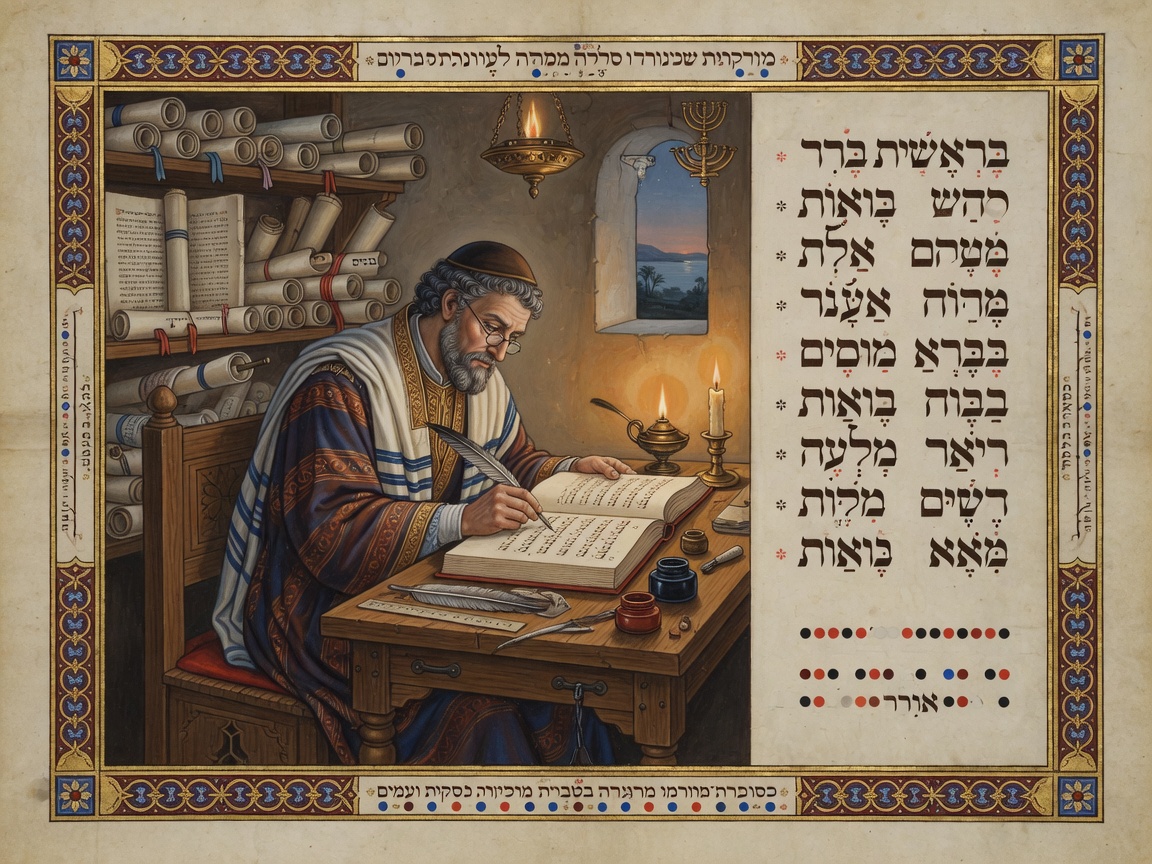
I. What Makes Yiddish a Jewish Language
Yiddish is not German with an accent. It is a fully developed Jewish language: Germanic skeleton, Hebrew-Aramaic soul (loshn koydesh), Slavic muscle acquired on the road east, and Hebrew letters as its written dress. For roughly a millennium it was how most European Jews argued, loved, traded, prayed privately, and — increasingly — wrote literature. Yet in synagogue they chanted the same Masoretic Text the Masoretes had pointed in Tiberias, with niqqud and te'amim learned in the cheder, not absorbed from Yiddish speech.
Max Weinreich's History of the Yiddish Language (1973, completed by his son Uriel Weinreich) remains the standard reference. YIVO (Yidisher Visnshaftlekher Institut), founded in Vilna in 1925, codified spelling and cultivated a literary standard still used in classrooms today.
II. Note Cluster
Origins on the Rhine, structure, diglossia, dialects, literature, and survival — the essential introduction.
Litvish, Poylish, Ukrainish, Western Yiddish — how speech changed from Cologne to Kiev.
From the Bove Bukh to Sholem Aleichem, theater, journalism, and modernist Yiddish.
Taytsh khumesh, tsenbeṭlakh, and how Yiddish brought the Masoretic Torah to the masses.
Loshn koydesh and taytsh, the cheder, women's tkhines, and why pointed Hebrew survived inside Yiddish civilization.
Catastrophe, Soviet Yiddishism, Israeli stigmatization, Hasidic demographic resurgence, and university Yiddish today.
III. Yiddish and the Masoretic Tradition
The connection between Yiddish and the Masoretes is indirect but profound. The Masoretes made Hebrew independently readable through vocalization; Ashkenazi Jews, who spoke Yiddish exclusively at home, nevertheless achieved the highest mass literacy in pointed biblical Hebrew anywhere in the diaspora. Yiddish functioned as the bridge language — taytsh (translation/explanation) of difficult Hebrew words, magid sermons unpacking the weekly portion, printed tsenbeṭlakh summarizing the parashah for households that had heard the Hebrew leyning in shul.
Rashi's eleventh-century French-Hebrew glosses on the Talmud anticipated the pattern centuries before Yiddish matured: sacred Hebrew on the line, vernacular explanation in the margin. → Teaching Hebrew in Ashkenaz
IV. Historical Timeline
Old Yiddish emerges on the Rhine; Hebrew remains sacred and legal language; earliest Yiddish glosses in manuscripts
Eastward migration; Bove Bukh and Old Yiddish epics; first Yiddish biblical translations (taytsh)
Mass Ashkenazi population growth; Hasidism; Yiddish theater and press; Haskalah debates
Holocaust; YIVO relocates to New York; Hasidic Yiddish heartland; academic revival