I. The Eastward Drift
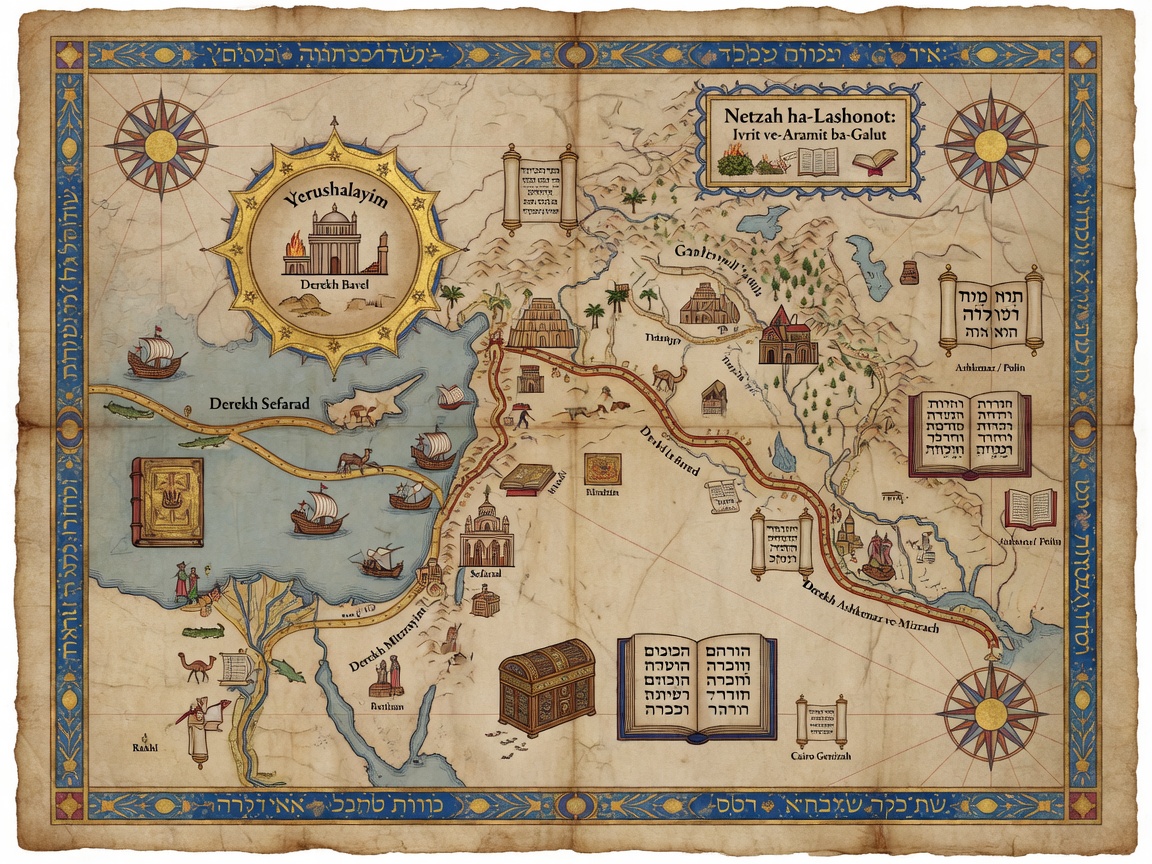
Yiddish began in the Rhineland and Bavaria as a Jewish reshaping of Middle High German. From the fourteenth century, invitations from Polish nobles — and later the trauma of Crusader violence in the West — drew Jews eastward into Poland-Lithuania, Ukraine, and Belarus. Each migration layer deposited new Slavic vocabulary and phonological habits onto the Germanic base. By 1900, the demographic center of Yiddish gravity lay not in Cologne but in Warsaw, Vilna, and Odessa.
Linguists map Yiddish dialects into Western and Eastern branches. Western Yiddish (spoken in Germany and the Netherlands until assimilation) retained a more Germanic profile. Eastern Yiddish — the ancestor of nearly all living Yiddish — divides into three major groups defined chiefly by vowel systems.
II. The Three Eastern Dialects
Spoken in Lithuania, Belarus, northeastern Poland, and Latvia. Associated with the Vilna Gaon's yeshiva culture and the rationalist Mitnagdim. YIVO's standard literary Yiddish is based largely on Litvish phonology and morphology — a political-linguistic choice that privileged Vilna's prestige over Warsaw's demographic weight.
Centered on Warsaw, Łódź, and Kraków. Characteristic vowel mergers and abundant Polish loanwords. Home of much interwar Yiddish journalism and the Polish-Jewish literary scene. Poylish speakers often viewed Litvish as harsh and hypercorrect; Litvaks returned the compliment with jokes about Polish Yiddish softness.
Odessa, Kiev, Bessarabia — the most Slavic-influenced major dialect, with Ukrainian phonology shaping vowels and prosody. Birthplace of much Yiddish theater and humor; Sholem Aleichem's characters often speak Ukrainish-inflected Yiddish.
III. Western Yiddish and Transitional Zones
Western Yiddish survived in rural Germany into the eighteenth century before German assimilation swallowed it. Swiss and Alsatian Jewish communities preserved distinctive western varieties. Transcarpathian, Galician, and Romanian Yiddish dialects form bridges between the three eastern groups — reminding us that dialect boundaries were gradients, not borders. A merchant traveling from Vilna to Warsaw in 1850 would have heard the shift week by week, like changing radio stations across a long drive.
IV. Dialect and Sacred Hebrew
Dialect variation in Yiddish did not produce dialect variation in Torah reading. The Masoretic Text with Tiberian pointing was standardized across Ashkenaz — minor local trope traditions aside, a Litvak and a Galitsyaner chanted the same consonants and vowels from the same pointed ḥumash. Yiddish dialects shaped how Jews talked about the Torah in the street; Hebrew with niqqud shaped how they read it in shul. That asymmetry is the whole point of Jewish diglossia.
V. Dialect Today
Holocaust destruction and postwar migration homogenized Yiddish speech. Hasidic communities preserve dialect features — Hungarian Yiddish in Satmar, Galician in Bobov — but YIVO standard dominates education. Field linguists rush to record elderly native speakers whose vowels encode geography no textbook can fully recover.