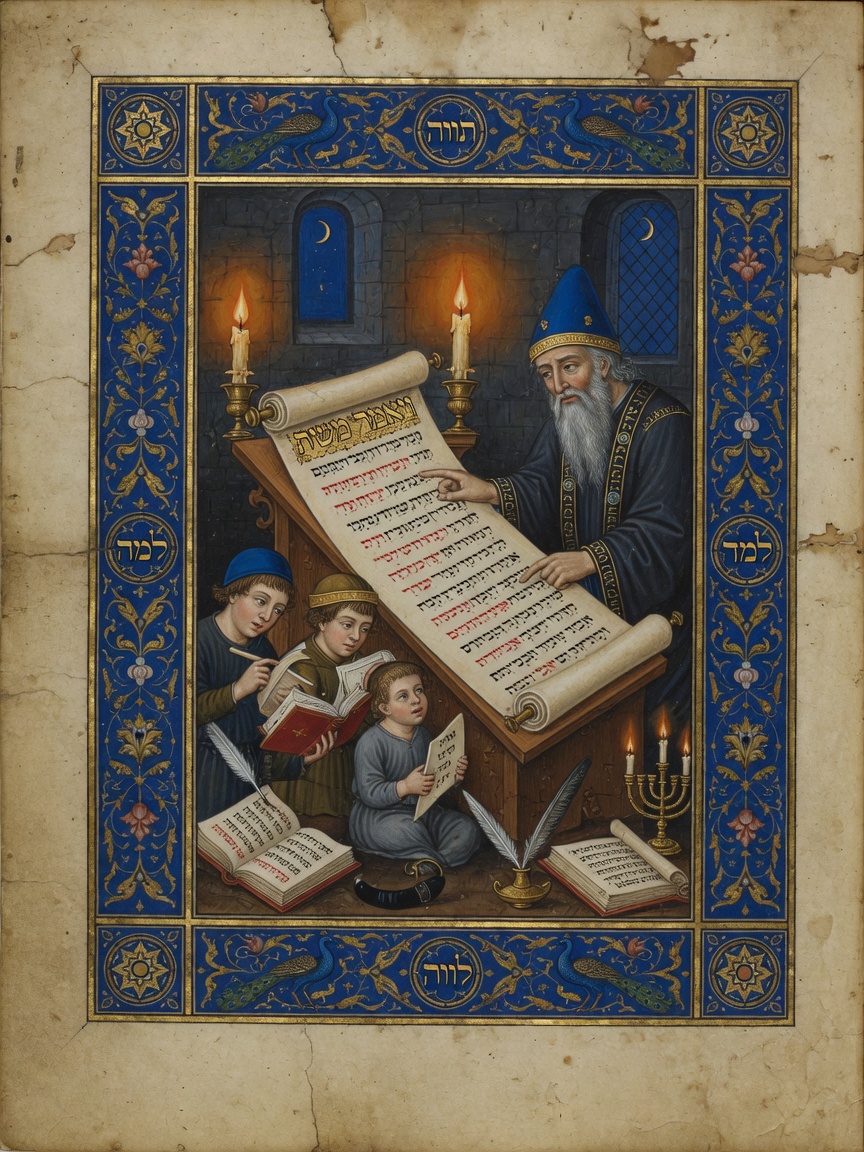
I. The Cheder: Architecture of Ashkenazi Literacy
In Ashkenazi communities from medieval Germany through early modern Poland and Lithuania, the cheder (literally "room") was the elementary school where Jewish boys — typically from age three to bar mitzvah — acquired Hebrew literacy. A melammed (teacher), often a poor Talmud scholar, taught in his home or a communal space, sometimes instructing only a handful of pupils. Fees were modest; discipline could be severe; and the curriculum was remarkably stable across centuries and geography.
The cheder's first goal was not conversational Hebrew but liturgical and biblical reading: recognizing letters, combining consonants with vowel points, chanting the Torah with cantillation marks, and reciting the siddur. Without the Masoretes' vocalization, this book-based pedagogy would have been impossible for communities that spoke Yiddish at home.
II. The Curriculum: Aleph-Bet to Gemara
Traditional Ashkenazi education followed a well-documented progression:
- Aleph-bet and nekudot — The teacher wrote letters on a slate; pupils chanted names and sounds. Vowels were taught as combinations: בָּ = ב + קָמָץ.
- Ḥumash with Rashi — Weekly Torah portions from a pointed ḥumash, with Rashi's commentary in Old French-inflected Hebrew as the first interpretive layer. Rashi became the universal first textbook of biblical Hebrew.
- Siddur and maḥzor — Prayer book fluency for synagogue participation.
- Mishnah and Gemara — Transition to Aramaic-Hebrew Talmud, usually in a bet midrash or yeshiva.
Talya Fishman argues in Becoming the People of the Talmud that elevating Talmud above Bible as the pinnacle of study was a deliberate medieval Ashkenazi transformation — one that made Hebrew and Aramaic textual skills the measure of Jewish adulthood.
III. Rashi: The First Textbook of Every Child
Rashi (Solomon ben Isaac, 1040–1105, Troyes) wrote Torah and Talmud commentaries so concise and pedagogically clear that they became inseparable from the text itself. For eight centuries, Ashkenazi children met Scripture through Rashi's Hebrew glosses — learning biblical vocabulary, syntax, and narrative logic alongside the Masoretic verse. Rashi did not teach grammar systematically (that was Sephardi dikduk), but his word-by-word explanations functioned as an immersive Hebrew reader. → Poland & Ashkenaz note
IV. Yeshiva Culture and Mass Literacy
Advanced study moved to the yeshiva — institutions like those of Volozhin, Slobodka, and later the Lithuanian musar yeshivot. Here Hebrew and Aramaic were the working languages of argument, citation, and composition. By the 19th century, Eastern European Jewry achieved what historians consider the largest population in history with functional Hebrew literacy: millions who could read the pointed Bible, follow rabbinic responsa, and chant Torah with trope.
Chava Turniansky (Hebrew University) has documented the texture of this literacy in Yiddish-Hebrew diglossia: sermons, women's prayers (tkhines), and private letters that mix vernacular Yiddish with Hebrew quotations. Marion Aptroot analyzes how Yiddish functioned as the bridge language in the classroom — explaining Hebrew texts in the tongue children actually spoke.
V. Women, Literacy, and the Boundaries of Instruction
Formal cheder education was for boys, but evidence shows substantial Hebrew literacy among women in certain Ashkenazi communities. Turniansky's editions of tkhines (Yiddish prayer collections with Hebrew headings and citations) and Fishman's studies of Italian Jewish women demonstrate that Hebrew reading was not exclusively male. Wealthy families sometimes hired tutors for daughters; wives of scholars often managed household correspondence in Hebrew. The pointed text made private, self-directed Hebrew learning possible outside institutional settings.
VI. The Vilna Gaon and Close Reading
Elijah ben Solomon Zalman (the Vilna Gaon, 1720–1797) epitomized Ashkenazi mastery of the Masoretic Bible through intense peshat reading — treating every particle, vowel, and cantillation mark as meaningful. His students and the Mikraot Gedolot editions published in Vilna (18th–19th c.) spread a culture in which Hebrew literacy meant not merely reading aloud but analytical engagement with the pointed text. → Eastern Europe note
VII. Transmission, Rupture, and Memory
Haym Soloveitchik's influential note "Rupture and Reconstruction" (1994) argues that pre-modern Jews learned religious practice through mimetic tradition — watching and copying elders — while modern Jews rely on textual instruction. The cheder exemplifies the textual pole: even young children learned from books with niqqud, not from improvised oral performance. The Masoretic codex was the technology that made text-primary pedagogy viable.