I. The Pedagogical Revolution of Pointing
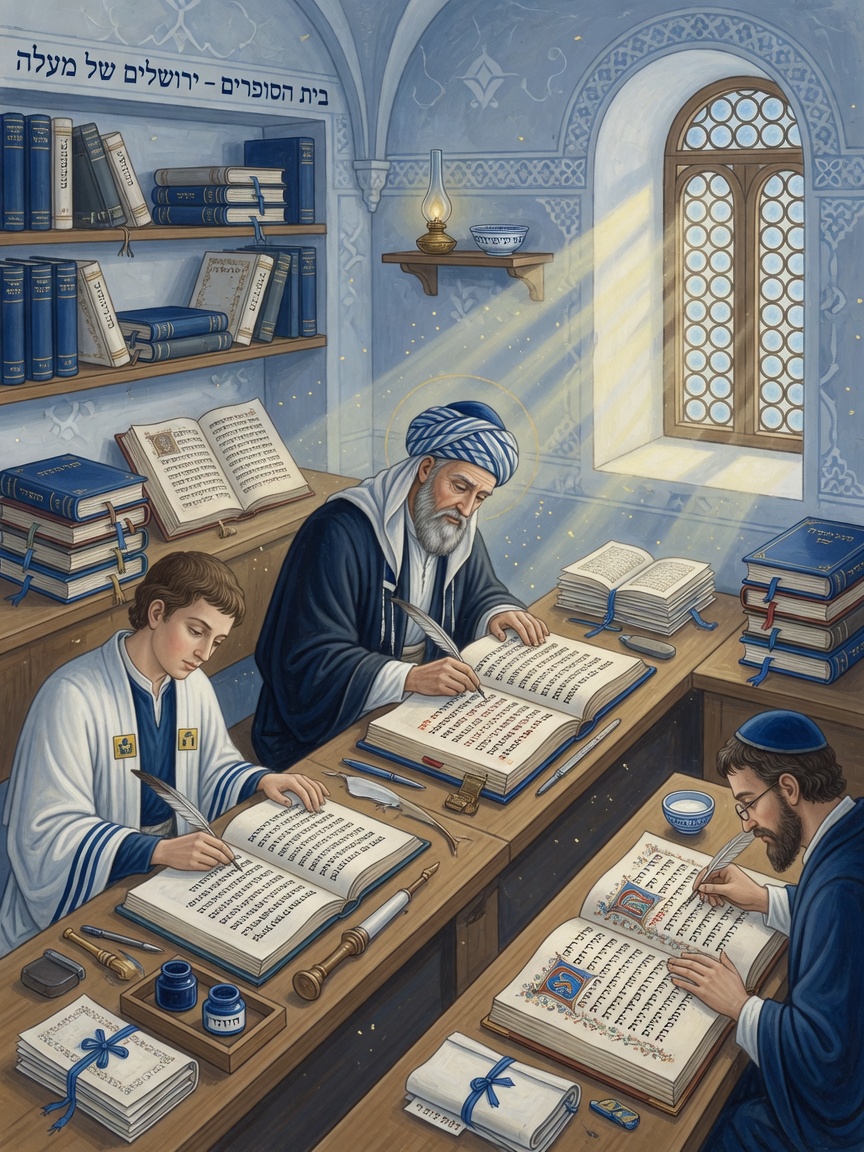
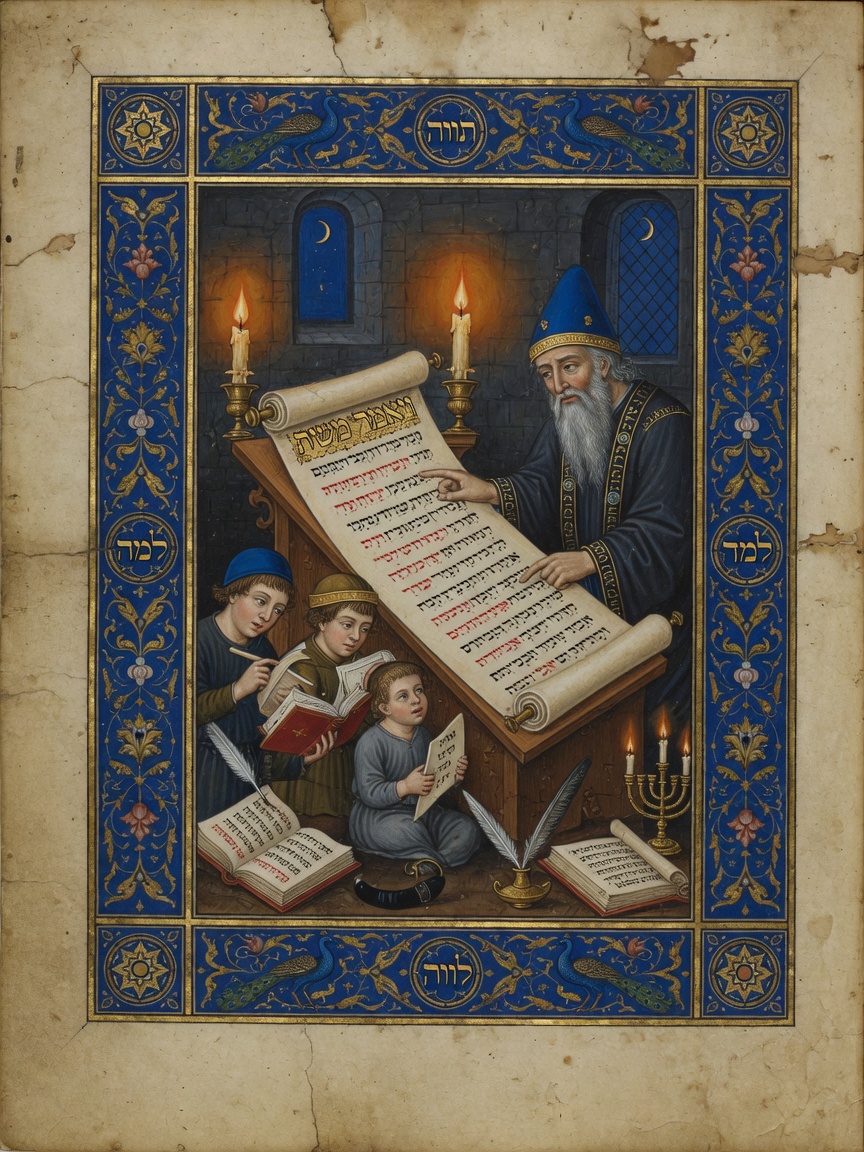
Before the Masoretes, teaching biblical Hebrew depended on oral transmission: a teacher pronounced each word while a pupil followed the unvocalized consonants. That model worked while communities retained living reading traditions, but it could not scale across the diaspora once everyday speech shifted to Aramaic, Arabic, Yiddish, and Ladino. The Tiberian pointing system — niqqud for vowels, te'amim for chant — inscribed pronunciation directly onto the page. A child in 12th-century Fustat or 17th-century Vilna could learn to read the same Masoretic Text from a book, not only from a master's mouth.
Geoffrey Khan has shown that the Tiberian tradition encodes a precise phonological system — evidence that medieval teachers were transmitting a disciplined reading science, not improvised guesswork. Judith Olszowy-Schlanger's work on Hebrew schoolbooks and children's exercises from the Cairo Genizah confirms that pointed codices, alphabet primers, and copybooks were ordinary classroom tools by the 11th century. → Niqqud and Te'amim note
II. What Was Taught, to Whom, and Where
Medieval and early modern Hebrew education was never monolithic. Communities distinguished several overlapping literacies:
- Liturgical literacy — reading the siddur and chanting the weekly Torah portion with correct trope
- Biblical literacy — reading the pointed Hebrew Bible, often with vernacular glosses or translation
- Rabbinic literacy — Mishnah and Talmud in Hebrew and Aramaic, for advanced boys and men
- Grammatical literacy (dikduk) — morphology, roots, and syntax, especially in Spain and Provence
- Compositional literacy — writing responsa, poetry, and letters in rabbinic Hebrew
Boys typically began between ages three and five; girls' instruction varied by region and class, though Chava Turniansky and Talya Fishman have documented substantial female Hebrew literacy in certain Ashkenazi and Italian contexts. Instruction took place in the cheder (elementary room), the bet midrash (study house), the yeshiva (academy), private tutoring with a melammed, and — after 1500 — increasingly in printed books that functioned as remote teachers.
III. Regional Traditions of Hebrew Instruction
Saadia Gaon, Geonic schools, Karaite primers, and Yemenite oral chains.
Grammar as science: Ibn Janach, Kimhi, and the dikduk curriculum.
The cheder, Rashi as first textbook, and mass Hebrew literacy.
Mikraot Gedolot, the Haskalah, and Christian Hebraists.
IV. The Standard Curriculum: Aleph-Bet to Talmud
Although details varied, a recognizable progression emerges across medieval sources and early modern memoirs:
Letter recognition, vowel sounds (nekudot), and syllable combination using a slate or primer. Genizah fragments preserve children's alphabet drills and benedictions copied in shaky hands — among the earliest evidence of systematic Hebrew pedagogy.
Reading the weekly Torah portion from a pointed ḥumash, then the prayer book. Students learned cantillation by repetition and musical notation. In Ashkenaz, Rashi's commentary became the default gloss from the first encounter with Scripture.
Transition to Aramaic-Hebrew Talmudic discourse. Talya Fishman's Becoming the People of the Talmud (2011) argues that this curricular shift — elevating Talmud above Bible as the pinnacle of study — was a deliberate medieval transformation, not an unbroken Second Temple inheritance.
In Sephardi and Provençal circles, students mastered dikduk through Kimhi's Mikhlol and Sefer ha-Shorashim. In Ashkenaz, advanced learners pursued peshat through Vilna Gaon-style close reading and the commentaries assembled in the Rabbinic Bible.
V. Scholars Who Have Illuminated This History
Modern research on medieval Hebrew pedagogy draws on Genizah documents, schoolbook manuscripts, communal regulations, and early modern memoirs. Key voices include:
- S. D. Goitein — education, literacy, and children's lives in A Mediterranean Society
- Talya Fishman — curricular history and the rise of Talmud-centered study
- Judith Olszowy-Schlanger — Hebrew schoolbooks and children's writing
- Robert Brody — Geonic academies and the transmission of rabbinic learning
- Chava Turniansky — Ashkenazi literacy, Yiddish-Hebrew diglossia, and women's writing
- Marion Aptroot — Yiddish and Hebrew in educational practice
- Geoffrey Khan — Tiberian phonology and reading traditions
- David B. Ruderman — early modern Jewish education and print culture
- Stephen G. Burnett — Christian Hebraism and the transmission of Jewish grammatical learning
- Haym Soloveitchik — continuity and rupture in transmitted religious knowledge
VI. From Manuscript Classroom to Printed Republic of Letters
The invention of Hebrew printing (c. 1476) multiplied the Masoretic classroom. A single Mikraot Gedolot volume placed Rashi, Ibn Ezra, Kimhi, and the pointed biblical text on every scholar's desk. The Haskalah (Jewish Enlightenment) later reformed Hebrew instruction toward biblical purity and modern subjects, while Christian universities from Paris to Wittenberg taught Hebrew to Protestant divinity students using Jewish grammars — often without acknowledging their sources. → Early Modern & Print note