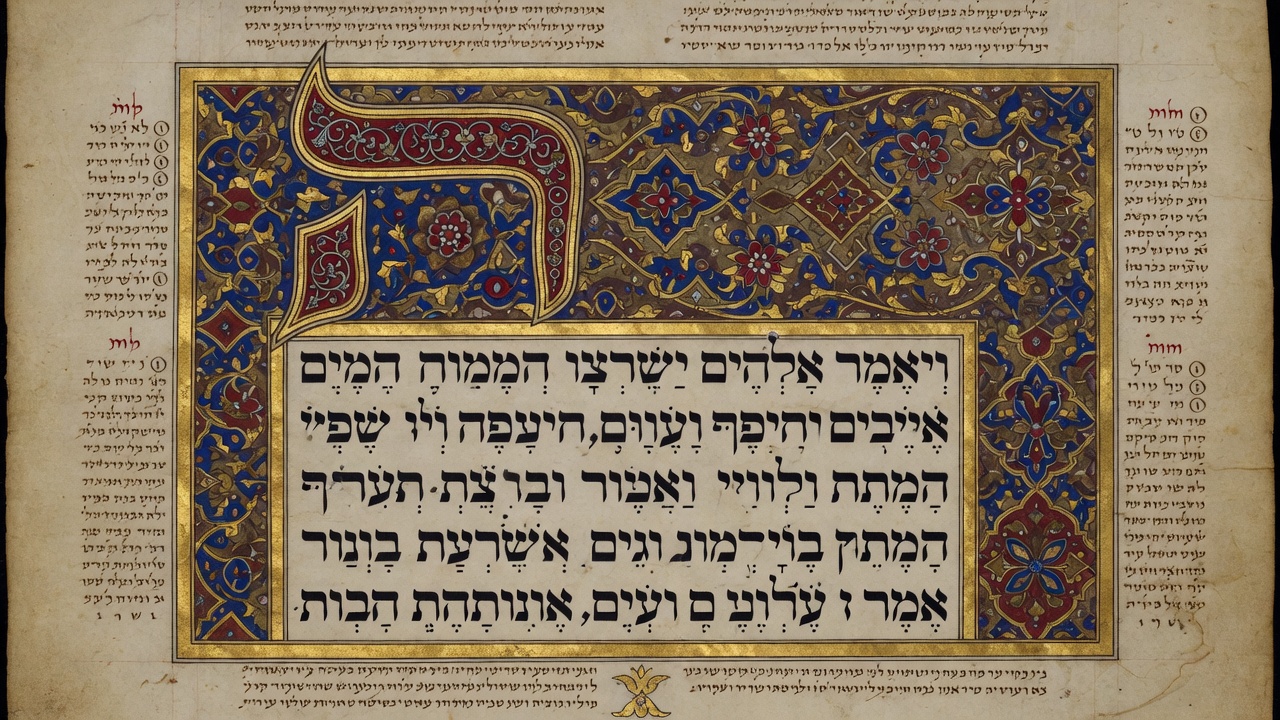
I. Grammar as Science: The Andalusian Revolution
In al-Andalus, Jewish scholars encountered Arabic naḥw (grammar) and Qur'anic philology at the same moment they inherited the fully vocalized Masoretic Bible from the Masoretes. The result was a pedagogical revolution: Hebrew would be taught not only as a liturgical language to be memorized, but as a grammatical system to be analyzed. The discipline came to be called dikduk (from דִּקְדּוּק, "precision") — and it treated the Tiberian-pointed text as empirical data.
Ángel Sáenz-Badillos (Universidad Autónoma de Madrid) traces this development in A History of the Hebrew Language, showing how Andalusian grammarians adapted Arabic philological methods to the biblical corpus.
II. The Founding Grammarians and Their Textbooks
The great Andalusian grammarians wrote the textbooks that defined Hebrew pedagogy for centuries:
- Jonah ibn Janach (c. 990–1055, Córdoba) — Sefer ha-Rikmah (grammar) and Sefer ha-Shorashim (dictionary of biblical roots). Ibn Janach derived every rule from attested biblical forms in the pointed text.
- Abraham ibn Ezra (1089–1167) — Wandering teacher who carried Andalusian methods to Italy, France, and England. His biblical commentaries embed grammatical lessons; his Sefer Moznayim and Sefer Zahut are pedagogical grammars.
- David Kimhi (Radak, c. 1160–1235, Narbonne) — Mikhlol (comprehensive grammar) and Sefer ha-Shorashim (lexicon). Kimhi's works became the standard reference for Jewish and Christian Hebrew students alike through the 19th century.
These works assumed students already read pointed Hebrew; they taught why the Masoretes pointed words as they did. → Spain note
III. The Curriculum in Sephardi Schools
Medieval Sephardi education combined liturgical training with grammatical science:
- Reading — Pointed ḥumash and siddur, as in Ashkenaz
- Grammar (dikduk) — Kimhi's Mikhlol or abridgments; parsing biblical verses by root, binyan, and syntactic function
- Lexicon — Sefer ha-Shorashim for vocabulary building
- Commentary — Ibn Ezra, Ramban (Nachmanides), and peshat exegesis
- Composition — Hebrew poetry and epistolary Hebrew, especially in the Golden Age courts
- Philosophy and science — Often in Judeo-Arabic, building on Hebrew vocabulary
Mordechai Z. Cohen (Bar-Ilan University) has analyzed how Sephardi exegetes integrated grammar into biblical interpretation, treating dikduk as a prerequisite for correct peshat reading.
IV. Ibn Ezra: The Wandering Hebrew Teacher
Abraham ibn Ezra is the outstanding example of the Sephardi teacher as itinerant scholar. After leaving Spain, he taught in Rome, Lucca, Mantua, Rouen, London, and Beziers — introducing grammatical Hebrew study to communities that had known only Rashi-style glossing. His commentaries embed mini-lessons on roots, cognate languages, and Masoretic vocalization. Where Rashi asked "what does the midrash say?", Ibn Ezra asked "what does the Hebrew grammar require?"
V. Provençal Bridge to Ashkenaz and Christendom
After the expulsion from Spain (1492), Sephardi pedagogical traditions dispersed to the Ottoman Empire, North Africa, and the Netherlands. But even before the expulsion, Provençal scholars like the Kimhi family had already bridged Sephardi grammar to Ashkenazi and Christian audiences. Kimhi's grammars were translated into Latin; Christian Hebraists in Paris, Salamanca, and Wittenberg used them to teach Hebrew to university students. The Masoretic pointed Bible plus Kimhi's Mikhlol became the standard Protestant seminary package. → Early Modern note
VI. Poetry and Living Hebrew
Sephardi education also cultivated compositional Hebrew — poetry in the Arabic quantitative meters adapted to Hebrew (fīʿī patterns), liturgical piyyutim, and epistolary prose. Figures like Judah Halevi and Solomon ibn Gabirol demonstrate that medieval Hebrew education produced writers who could compose original literature, not merely read Scripture. This "living Hebrew" strand would resurface in the Haskalah and the modern revival.