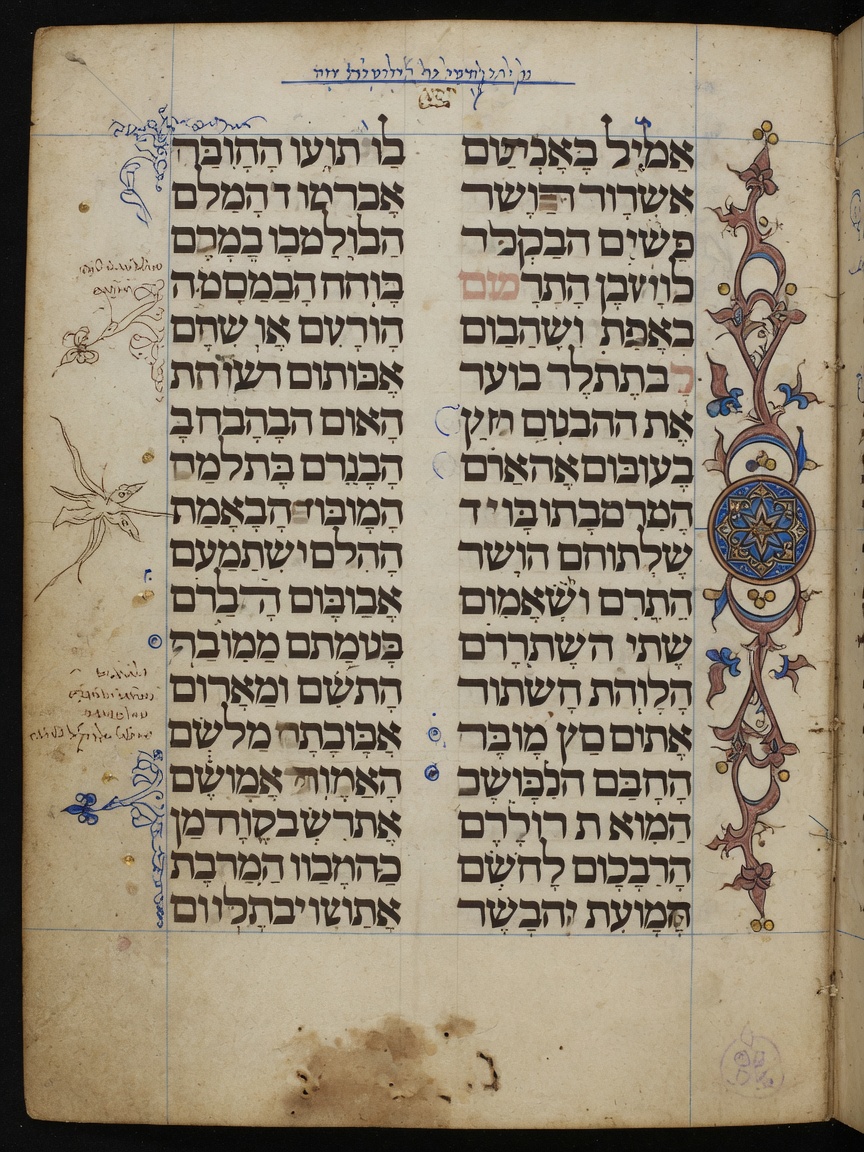
I. The Printing Revolution and the Masoretic Classroom
When Daniel Bomberg printed the first complete Mikraot Gedolot (Rabbinic Bible) in Venice (1516–1517), he transformed Hebrew pedagogy. A single volume now placed the pointed Masoretic text alongside Rashi, Ibn Ezra, Kimhi, and the Masorah — everything a student needed without a library of manuscripts. The Soncino press (1477 onward) had already printed individual biblical books and Kimhi's grammars; Bomberg's edition standardized the format for centuries.
Print did not change the Masoretic text, but it multiplied access to it. A cheder in Poland, a yeshiva in Yemen, and a maskilic school in Berlin could all use the same pointed Hebrew — the pedagogical legacy of Tiberias now machine-reproduced.
II. Christian Hebraism: Jewish Grammars in Protestant Seminaries
The Protestant Reformation's return ad fontes ("to the sources") created explosive demand for Hebrew instruction in Christian Europe. Reformers needed to read the Old Testament in the original to challenge Catholic exegesis. They turned to Jewish teachers and textbooks:
- Johannes Reuchlin (1455–1522) — studied with Jewish scholars; his De Arte Cabalistica and Hebrew grammar opened German humanist Hebrew study
- Johann Buxtorf the Elder (1564–1629, Basel) — the "Master of the Rabbis"; his Hebrew lexicon and grammar, derived from Kimhi and Ibn Janach, became the standard Protestant textbooks
- University Hebrew chairs — Established at Paris, Leiden, Oxford, Cambridge, and Wittenberg from the early 1500s
Stephen G. Burnett (University of Nebraska) documents this transmission in Christian Hebraism in the Reformation Era (1500–1660) (Brill, 2012), showing how Jewish grammatical learning — rooted in the Masoretic text — became essential to Christian biblical scholarship, often without acknowledgment of its Jewish origins.
III. The Haskalah: Reforming Hebrew Education
The Haskalah (Jewish Enlightenment, c. 1770–1880) sought to reform Hebrew instruction toward:
- Biblical Hebrew purity — Stripping rabbinic neologisms from modern writing; returning to biblical idiom
- Secular subjects — Mathematics, sciences, and European languages alongside Hebrew
- Vernacular integration — Teaching in German, Russian, or Polish while maintaining Hebrew literacy
- Girls' education — Maskilic schools often included girls, challenging the cheder's boys-only model
David B. Ruderman (University of Pennsylvania) analyzes early modern Jewish educational transformation in Early Modern Jewry (2010). Iris Idelson-Sheinberg (Ben-Gurion University) has studied Haskalah textbooks and the ideology of Hebrew as a rational, beautiful language fit for modern discourse — a direct heir of Sephardi dikduk and Masoretic precision.
IV. Maskilic Textbooks and the Path to Revival
Haskalah authors produced new Hebrew primers designed for modern classrooms:
- Graded readers moving from alphabet to biblical narrative
- Grammar manuals influenced by Kimhi but adapted to European pedagogical norms
- Hebrew periodicals (Ha-Me'assef, Ha-Maggid) as living texts for advanced students
This educational reform prepared the ground for Eliezer Ben-Yehuda and the revival of Hebrew as a spoken language in late 19th-century Palestine. Ben-Yehuda's children were raised speaking Hebrew at home — but they read the Masoretic Bible with niqqud, the same pointed text the Masoretes had made teachable a millennium earlier. → Survival of Hebrew note
V. Vilna, Amsterdam, and the Printed Canon
Major printing centers shaped what "correct" Hebrew looked like in the classroom:
- Vilna — The Romm publishing house's Mikraot Gedolot (1845 onward) and Talmud editions became the standard texts of Eastern European yeshivot
- Amsterdam — Sephardi and Ashkenazi presses served the western diaspora with uniform pointed Bibles
- Constantinople and Salonica — Ottoman presses carried Sephardi grammatical traditions eastward after 1492
Every printed edition transmitted the Tiberian vocalization — the Masoretic classroom technology now frozen in type metal.
VI. What Early Modern Scholars Debate
- How dependent were Protestant Hebraists on Jewish teachers? (Burnett)
- Did Christian Hebrew study feed back into Jewish pedagogy?
- How did Buxtorf's grammars transmit Kimhi's Masoretic assumptions?