I. What Was the Golden Age?
Historians use the phrase Golden Age (תְּקוּפַת הַזָּהָב) for the period roughly from the mid-tenth to the mid-twelfth centuries — and, in a broader sense, through the thirteenth century — when Jews under Islamic rule in Iberia achieved a level of political access, economic prosperity, and cultural creativity unmatched elsewhere in the diaspora. In Córdoba under the Umayyad caliphs, in Granada under the Zirids and later the Nasrids, and in the taifa kingdoms that succeeded the caliphate, Jewish physicians, financiers, poets, and grammarians operated at the summit of Andalusian civilization.
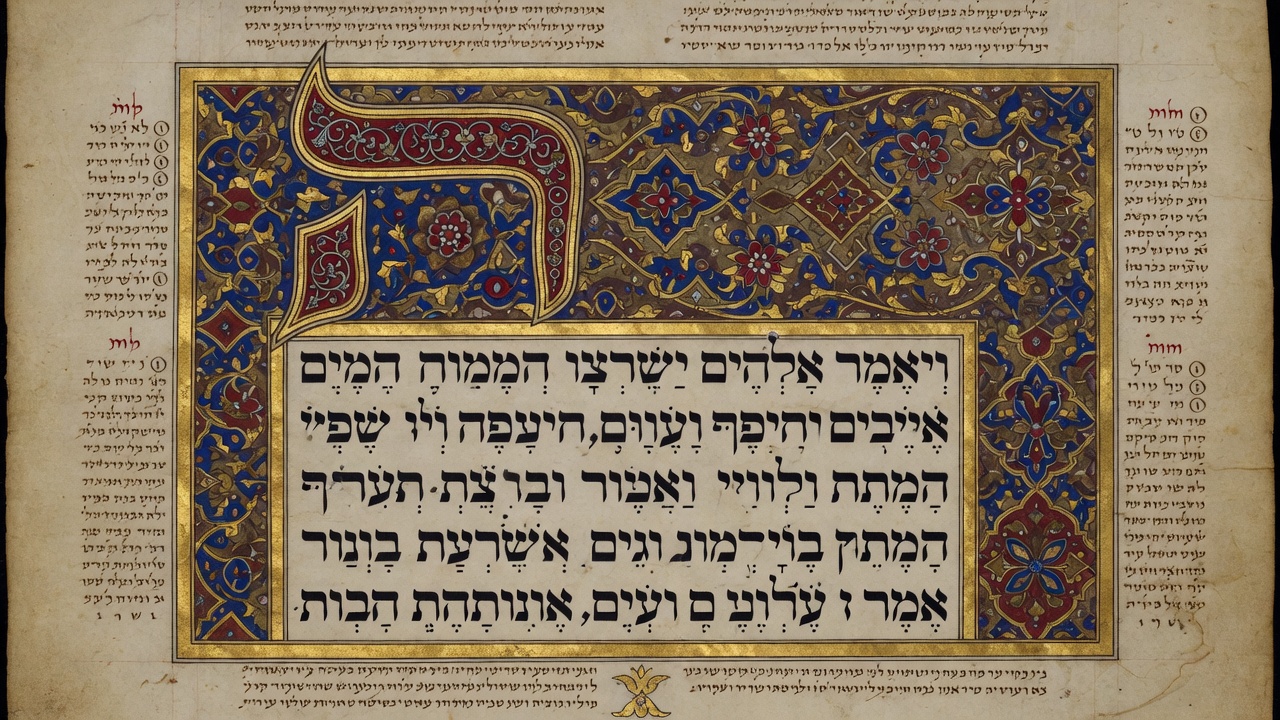
The Golden Age was not a modern liberal democracy — Jews were dhimmis, protected non-Muslims who paid the jizya tax and lived under Islamic law. Yet within that framework, Andalusian Jewry produced Hebrew poetry to rival the Psalms, philosophy to challenge Aristotle, and grammatical science that made the Masoretic Text newly legible. When the Masoretes had finished pointing Scripture in Tiberias, it was in Spain that Jews learned to read every dot as grammar.
II. Bernard Lewis: Jews Under Islamic Rule
Bernard Lewis (1916–2018), the Princeton and Oxford historian of Islam, devoted sustained attention to Jewish life in Muslim lands in The Jews of Islam (1984; updated edition, Princeton University Press). Lewis placed al-Andalus at the center of his account of Jewish achievement under Islam — not as an exception but as the high point of a pattern stretching from Baghdad to Cairo.
Lewis argued several propositions that remain essential for understanding Sepharad:
- Dhimmi status as double-edged sword: Islamic law guaranteed Jews protection, communal autonomy, and freedom of worship — but also subordination, legal disabilities, and vulnerability to the moods of rulers and mobs.
- Relative tolerance: Compared with contemporary Christian Europe — where Jews faced expulsion, forced conversion, and blood libels — Islamic Spain often (not always) offered greater security and social mobility, especially in the tenth and eleventh centuries.
- Cultural symbiosis: Jewish elites mastered Arabic — the language of science, philosophy, and administration — while producing major works in Hebrew and Judeo-Arabic. Lewis stressed that this bilingualism was characteristic of Islamicate civilization, not a Jewish anomaly.
- No romanticism: Lewis warned against idealizing convivencia. The Granada massacre of 1066, the Almohad persecutions of the 1140s–1160s, and the rising fanaticism of later centuries showed that the Golden Age was contingent, reversible, and never free of violence.
Lewis summarized the arc in The Jews of Islam: under early and classical Islamic rule, Jews in Spain and elsewhere often flourished as scholars, merchants, and courtiers to a degree impossible in Christendom — yet they remained a subject minority whose fate depended on the goodwill of Muslim sovereigns.
III. Martin Gilbert: Narrative History and the Long View
Martin Gilbert (1936–2015), Churchill's official biographer and one of the most prolific historians of the twentieth century, approached Jewish history with a cartographer's eye for chronology and geography. In In Ishmael's House: A History of Jews in Muslim Lands (2010), Gilbert traced fourteen centuries of Jewish life from the advent of Islam to the present — with Iberia occupying a central chapter in the medieval narrative.
Where Lewis analyzed structures of law and society, Gilbert told stories: individual Jews navigating courts, pogroms, and expulsions across time. For Spain he emphasized:
- The Umayyad caliphate of Córdoba (929–1031) as the seedbed of the Golden Age — when Hasdai ibn Shaprut served as physician-diplomat to Caliph Abd al-Rahman III and rebuilt Jewish institutions across the diaspora.
- Samuel ha-Nagid (Ismail ibn Nagrela, d. 1056) — vizier of Granada, Talmudist, and Hebrew poet — as proof that a Jew could reach the apex of Muslim political power while remaining a committed rabbinic scholar.
- The poets and philosophers — Solomon ibn Gabirol, Judah Halevi, Moses ibn Ezra — whose Hebrew verse preserved biblical idiom for a civilization that spoke Arabic in the marketplace.
- 1492 as watershed: Gilbert treated the Catholic expulsion edict of Ferdinand and Isabella not merely as a Spanish event but as a turning point that scattered Sephardi learning to the Ottoman Empire, North Africa, and the Netherlands — carrying the Masoretic tradition with it.
Gilbert's earlier The Routledge Atlas of Jewish History (1993) likewise maps the expansion of Jewish settlement in Iberia under Islam and its catastrophic contraction under Christian reconquista — a visual complement to the narrative of In Ishmael's House.
IV. Courts, Commerce, and Community
The Golden Age was built on institutions as much as genius. Jewish nagidim (leaders) and courtiers brokered alliances between Muslim rulers and their Jewish communities. Academies in Córdoba and Lucena trained rabbis who cited the Talmud in Hebrew and Aramaic while writing responsa in Judeo-Arabic. Merchants connected al-Andalus to the Maghreb, Egypt, and the trade routes that carried pointed codices from the eastern Mediterranean.
Physician to the caliph; diplomat to Byzantine and German courts; patron who invited scholars to Córdoba and corresponded with the Khazar king — a symbol of Andalusian Jewish prestige at its zenith.
Vizier and commander of Granada's armies; author of Hebrew poetry on war and Torah; defender of rabbinic law — proof that power and piety could coexist in the Golden Age.
Greatest Hebrew poet of the age; author of the Kuzari — a philosophical defense of Judaism in Judeo-Arabic; his biblical Hebrew lyrics remain in liturgy.
Born in Córdoba, fled Almohad persecution, died in Cairo — philosopher, jurist, and legislator of the Aleppo Codex standard. → Full note
V. Scripture at the Center
The Golden Age was not only poetry and philosophy. It was the age when Jews made the Masoretic Bible an object of grammatical science — treating Tiberian pointing as data to be explained, not merely recited. Jonah ibn Janach's Sefer ha-Shorashim and Sefer ha-Rikmah, Abraham ibn Ezra's peshat commentaries, and David Kimhi's lexicon transformed how every subsequent generation read Scripture.
Lewis and Gilbert both note that Hebrew remained the language of prayer and Torah even when Arabic dominated the street — a diglossia parallel to the one described in our notes on Judeo-Arabic and Yiddish–Hebrew diglossia. The Golden Age proved that a civilization could be thoroughly Islamicate in its public culture while keeping the pointed Hebrew Bible as its ultimate sacred book. → Bible Scholarship in Medieval Spain • Teaching Hebrew in Sepharad
VI. Twilight: Reconquista, Almohads, and 1492
Neither Lewis nor Gilbert treats the Golden Age as permanent. The Christian Reconquista progressively restricted Jewish security; the fundamentalist Almohads forced conversions and exiled families including the young Maimonides. Pogroms, such as the 1391 massacres and forced baptisms across Castile and Aragon, foreshadowed the final catastrophe.
On 31 March 1492, Ferdinand and Isabella signed the edict expelling all Jews who refused baptism. Gilbert narrates the exodus ships — to Ottoman Salonica, to Moroccan Fez, to Italian ports — as one of the great dispersals of Jewish history. Lewis, in turn, emphasizes that Sephardi refugees often found more welcoming conditions in Muslim lands than in Christian Europe, repeating a pattern he documented across centuries of Islamicate rule.
The expelled carried manuscripts, liturgical traditions, and grammatical methods. Ladino would preserve their spoken language; Mikraot Gedolot editions would preserve their commentaries; and every Torah scroll copied in Salonica or Amsterdam would still follow the Masoretic consonants the Spanish grammarians had taught their readers to understand.
VII. Lewis and Gilbert in Dialogue
Structural, comparative, Islamic-legal framework. Asks: what did dhimmi status permit and forbid? How did Spain compare with Iraq, Egypt, and Iran? Cautions against both idealization and demonization of Muslim–Jewish relations.
Narrative, chronological, human-scale framework. Asks: what did individual Jews experience? How did expulsions redraw the map? Complements Lewis with story, date, and geography — especially in In Ishmael's House and his historical atlases.
Read together, Lewis and Gilbert supply the two lenses most useful for students of the Golden Age: Lewis explains why Jewish culture could flourish under Islamic rule in Spain; Gilbert shows who made it flourish, when it ended, and where its heirs rebuilt their world.