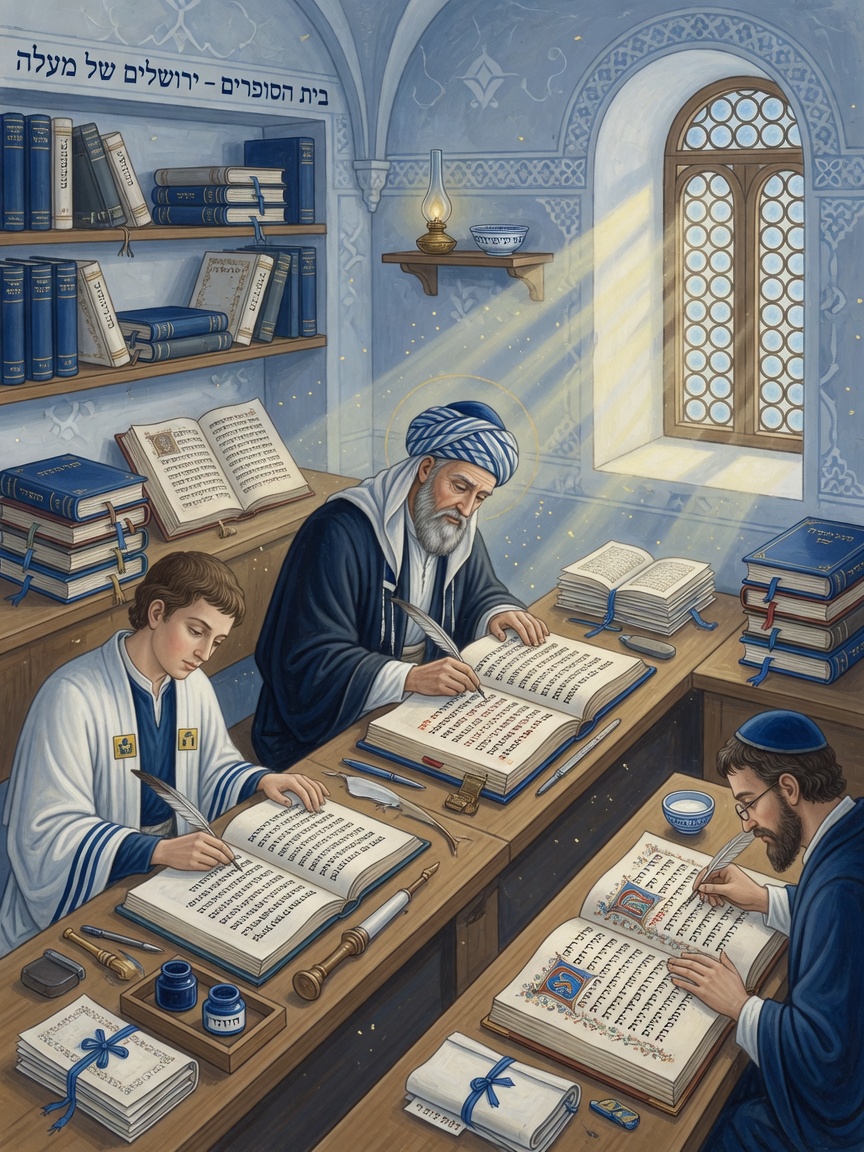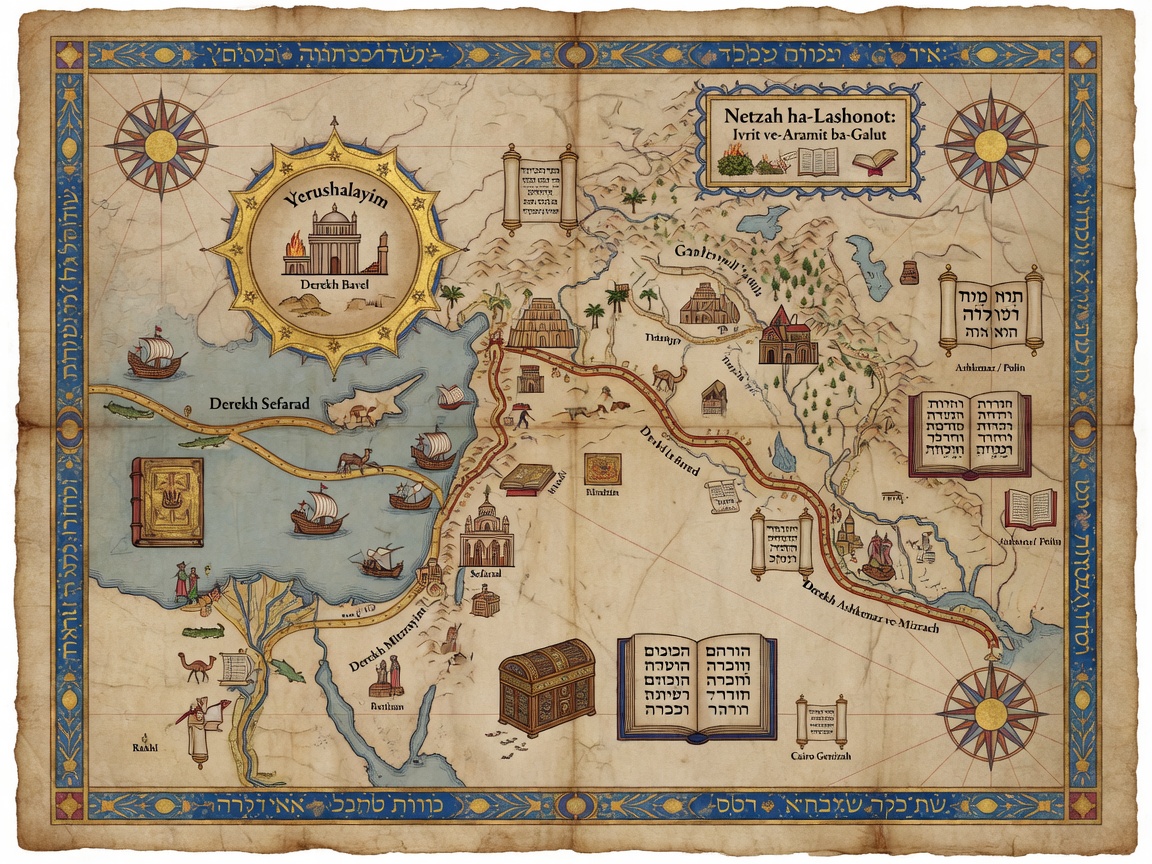
I. Two Semitic Sisters
The Hebrew Bible is mostly Hebrew, but substantial passages — notably in Daniel and Ezra — are in Aramaic. By the late Second Temple period, Aramaic had become the everyday language of Jews in Palestine and the Near East, while Hebrew remained the language of liturgy, law, and sacred study. This diglossia — two languages, two functions — shaped everything the Masoretes later accomplished: they vocalized a Hebrew text that congregations still chanted even when they spoke Aramaic, Arabic, or Yiddish at home.
Scholars such as Aaron Koller and Emanuel Tov have debated how widely Hebrew was still spoken in the first centuries CE; what is not in dispute is that Jewish institutions — Temple, synagogue, academy, scriptorium — kept both languages alive as textual and ritual media long after they ceased to be ordinary vernaculars in most Jewish neighborhoods.
II. Why the Masoretes Matter for Language Survival
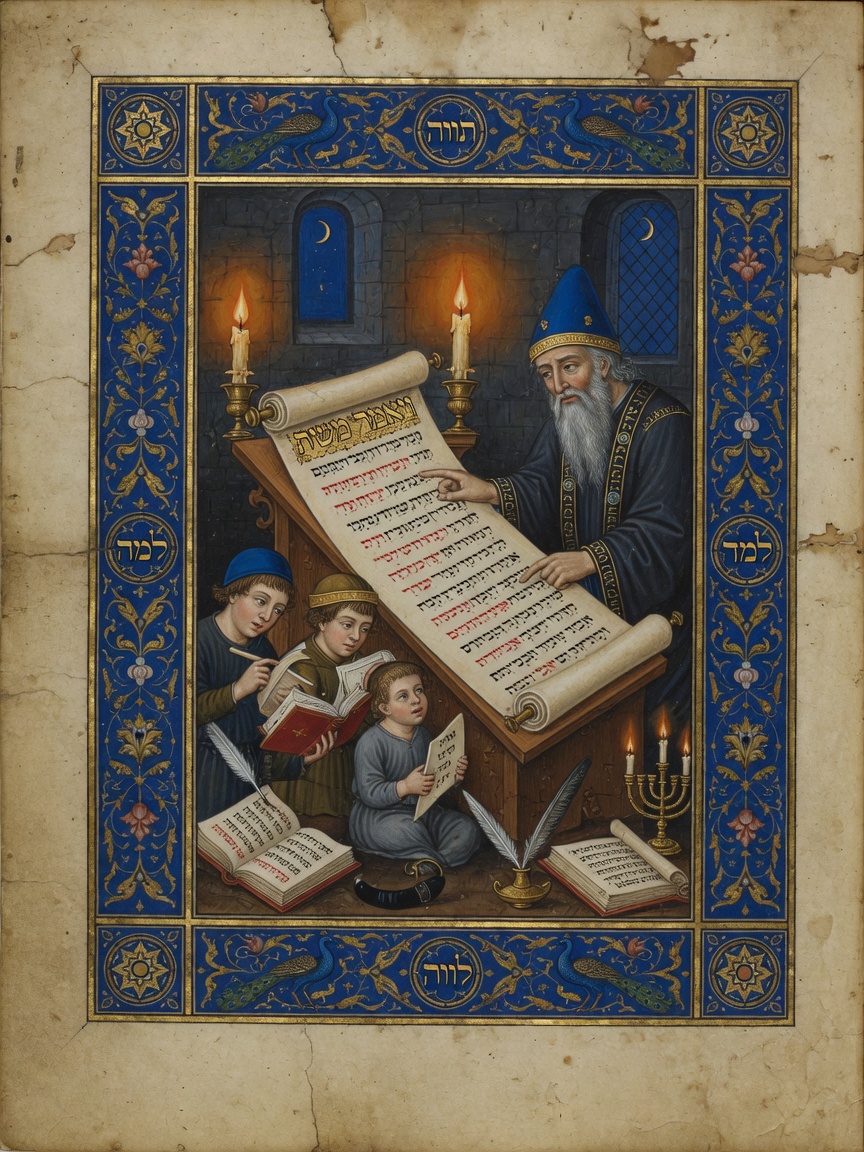
When spoken Hebrew weakened, the consonantal biblical text risked becoming unreadable without trained memory. The Masoretes answered that crisis by inscribing pronunciation directly onto the parchment: niqqud (vowels), te'amim (cantillation), and Masorah (tradition notes). A child in 11th-century Cairo or 18th-century Vilna could learn to read Hebrew from a book, not only from a living teacher's mouth. That technological shift is one reason Hebrew survived as a read language when it had largely disappeared as a spoken one.
III. Vernacular Jewish Languages of the Diaspora
Hebrew and Aramaic were the sacred core, but Jews across the diaspora spoke dozens of vernacular "coat languages" — Arabic, Persian, Berber, Yiddish, Ladino, and Neo-Aramaic in Jewish dress. → Full diaspora languages hub
IV. Deep Dives: Survival & Pedagogy
From biblical speech to liturgical language, Ladino and Yiddish diglossia, the cheder, and modern revival.
Targumim, the Babylonian Talmud, Kaddish, and Jewish Neo-Aramaic dialects.
The cheder, dikduk, Geonic academies, and the print revolution — how the Masoretic pointed text became the world's Hebrew textbook. Notes on Ashkenaz, Sepharad, the Islamic world, and early modern instruction.
V. A Comparative Timeline
- Biblical period — spoken and written language of Israel and Judah
- Second Temple — diglossia with Aramaic; Hebrew in worship and study
- 200–1000 CE — primarily liturgical and literary; preserved by Masoretes through vocalization
- 1000–1900 CE — sacred language of prayer, Talmud study, and rabbinic writing across the diaspora
- 1880s onward — modern spoken revival in Palestine/Israel (Ben-Yehuda and the Ivrit movement)
- First millennium BCE — imperial lingua franca of Assyria, Babylonia, Persia
- Second Temple — everyday Jewish language in Palestine and Babylonia
- 200–600 CE — language of the Talmud Bavli and synagogue prayers (Kaddish, Kol Nidre)
- 600–1900 CE — literary Aramaic in Zohar and legal codes; vernacular dialects in Kurdistan, Syria, Iraq
- Today — small Neo-Aramaic-speaking communities; classical Aramaic still studied wherever Talmud is learned
VI. The Genizah as Linguistic Laboratory
The Cairo Genizah preserves the everyday multilingual reality of medieval Jewry: biblical Hebrew with full Tiberian pointing, Aramaic legal documents, Judeo-Arabic letters, and children's exercises mixing all three. S. D. Goitein showed that Fustat merchants conducted business in Arabic while quoting Hebrew Scripture and Aramaic formulae in their contracts — a living portrait of how sacred languages survived inside a vernacular world.