I. What Is a "Jewish Language"?
A Jewish language is not merely a language spoken by Jews. It is a speech variety shaped by Jewish history: written in Hebrew characters (or, for Karaim, adapted Turkic script), layered with Hebrew and Aramaic vocabulary for religion and law, and marked by the social experience of minority life under Christian or Muslim rule. Scholars such as Sarah Bunin Benor, Geoffrey Khan, and S. D. Goitein have shown that these languages are best understood as products of diglossia — a stable split between a "high" sacred tongue (Hebrew, often Aramaic) and a "low" everyday vernacular that absorbed the sounds of the surrounding world while remaining unmistakably Jewish.
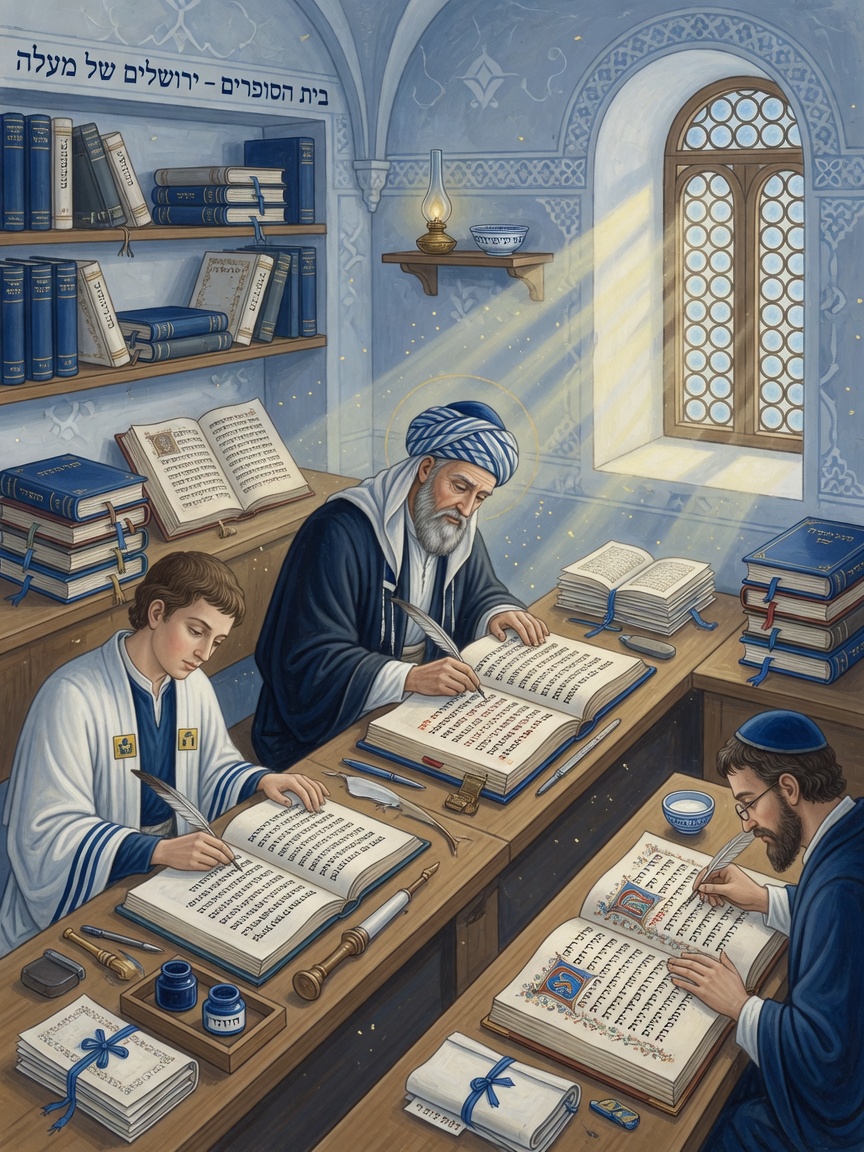
The Masoretes did not create these vernaculars, but their work made the diglossia durable. By fixing a readable, chantable Hebrew Bible, they ensured that no matter whether a Jew in 12th-century Fustat bargained in Judeo-Arabic or a merchant in 18th-century Brody gossiped in Yiddish, the same pointed Masoretic Text could be read aloud in synagogue on Shabbat morning.
II. Two Great Linguistic Worlds
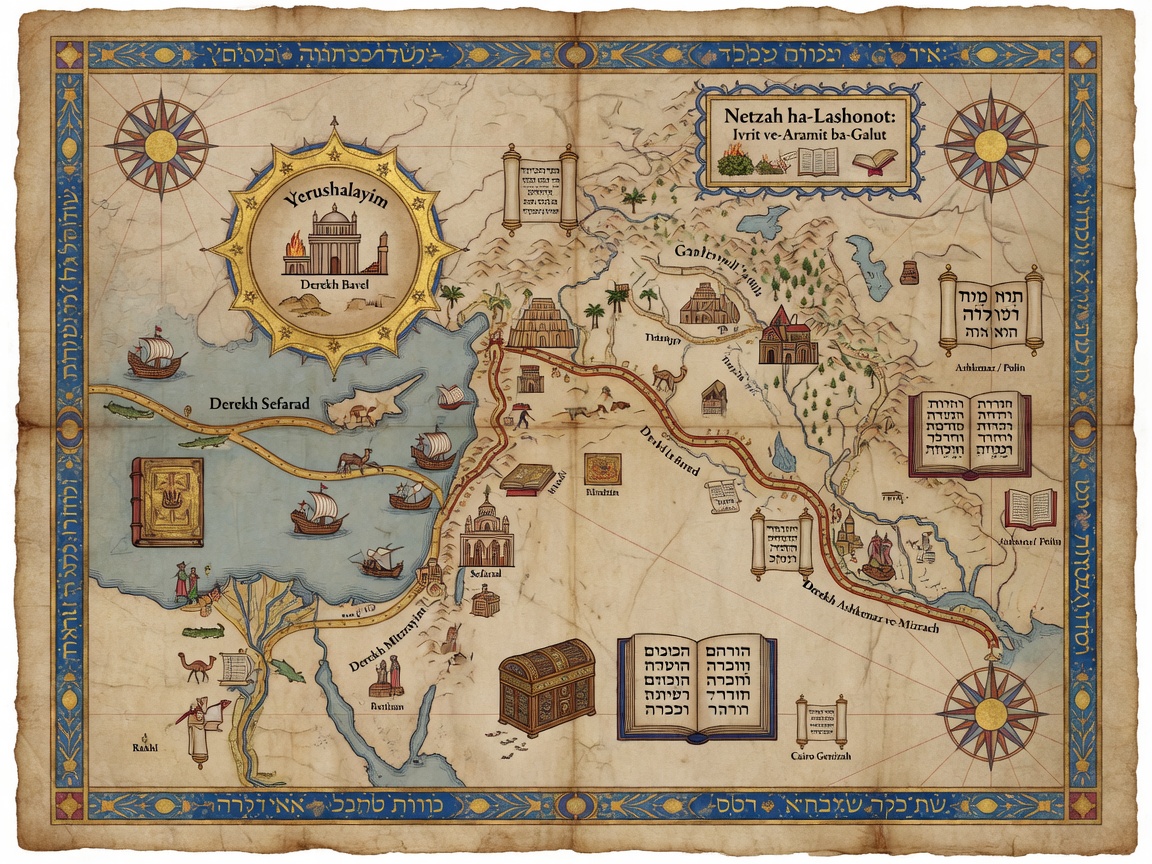
The diaspora languages treated in depth on this site cluster into two vast regions — the Middle East and North Africa (MENA) and Eastern Europe — each with its own migrations, empires, and soundscapes. Sephardic and Mizrahi communities under Islam developed Judeo-Arabic, Judeo-Persian, Ladino, Judeo-Berber, and Jewish Neo-Aramaic; Ashkenazi and related communities in the Slavic-Germanic borderlands developed Yiddish and its dialect archipelago, alongside smaller languages like Karaim and Judeo-Slavic.
Judeo-Arabic, Judeo-Persian, Ladino in the Ottoman world, Judeo-Berber, Jewish Neo-Aramaic, and the Yemenite tradition — languages of the Islamic world and the Maghreb.
Yiddish and its dialects, Karaim, Judeo-Slavic influences, and the Ashkenazi soundscape from the Rhine to the Pale of Settlement.
III. Language Notes
From Saadia's Tafsir to the Cairo Genizah — the Arabic of Jewish letters, law, and daily life.
Hub + 6 notes — dialects, literature, Bible translation, diglossia, revival, and overview.
The language of Sephardic exile — romances, responsa, and the post-1492 diaspora.
Iranian Jewish vernaculars, biblical translation, and the communities of Isfahan and Shiraz.
The living Aramaic of Kurdistan and Iraq — from Talmudic inheritance to endangered dialects.
Moroccan Amazigh in Hebrew script — a window into Berber-speaking Jewish villages.
IV. How Vernaculars and Sacred Languages Interacted
Jewish multilingualism was never random code-switching. It followed patterns:
- Synagogue and study — Hebrew Torah reading with Masoretic pointing; Aramaic Targum and Kaddish
- Exegesis and law — Judeo-Arabic commentaries (sharḥ), Yiddish tsenbeṭlakh on the weekly portion, Ladino me'am lo'ez
- Commerce and household — vernacular letters, women's vernacular literature, proverbs, lullabies
- Writing systems — Hebrew alphabet as a Jewish "coat" worn by Arabic, Spanish, Persian, German, and Berber phonologies
The Cairo Genizah preserves this ecology in fragments: a merchant's Judeo-Arabic note beside a child's Hebrew primer, a ketubah in Hebrew with Aramaic formulae and Arabic witnesses. Eastern European archives tell a parallel story in Yiddish petitions, Hebrew responsa, and Slavic loanwords embedded in both.
V. Sacred Languages Hub
For the story of how Hebrew and Aramaic themselves survived — through the Masoretes, the cheder, and modern revival — see the companion hub:
Diglossia, timelines, pointing, and the pedagogical revolution that kept sacred languages readable across the diaspora.