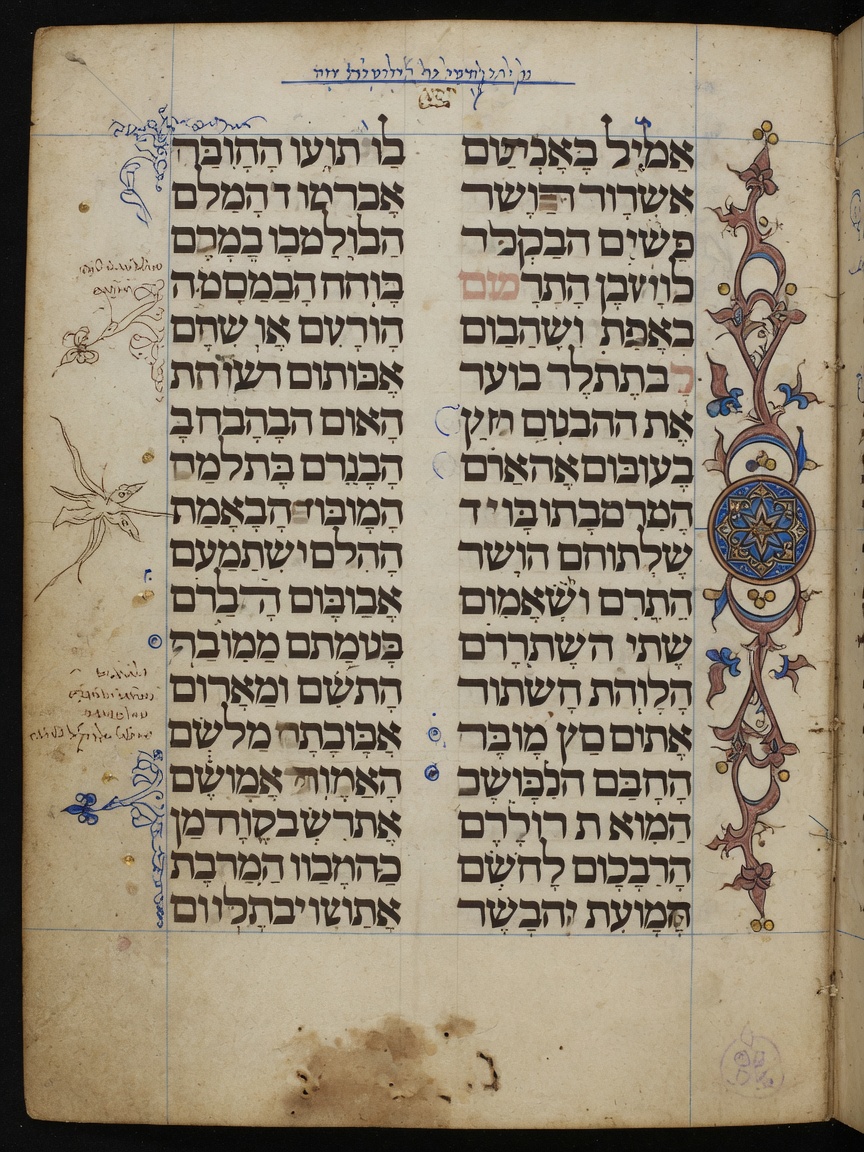
I. Aramaic in the Biblical World
Aramaic was the international language of the ancient Near East — the tongue of Assyrian and Babylonian administration, of Persian imperial correspondence, and of daily life across Syria, Palestine, and Mesopotamia. Portions of the Hebrew Bible are written in Aramaic: chapters 2–7 of Daniel, Ezra 4:8–6:18 and 7:12–26, Jeremiah 10:11, and two words in Genesis 31:47. By the time of Jesus, Jewish Palestinians commonly spoke Aramaic (in dialects scholars associate with Jewish Palestinian Aramaic), while retaining Hebrew for prayer and Torah study.
II. The Targumim: Aramaic Beside the Hebrew Bible
The Targumim (singular targum, "translation") are Aramaic renderings of biblical books, read in synagogue alongside the Hebrew Masoretic text. The most famous — Targum Onkelos on the Torah and Targum Jonathan on the Prophets — became authoritative in Babylonia and beyond. They:
- Made Scripture intelligible to congregations that understood Aramaic better than Hebrew
- Preserved ancient interpretive traditions embedded in translation choices
- Were printed in the Mikraot Gedolot beside Hebrew and commentary — a permanent bilingual layout
Rashi routinely cites Targum Onkelos in his Torah commentary, treating Aramaic translation as a primary tool for establishing the plain sense of Hebrew words.
III. The Babylonian Talmud: Aramaic as the Language of Law
The Babylonian Talmud (Talmud Bavli) — the dominant legal and narrative corpus of rabbinic Judaism — is composed primarily in Aramaic, with Hebrew used for citations of mishnayot and biblical verses. For a millennium of diaspora life, any serious student of Jewish law mastered Aramaic sufficient to read the Gemara. The Geonim of Sura and Pumbedita taught in this language; Benjamin of Tudela witnessed thousands studying it in Baghdad.
IV. Aramaic in Synagogue and Home
Several of the most familiar Jewish prayers are in Aramaic, not Hebrew:
- Kaddish — the doxology recited in every service, in Aramaic so the unlearned could understand and respond Amen
- Kol Nidre — the opening of Yom Kippur, in Aramaic legal formula
- Had Gadya — the Passover Seder closing song
- Berikh shemeh and other liturgical insertions
The rabbis' choice of Aramaic for these texts ensured that Aramaic remained audible in every synagogue, week after week, even in communities where no one spoke Aramaic conversationally.
V. Literary Aramaic: Zohar, Legal Codes, and Magic Bowls
Medieval and early modern Jewish literature continued to compose in Aramaic. The Zohar — the central text of Kabbalah — is largely Aramaic, deliberately archaizing to evoke the aura of ancient revelation. Legal works such as the Arba'ah Turim and responsa literature quote Aramaic Talmudic passages constantly. Archaeology has recovered Jewish Aramaic incantation bowls from Mesopotamia, showing everyday Aramaic use in magic and domestic religion.
VI. Jewish Neo-Aramaic Dialects
Unlike Hebrew, Aramaic also survived as a spoken vernacular in some Jewish communities into the 20th century:
Jewish communities in Kurdistan, Iraq, and western Iran spoke dialects of Neo-Aramaic (often called "Targumic" or Judeo-Aramaic in older scholarship). Speakers immigrated to Israel in the 1950s; few fluent speakers remain today.
Small Christian and Muslim communities in Syria (Maaloula, Bakh'a) preserve Western Aramaic dialects; Jewish Western Aramaic did not survive into modern times, but left traces in Palestinian Talmudic Aramaic.
Scholars such as Geoffrey Khan and the Cambridge team have documented these dialects while they could still be recorded — preserving evidence for how Aramaic evolved from antiquity to the present.
VII. Aramaic and the Masoretic Enterprise
The Masoretes worked in Hebrew, but their world was Aramaic-saturated: the Babylonian academies taught in Aramaic, Karaite and Rabbanite polemics in the Near East used Aramaic legal terms, and the Genizah preserves Aramaic documents alongside pointed Hebrew Bibles. The square Hebrew script itself is borrowed from Aramaic scribal practice — a physical reminder that Hebrew and Aramaic share not only vocabulary and grammar but the very letterforms on the page.
VIII. Aramaic Today
Classical Jewish Aramaic remains a living study language wherever the Talmud is learned — from yeshivot in Jerusalem and New York to university Semitics departments. Neo-Aramaic vernaculars are endangered; UNESCO and academic projects work to document them. For the student of the Masoretic tradition, Aramaic is not optional background: it is the language of the Targum that explains difficult Hebrew, of the Talmud that governs how Torah scrolls are written, and of the Kaddish that sanctifies every service where a Masoretic codex is read.