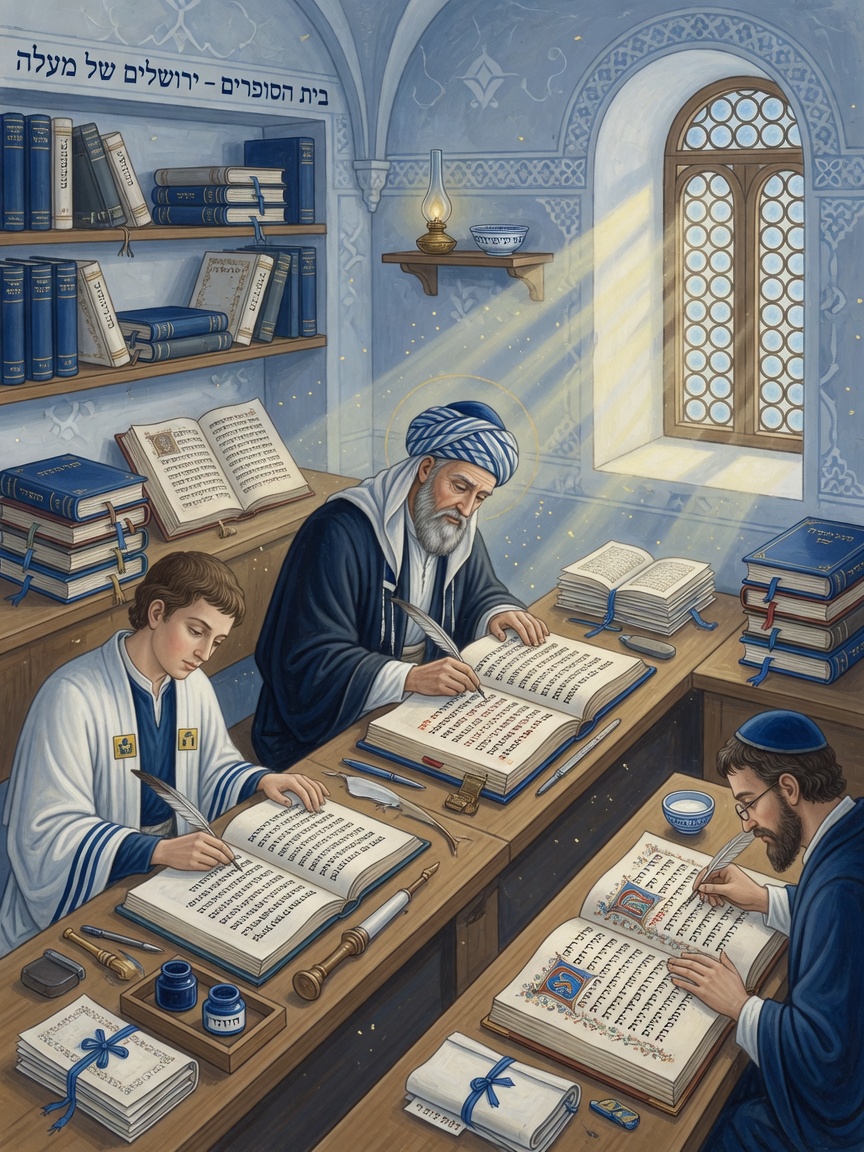
I. The Geonic Academies: Sura and Pumbedita
Between the 7th and 11th centuries, the Geonim (exilarchal academy heads) in Sura and Pumbedita (Babylonia) governed Jewish law and learning for the entire diaspora. Their curricula centered on the Babylonian Talmud — predominantly Aramaic — but presupposed Hebrew literacy for biblical citations, prayer, and legal responsa. Students arrived with elementary Hebrew reading ability; the academies refined it through relentless textual engagement.
Robert Brody's The Geonim of Babylonia and the Shaping of Medieval Jewish Culture (Yale, 2013) documents how these institutions standardized Talmudic study, regulated communal education through responsa, and transmitted the Masoretic biblical text as the authoritative Scripture. → Middle East note
II. Saadia Gaon: Translator and Teacher
Saadia ben Joseph al-Fayyūmī (882–942), Gaon of Sura, was the most influential Hebrew pedagogue of the early medieval period. His educational contributions include:
- Arabic translation of the Torah (Tafsīr) — making Scripture accessible to Jews whose vernacular was Judeo-Arabic, while treating the Hebrew original as the authoritative text
- Sefer ha-Nivdar (Book of Selected Terms) — a Hebrew dictionary for advanced students
- Egron — an early Hebrew rhyming dictionary, pedagogically organized by word endings
- Polemical and philosophical works in Judeo-Arabic — teaching biblical narrative through rationalist exegesis
Saadia's method assumed the Tiberian-pointed Bible. He defended the Masoretic text against Karaite challenges and argued that oral tradition and vocalization together preserve correct reading.
III. The Cairo Genizah as Classroom Archive
The Cairo Genizah preserves extraordinary evidence of everyday Hebrew teaching in Fustat (medieval Cairo) from the 10th–13th centuries:
- Alphabet primers and exercises in children's handwriting
- Benedictions recited when a child began Torah study
- Copied biblical verses with full niqqud and te'amim
- Teacher-student correspondence and fee receipts for tutoring
- Multilingual word lists (Hebrew-Arabic) for vocabulary drill
S. D. Goitein reconstructed the social world behind these fragments in A Mediterranean Society, showing that Hebrew literacy was a normal middle-class expectation in Fustat, taught by private tutors and in synagogue-adjacent schools. Judith Olszowy-Schlanger has published specifically on the schoolbook fragments, identifying standardized teaching sequences.
IV. Karaite Schools and Alternative Pedagogies
Karaite communities, who rejected rabbinic oral law, placed even greater emphasis on direct Hebrew Bible study. Karaite pedagogues produced:
- Children's primers (meqor ḥayyim traditions) teaching alphabet and reading
- Hebrew grammars influenced by but independent of Rabbanite dikduk
- Literalist biblical commentaries requiring advanced Hebrew comprehension
Yosef Rivlin and Daniel Lasker (Ben-Gurion University) have documented how Karaite insistence on Scripture intensified Hebrew literacy while generating rival reading traditions. The Karaite debate with the Masoretes over vocalization was itself a pedagogical argument: who has authority to teach correct reading? → Rabbanites & Karaites note
V. Yemen: Oral Chain and Archaic Pronunciation
Yemenite Jewry preserved a distinctive Hebrew reading tradition, transmitted orally in schools and synagogues with features that may reflect pre-Tiberian or parallel Babylonian pronunciation. Yemenite children learned Hebrew through intensive oral-aural methods — repeating after the teacher, memorizing portions, and chanting with a system of cantillation related to but distinct from the standard Tiberian te'amim.
Moshe Bar-Asher (Hebrew University) has published extensively on Yemenite Hebrew and the living transmission of ancient reading traditions. Geoffrey Khan's reconstruction of Tiberian phonology uses Yemenite and other living traditions as comparative evidence for what medieval teachers were trying to preserve.
VI. Judeo-Arabic as the Language of Explanation
In the Islamic world, Hebrew was taught through Judeo-Arabic — Arabic written in Hebrew characters. Teachers explained biblical vocabulary, grammar, and narrative in the student's spoken language while keeping the sacred text in Hebrew. This bilingual pedagogy mirrors the Ashkenazi use of Yiddish and the Sephardi use of Ladino as explanatory media. The Hebrew script unified Jewish literacy across the Arabic-speaking world even when the spoken tongue was Arabic.