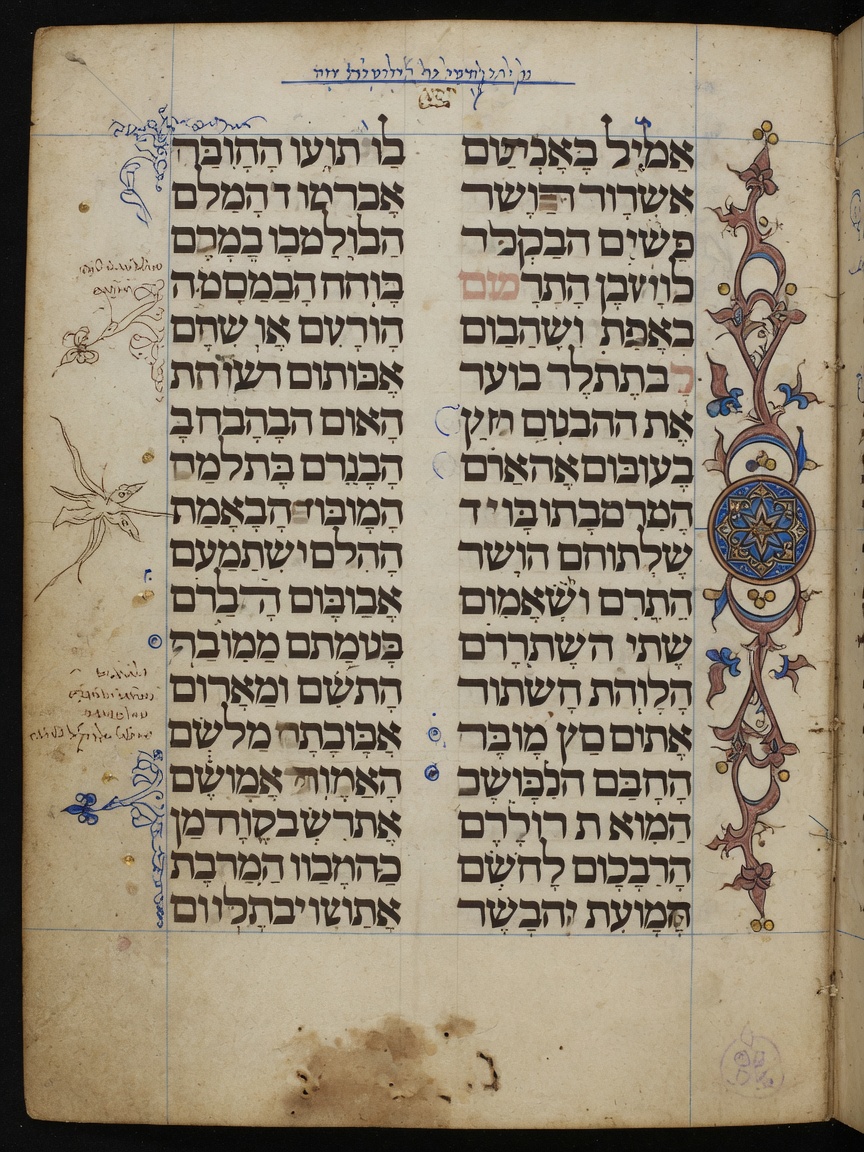
Ornate illuminated medieval Hebrew Bible manuscript page in the style of the Aleppo Codex, on aged parchment with gold leaf borders, intricate filigree, and a wide variety of authentic distinct Hebrew lettering from Genesis with full Tiberian niqqud and cantillation marks
ILLUMINATED MANUSCRIPT • 10TH CENTURY
7TH — 10TH CENTURIES OF THE COMMON ERA

Masters of the Sacred Text

In the centuries following the destruction of the Second Temple, a circle of devoted Jewish scholars in Tiberias labored in scriptoria to preserve every letter, every vowel, and every chant of the Hebrew Bible. Working at the intersection of grammar, phonetics, liturgy, and scribal law, they transformed a consonantal skeleton — readable only with trained memory — into a fully annotated, singable, and statistically verifiable text. Their achievement, the Masoretic Text, remains the authoritative Hebrew Bible of Rabbinic Judaism and the primary Vorlage for virtually all modern translations.

Modern textual critics, paleographers, and linguists still study their manuscripts as primary evidence for how biblical Hebrew was pronounced, punctuated, and transmitted in the early medieval period — a rare case in which medieval scribal labor, not ancient archaeological discovery alone, defines the received text of a world scripture.

INTRODUCTION

So Who Were These Scribes?

The Masoretes (Hebrew: בַּעֲלֵי הַמָּסוֹרָה, Ba'alei ha-Masorah, "masters of the tradition") were a group of dedicated Jewish scribes, grammarians, and scholars active primarily between the 7th and 10th centuries CE. Their name comes from the Hebrew word masorah, meaning "tradition" or "transmission."

They lived and worked mainly in Tiberias on the western shore of the Sea of Galilee (in what is today northern Israel), with important parallel activity in Jerusalem and in the great academies of Babylonia (modern Iraq). This was the period of the early Islamic caliphates — first the Umayyads and then the Abbasids.

By the time the Masoretes began their work, Hebrew had long ceased to be a spoken language for everyday use. It survived as a sacred and literary language, while Aramaic and later Arabic were the vernaculars. The risk of the precise ancient pronunciation, chanting, and even the exact spelling of the biblical text drifting or being corrupted was very real. The Masoretes saw themselves as the last line of defense for the Hebrew Bible (Tanakh).

They did not compose new books of the Bible. Instead, they took the existing consonantal text (which had already been largely standardized in earlier centuries) and created an elaborate system of safeguards around it so that every future copy would match the authoritative version exactly.

The word masorah itself is theologically loaded. Rabbinic tradition understood it as a "fence" (גְּדֵרָה) around the Torah — not an alteration of revelation, but a protective apparatus ensuring that revelation could not silently drift. The Masoretes therefore operated under a severe constraint: the consonantal ketiv was sacred and fixed; their innovations had to be layered around it in the form of vowels, accents, and marginalia.

Scholarship distinguishes three major regional schools of vocalization that developed roughly in parallel: the Tiberian (most elaborate and ultimately dominant), the Palestinian (simpler, often supralinear), and the Babylonian (also often supralinear, associated with the great Geonic academies). Tiberias won not because it was the only center of learning — Jerusalem, Ramla, and Babylon were equally important in broader Jewish intellectual life — but because its system combined maximal phonetic precision with a fully developed accentual and statistical apparatus. The reconstructed Tiberian pronunciation tradition, studied in detail by Geoffrey Khan and others, reflects a scholarly community obsessed with auditory exactitude.

The Masoretes were not isolated antiquarians. They worked during the Geonic period, when the heads of the Babylonian academies (Geonim) exercised wide legal authority across the diaspora, and when Karaites and Rabbanites debated the role of written versus oral tradition. Karaite emphasis on Scripture heightened the stakes of having a correct, fully pointed biblical codex. Rabbinic Judaism, meanwhile, depended on the biblical text for public liturgical reading (qeri'at ha-Torah), for daily and festival lectionaries, and as the lexical foundation of the Talmud. Every community needed the same consonants, the same vowels, and the same cantillation if worship and study were to remain unified across Egypt, Syria, Iraq, and the western diaspora.

Tiberias as a Scriptorium City

After the abolition of the Patriarchate (Nesi'ut) in the early fifth century and the shifting of Jewish demographic weight toward Galilee, Tiberias became a major hub of Hebrew philology. The city's Masoretes collaborated with grammarians such as the members of the Ben Asher and Ben Naphtali families, whose disputes over pointing and accentuation were later catalogued in works like Sefer ha-Chilufim. Their scriptoria produced not scrolls for synagogue use (which remained unpointed by ritual law) but codices — bound manuscript books in which the full apparatus could be displayed. These codices were the laboratories of textual science and the ancestors of every printed Rabbinic Bible.

ScribesGrammarians • Guardians of Tradition
THE KEY ACHIEVEMENT
They never altered a single letter of the ancient consonantal text. Instead, they developed the most sophisticated system of vocalization, accentuation, and marginal notes ever created for any sacred text — allowing the oral reading tradition to be perfectly preserved in writing for all generations.

Their method combined empirical observation (counting every occurrence of a form), legal reverence (the text as revelation), and grammatical analysis (classifying vowels, accents, and word shapes). No other scribal culture in antiquity built a comparably dense error-detection layer around a scriptural corpus.

Main Center
Active Period
c. 650 – 950 CE
Major Innovation
Result
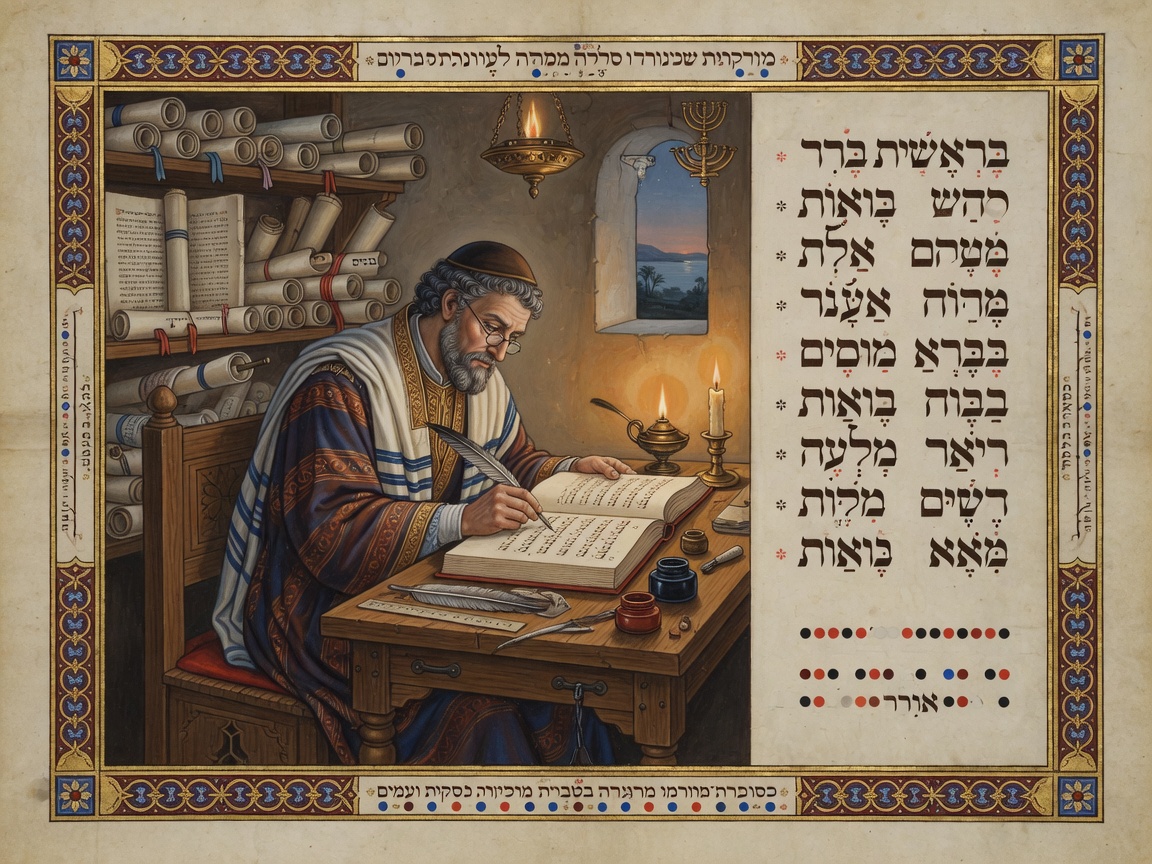
Medieval Jewish scribe at work in a scriptorium, adding precise vocalization and Masoretic notes to a parchment codex
A Masorete at work • Illustration in the medieval manuscript style
CHRONOLOGY

How It All Unfolded

The timeline below is not a list of isolated dates but a chain of institutional responses to a single problem: how to keep one sacred text identical across communities when the language of daily life had changed, the Temple was gone, and books were multiplying. Each milestone reflects a new layer of standardization — script, vocalization, accentuation, statistical Masorah, and finally print.

70
70 CE — Destruction of the Second Temple
Roman forces destroy the Temple in Jerusalem. The loss of the central religious and scribal authority makes uniform preservation of the biblical text across the Jewish diaspora an urgent priority. Rabbinic leaders begin emphasizing exact transmission of the text. The shift from Temple-centered sacrifice to Torah-centered study accelerates; public reading and memorization of Scripture become the primary communal acts of devotion. Scribal correctness is increasingly treated as a religious obligation, not merely a technical skill.
~200
c. 200 CE — The Mishnah and Early Textual Fixation
Rabbi Judah the Prince compiles the Mishnah. Rabbinic literature repeatedly stresses that even a single letter of the Torah scroll must not be changed. The square script (Ktav Ashuri) is now required for valid Torah scrolls; paleo-Hebrew is ruled invalid for ritual use. Tractates such as Soferim and later scribal manuals begin codifying layout rules — line count, spacing, column format — that the Masoretes will later perfect in codex form. The consonantal text is increasingly treated as a closed corpus.
7th C
7th Century — Islamic Conquest; Palestinian & Babylonian Pointing
The Arab conquest of the Near East (from the 630s onward) reshapes the Jewish world but does not halt Masoretic activity. Under Umayyad rule, Jewish communities in Palestine, Syria, and Iraq continue copying and studying Scripture. Early supralinear vocalization systems — Palestinian and Babylonian — appear in fragments and codices. These systems use dots above letters and are less phonetically detailed than the later Tiberian sublinear system, but they demonstrate that the problem of fixing pronunciation in writing has become urgent across multiple centers, not only in Galilee.
6th C
6th–8th Century — The Masoretic Enterprise Takes Shape
Systematic Masoretic activity intensifies in Tiberias and the Babylonian academies of Sura and Pumbedita. Scribes compile lists of unusual spellings, word counts, and "fences" (safeguards) around the text — the beginning of the formal Masorah. The Ben Asher dynasty traces its roots to this period. Treatises on the miqra soferim ("traditions of the scribes") circulate, preserving extraordinary claims about suspended letters, enlarged letters, and other graphic peculiarities in the Torah.
10th C
10th Century — Tiberian System Matures; Ben Asher vs. Ben Naphtali
The fully developed Tiberian system of sublinear niqqud and te'amim reaches its classical form. The rival schools of Aaron ben Moses ben Asher (Tiberias) and Moses ben David ben Naphtali disagree in roughly 875 documented places — chiefly in accent placement and occasional vocalization. Medieval scholars preserve these differences in comparative lists. Although both traditions are Masoretic, Ben Asher's will ultimately be treated as normative in Rabbinic Judaism, largely through the authority of Maimonides.
895
895 CE — Cairo Codex of the Prophets
One of the oldest surviving large-scale Masoretic manuscripts, traditionally attributed to Moses ben Asher (father of Aaron). It contains the books of the Former and Latter Prophets with full vocalization and Masoretic notes. It is still kept in the Karaite synagogue in Cairo.
~900
c. 900 CE — Codex Sassoon 1053 (Sassoon Codex)
An unknown scribe produces this nearly complete Hebrew Bible (only ~12 leaves missing) with full Tiberian vocalization and Masorah. One of the earliest and most important witnesses alongside the Aleppo Codex. Long in private hands (including the collection of David Solomon Sassoon), it was sold in 2023 for $38.1 million and is now on permanent display at the ANU Museum of the Jewish People in Tel Aviv. Learn more →
~920
c. 920 CE — The Aleppo Codex Is Completed
Scribe Shlomo ben Buya'a writes the consonantal text. Aaron ben Moses ben Asher adds the definitive Tiberian vocalization, accents, and extensive Masoretic apparatus in Tiberias. A dedicatory note at the end of the Former Prophets section records the completion. The codex is later entrusted to the Jewish community of Aleppo, where it is venerated for centuries as the Keter ("Crown"). In his Mishneh Torah, Maimonides (12th century) treats it as the model for Torah scroll layout — a judgment that cemented its authority. Full story →
1008
1008/1009 CE — The Leningrad Codex
Scribe Samuel ben Jacob completes the oldest surviving complete manuscript of the entire Hebrew Bible in Cairo. It closely follows the Ben Asher tradition and contains a long colophon. Today it is housed in the National Library of Russia in St. Petersburg and serves as the base text for nearly all modern critical editions. See it →
1525
1524–1525 — Bomberg’s Second Rabbinic Bible
Venetian printer Daniel Bomberg publishes the first printed edition of the complete Masoretic Text, edited by Jacob ben Chayyim ibn Adoniyahu. This "textus receptus" becomes the standard Hebrew Bible for centuries and is the basis for the King James Version Old Testament and many later translations. Ben Chayyim synthesizes Masoretic notes from multiple manuscripts into a printed marginal apparatus — transferring a scribal technology born in codices into the age of movable type. More on the Rabbinic Bible
1896
1896 onward — Solomon Schechter, the Cairo Genizah & Modern Textual Criticism
Solomon Schechter's 1896–1897 expedition to the Ben Ezra Synagogue opens the Cairo Genizah, yielding hundreds of thousands of manuscript fragments, including early Masoretic, Palestinian-pointed, and Babylonian-pointed biblical texts. Scholars such as Paul Kahle, Shelomo Morag, and Israel Yeivin use these materials to reconstruct the history of vocalization. The Genizah confirms that the Tiberian tradition was one stream among several — but also demonstrates how thoroughly it eventually dominated the received text. Modern critical editions (BHS, BHQ) continue to annotate the Masoretic tradition while noting variants from the Dead Sea Scrolls and ancient versions. Read the full scholarly essay →
THE MASORAH — THEIR SECRET WEAPON

What Exactly Did They Do?

They took the existing consonantal skeleton of the Bible and wrapped it in the most elaborate protective system of vocalization, musical notation, and statistical safeguards the ancient world ever saw — all without changing a single letter of the sacred text.

To understand their labor, imagine a language written without vowels, without punctuation, and without paragraph breaks — yet legally required to be read aloud in public with perfect accuracy, correct melody, and precise syntactic phrasing. That was biblical Hebrew in the hands of post-biblical scribes. The Masoretes solved this through a multi-layered technology: phonetic pointing (niqqud), prosodic and syntactic accents (te'amim), and a vast database of cross-references (Masorah) that recorded every anomaly. Modern scholars sometimes compare a fully Masoretic page to a medieval hypertext: the main line is Scripture; the margins are a commentary of statistics, variants, and warnings.

Vocalization (Niqqud)

The Masoretes developed a complete system of dots and dashes placed above, below, and inside the consonants to indicate exact vowel sounds. Before this, readers had to rely entirely on oral tradition and context. A consonantal string like בראשית could theoretically be divided and vocalized in more than one way; pointing fixes the received reading as בְּרֵאשִׁית ("in the beginning").

The Tiberian system they perfected eventually won out over the simpler Palestinian and Babylonian systems and became the standard used in all printed Hebrew Bibles today. It distinguishes long and short vowels, uses sheva (ְ) for reduced or zero vowels, and employs dagesh (ּ) to mark consonant gemination or fricative/plosive alternation (for example, the p in פ versus פּ).

The Tiberian grammarians also classified vowels into five classes (among them gutturals — א, ה, ח, ע — which attract special vowels) and developed intricate rules for begadkefat letters, meteg, and raphe. Their work is preserved not only in manuscripts but in technical treatises on accentuation and vocalization.

EXAMPLE — GENESIS 1:1
בְּרֵאשִׁ֖ית בָּרָ֣א אֱלֹהִ֑ים
The sheva and segol under the bet, the ḥolam above the resh, the kamatz and patach, etc.

Cantillation (Te'amim)

A sophisticated system of accents (te'amim or trope) that simultaneously serves three purposes. The Torah employs a set of 21 disjunctive accents (major pauses) and a smaller number of conjunctive accents that link words within a phrase. The Prophets (Haftarah cantillation) use a different melodic system. The three books of poetic cantillationPsalms, Proverbs, and Job — use yet another.

  • Musical notation for the traditional chanting of the Torah and other books in synagogue
  • Syntactic punctuation that shows how phrases and sentences are divided
  • Guidance for stress and phrasing in public reading
  • Hierarchical structure: disjunctives nest inside one another like nested parentheses, governing how long a phrase may run before a reader must pause

The accents are not merely musical decoration. A misplaced etnaḥta or zaqef can change the perceived syntax of a verse. Masoretic treatises therefore discuss "fine points of the accents" (dikdukei ha-te'amim) with the same rigor applied to vowels.

֑ Etnaḥta — major pause (like a semicolon)
֖ Tipḥa — secondary division
֔ Zaqef qatan — smaller pause

The Masorah

Hundreds of thousands of marginal and end-of-book notes form a vast "fence around the Torah." They record rare spellings, total word and letter counts, qere/ketiv readings (what to read vs. what is written), and warnings against common scribal errors. The Masorah is often classified into three types: Masorah Parva (brief side notes), Masorah Magna (expanded lists), and Masorah Finalis (summaries at the end of biblical books giving total verses, words, and letters).

A typical Parva note might consist of a single letter in the margin, keyed by a matching letter in the text, pointing the reader to a Magna list elsewhere. This economy of space allowed enormous databases of information to fit on the same page as Scripture.

Example: “The word וַיֹּאמֶר occurs 2,357 times. In 15 instances it is written defectively without the yod.” Another common note form: “This word appears only once in the Bible” — forcing the scribe to verify a hapax legomenon against a master copy.

Masorah Parva & Masorah Magna

The notes come in two forms. The Masorah Parva (small Masorah) consists of short notes written in the side margins. The Masorah Magna (large Masorah) contains longer, more detailed lists usually written at the top and bottom of the page or collected at the end of books.

Together they function like an ancient critical apparatus and spell-checker combined.

Qere and Ketiv

One of the most interesting features the Masoretes preserved: places where the written text (ketiv, “what is written”) differs from what should be read aloud (qere, “what is read”).

These differences are marked in the manuscripts. The Masoretes did not “correct” the text — they recorded both the traditional written form and the accepted reading tradition. Scholars classify qere types: ordinary qere, qere we-la' ketiv ("read but do not write"), ketiv we-la' qere ("write but do not read"), and cases where the qere changes meaning substantially (as in euphemistic readings of divine or sexual language).

Famous examples include places where the written text uses an archaic or theologically difficult form, while the qere supplies the form recited in synagogue. The Masoretic apparatus thus preserves textual archaeology inside the authoritative line of transmission.

Sections, Parashiyyot & Layout

Beyond vowels and accents, the Masoretes standardized the physical architecture of the text. They marked open sections (פתוחה, parashah petuhah) and closed sections (סתומה, parashah setumah), governed column layout in Torah scrolls, and preserved traditions about special spacing (for example, the blank space before Genesis 3:15 or the arrangement of the Song of the Sea).

Maimonides' description of the Aleppo Codex as the exemplar for Torah scrolls concerns not only letters and pointing but also which verses begin at the tops of columns — a level of codicological precision rarely matched in other ancient literatures.

Tiberian Phonetics & Grammar

The Tiberian pointing system encodes a specific historical pronunciation of Hebrew — not identical to modern Israeli Hebrew. Scholars reconstruct its vowel qualities, stress patterns, and guttural distinctions through manuscript evidence and medieval grammatical treatises.

Masoretic grammarians such as Saadia Gaon (10th century) and later David Kimhi built on this foundation, but the pointing itself remains the primary linguistic record. Comparative Semitics, liturgical tradition, and Karaite transcriptions all help modern linguists validate the Tiberian reconstruction.

Orthography: Full & Defective Spellings

Biblical Hebrew often spells words defectively (without matres lectionis — the letters ו, י, ה used as vowel markers) or plene ("full"). The Masorah tracks both forms meticulously. A scribe who wrote שלם where tradition required שלום would be caught by statistical notes listing all occurrences of each spelling.

This orthographic conservatism is one reason the Masoretic Text often preserves older spellings alongside later pronunciation — a boon for historical linguists and textual critics comparing the MT to the Dead Sea Scrolls, where spelling can be freer.

The Famous “Fence”
Rabbi Akiva taught that “the masorah is a fence for the Torah.” The Masoretes took this literally. They counted every letter in the Torah (304,805 according to the received tradition), noted every unusual spelling, and created exhaustive lists so that any deviation by a future copyist would be immediately obvious. Similar statistics govern the other books: traditional counts of verses in each biblical book appear in Masoretic colophons and are still printed in many Hebrew Bibles today.

The famous rabbinic list of scribal oddities — enlarged letters, diminished letters, dots above words, suspended letters — belongs to the same culture of precision. Whether every item in that list is equally ancient is debated by scholars, but the Masoretic manuscripts preserve the graphic traditions with remarkable consistency.

Letters counted
in the entire Torah
304,805
Words: 79,847
Verses: 5,845
Full Essay: Niqqud & Te'amim Vocalization, cantillation, Tiberian phonology, scroll vs. codex
SCHOLARLY NOTE — THE CONSONANTAL BASE

Modern scholarship generally holds that the consonantal text stabilized between the first and early second centuries CE — a process sometimes linked to rabbinic authority and the trauma of the Temple's destruction. The Masoretes inherited this stabilized consonantal tradition (often called the "proto-Masoretic" stream visible in many Qumran scrolls) and added the vocalic and accentual superstructure centuries later. Their work should therefore be distinguished from, but not divorced from, the earlier history of textual transmission.

SCHOLARLY NOTE — RITUAL VS. STUDY COPIES

A Torah scroll used in synagogue remains unpointed: only consonants appear on the parchment. Pointed codices were study Bibles for scholars, cantors, and students learning to read with correct vowels and cantillation. This dual-track tradition — unpointed ritual scroll plus pointed scholarly codex — persists in Judaism today and explains why Masoretic labor concentrated on codices rather than on replacing synagogue scrolls.

THE ALPHABET

The Fascinating Story of the Hebrew Script

The Masoretes did not invent the square letters used today. They inherited an already-standard script (called Ktav Ashuri or “Assyrian script”) and layered their revolutionary system of vowels and notes on top of it. By the time the Masoretes were active in the 7th–10th centuries CE, Ktav Ashuri had been the dominant Jewish script for nearly a millennium.

The story of its adoption is a fascinating tale of exile, empire, practicality, and religious authority—one that transformed how the Hebrew Bible would be written and read forever.

The Name “Ashuri” and Its Origins

The term “Ktav Ashuri” literally means “Assyrian script.” This name is somewhat ironic: the script itself is a stylized form of the Imperial Aramaic alphabet, which spread through the Near East under the Assyrian, Babylonian, and especially the Persian (Achaemenid) empires. Rabbinic tradition (Sanhedrin 21b–22a) offers several explanations, including that the script was brought back from exile in Assyria by Ezra the Scribe, or that it was the original script of the Torah that had been “forgotten” and was restored. In practice, it was the everyday administrative script of the great eastern empires that Jews encountered during and after the Babylonian Exile.

The Babylonian Exile and the Shift Begins (586 BCE onward)

Before the destruction of the First Temple, Israelites and Judahites wrote in the Paleo-Hebrew script (Ktav Ivri), an alphabet closely related to Phoenician. The Babylonian conquest and exile of 586 BCE changed everything. In Babylon, Aramaic had become the dominant spoken and written language of administration. Jews in exile quickly adopted the Aramaic script for legal documents, letters, and daily affairs simply because it was the lingua franca of the empire.

Aramaic was easier for longer texts and was already the script of international diplomacy. While some continued to use paleo-Hebrew for Hebrew religious or personal texts (as seen in labels on cuneiform tablets from the “town of the Jews” in Babylon), the practical advantages of the square Aramaic letters began the long transition.

The Persian Period: Imperial Standardization

Under Persian rule (539–332 BCE), Aramaic became the official language of the vast Achaemenid Empire. The Persians deliberately promoted a standardized, “square” form of the Aramaic alphabet across their territories—from Egypt (see the Elephantine papyri) to Bactria. Jewish communities in the diaspora and in Yehud (the Persian province of Judah) used this script for official documents. Hebrew continued to be written, but increasingly in the new square letters. This period marks the real beginning of Ktav Ashuri as the Jewish script.

Second Temple Period: Dual Scripts and Gradual Dominance

During the Hellenistic and Roman periods, both scripts coexisted for a time. The Dead Sea Scrolls (3rd century BCE–1st century CE) provide the clearest evidence: the overwhelming majority of biblical and non-biblical texts are written in the square script, but a handful of Pentateuch and Job scrolls use paleo-Hebrew. In several manuscripts the Tetragrammaton (YHWH) is deliberately written in paleo-Hebrew even when the surrounding text is square—an apparent act of reverence or caution to keep the divine name visually distinct and sacred.

Hasmonean coins and Bar Kokhba revolt coins (2nd century BCE–2nd century CE) often used paleo-Hebrew, likely for nationalist and symbolic reasons—to evoke the ancient kingdom of Israel. Yet for sacred Torah scrolls, the square script was gaining ground. The transition was not sudden but a slow cultural and practical shift over roughly four centuries.

Rabbinic Codification and the Triumph of Ktav Ashuri

After the destruction of the Second Temple in 70 CE and the Bar Kokhba revolt (132–135 CE), the rabbis moved to standardize Jewish practice. The Mishnah (Yadayim 4:5) explicitly rules that a Torah scroll written in paleo-Hebrew (Ktav Ivri) does not render the hands impure in the ritual sense and is not considered valid for public reading. Only a scroll written in Ktav Ashuri on parchment with ink qualifies.

The Babylonian Talmud (Sanhedrin 21b–22a) preserves a famous debate: one tradition holds that the Torah was originally given in paleo-Hebrew and was later changed to Assyrian script by Ezra the Scribe upon the return from exile; another view holds that the Assyrian script was always the sacred one. Whatever the historical details, the rabbis decisively chose Ktav Ashuri as the only legitimate script for sacred texts. This decision had lasting consequences: it distanced mainstream Judaism from the Samaritans (who retained a version of paleo-Hebrew for their Torah) and ensured a uniform, legible script for the growing body of rabbinic literature.

Why Ktav Ashuri Was Adopted

  • Practicality: The square Aramaic letters were easier to write quickly and were already the script of government and commerce.
  • Imperial Influence: Centuries of exposure to Aramaic under Assyrian, Babylonian, and Persian rule made the script familiar.
  • Legibility and Uniformity: The more angular square forms proved well-suited to the production of large codices and scrolls.
  • Religious and Political Identity: Post-exilic leaders (including Ezra) used the new script as part of a broader program of religious renewal and separation from surrounding cultures and from Samaritan practice.
  • Sacred Status: Once the rabbis declared it the only valid script for Torah scrolls, its adoption became non-negotiable for ritual purposes.

By the time the Masoretes of Tiberias began their work in the early Islamic period, Ktav Ashuri was the uncontested Jewish script. Their great achievement was not changing the letters themselves but perfecting the system of dots, dashes, and marginal notes that could be added to this already-standard square alphabet.

From Consonants to a Reading Machine

It is crucial to separate two revolutions. The first — adoption of the square script — solved the problem of which letters to write. The second — Masoretic pointing — solved the problem of how to read them aloud. A scroll in Ktav Ashuri without niqqud is legible to a trained reader but ambiguous to a learner; a pointed codex is a pedagogical instrument that encodes centuries of oral tradition in ink.

Paleographers study letter forms across centuries: Hasmonean, Herodian, and medieval Ashuri hands differ in stroke, final-letter shape, and ornamentation. The Masoretes wrote in a mature medieval Ashuri hand characterized by clarity, uniformity, and suitability for dense marginal annotation — quite different from the rougher square script of many Qumran scrolls.

Competing Pointing Systems on the Same Script

Even after Ktav Ashuri became standard, three pointing traditions mapped different phonetic systems onto the same consonantal skeleton. Palestinian manuscripts often place dots above the letters; Babylonian manuscripts do similarly with a different dot vocabulary; Tiberian manuscripts place vowels predominantly below the line and accents above. The script was shared; the phonetic interpretation was not. The victory of Tiberian pointing in the received Masoretic Text is one of the decisive events in the history of Hebrew.
HOW THE LETTERS EVOLVED
~10th – 2nd century BCE
Still used by Samaritans
בראשית ברא אלהים
The original Israelite script. More angular and pictographic in feel. Used on the famous Mesha Stele and many seals.
2. EARLY SQUARE SCRIPT
Ktav Ashuri • from 5th century BCE
בראשית ברא אלהים
The Aramaic-derived square script that gradually became standard. Consonants only — no vowels yet. This form is technically known as Imperial Aramaic script adapted for Hebrew.
10th century CE • Full system
THE STANDARD TODAY
בְּרֵאשִׁ֖ית בָּרָ֣א אֱלֹהִ֑ים
The complete system created by the Masoretes: consonants + niqqud (vowels) + te'amim (cantillation) + Masoretic notes.
The Masoretes perfected the Tiberian system of diacritics on top of an already-standard square script. The traditional name “Ashuri” (Assyrian) reflects its origins in the Aramaic scribal culture of the great Near Eastern empires. See also the Talmudic discussion in Sanhedrin 21b–22a on the change of script under Ezra. Excellent deep dive →
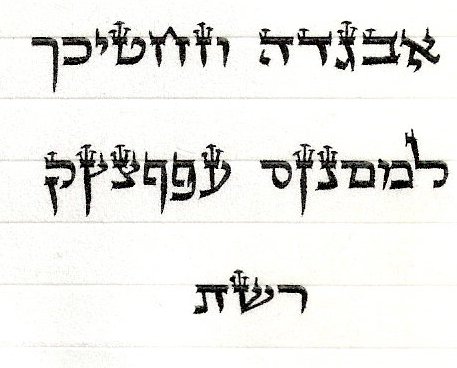
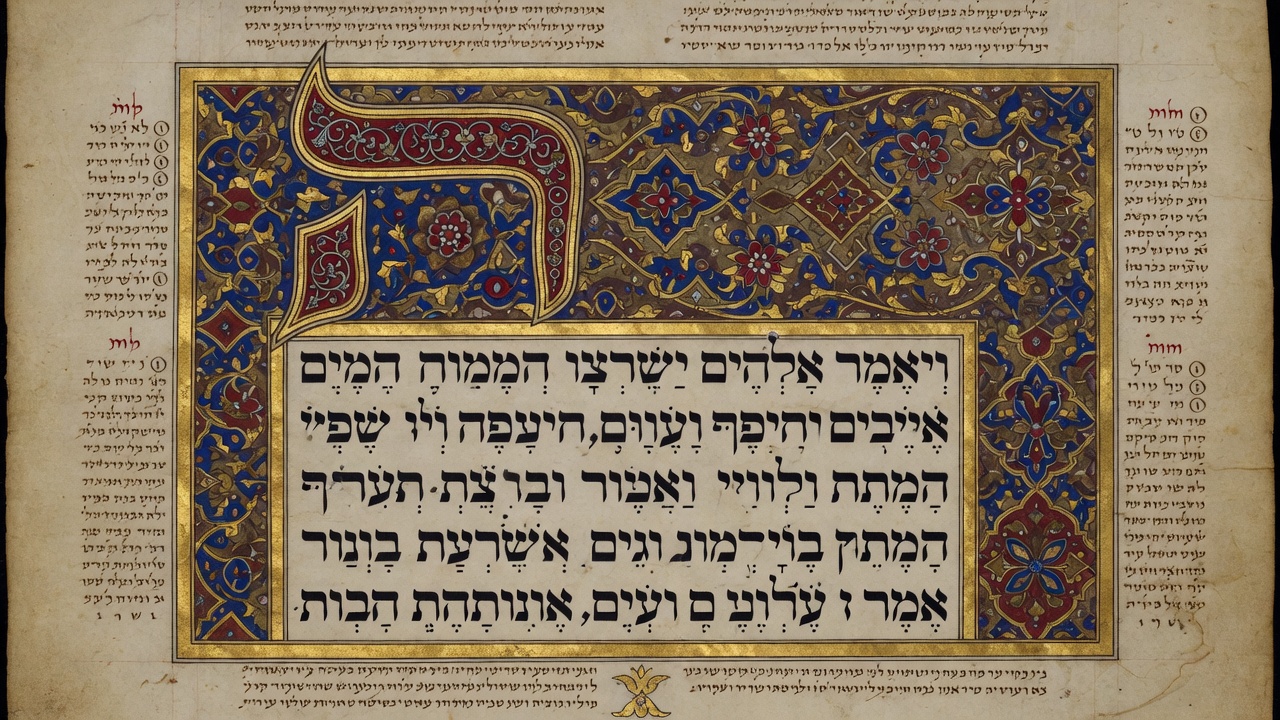
Example of the Ashuri (square) Hebrew alphabet written on parchment
Ktav Ashuri alphabet on parchment • Manuscript illustration
THE STAR MANUSCRIPTS & THE PEOPLE WHO MADE THEM

The Famous Manuscripts & the People Behind Them

Among the most important surviving Masoretic codices are the Aleppo Codex, Codex Sassoon 1053, and the Leningrad Codex — three landmark witnesses to the Tiberian tradition from the 9th–11th centuries. Alongside them stand the Cairo Codex of the Prophets (895 CE), the Codex Cairensis (Prophets, attributed to Moses ben Asher), and thousands of Cairo Genizah fragments that document how Masoretic Bibles were actually copied, corrected, and used in daily life.

Read the full essay on the great codices → Textual critics treat these manuscripts not as interchangeable copies but as independent witnesses in a stemma of transmission. Agreement between the Aleppo and Leningrad codices on a difficult reading lends confidence; disagreement flags either scribal error or a genuine pre-Masoretic variant that one school preserved and another did not. The Masoretes' own marginal notes sometimes record that a form appears "nowhere else in Scripture" — a built-in critical apparatus centuries before modern philology.

Page from the Aleppo Codex showing Deuteronomy with Tiberian vocalization and Masoretic annotations
Aleppo Codex (Deuteronomy) • Israel Museum, Shrine of the Book, Jerusalem

The Ben Asher Family — Five Generations of Masters

fl. first half of 10th century • Tiberias
The greatest of the Masoretes. He added the vocalization, accents, and Masoretic notes to the Aleppo Codex. Maimonides declared his tradition authoritative in his legal code, the Mishneh Torah (Hilkhot Sefer Torah 8:4), where he instructs scribes to follow the vocalization and section divisions of Ben Asher's codex — a rare case of a philosopher-jurist canonizing a particular manuscript tradition. Aaron also authored important grammatical works such as Sefer Dikdukei ha-Te'amim (“The Book of the Fine Points of the Accents”) and is credited with systematizing the relationship between disjunctive and conjunctive accents. Full biography →
Late 9th century
Aaron’s father. He is credited with producing the Cairo Codex of the Prophets in 895 CE — one of the oldest substantial Masoretic codices that still survives. The colophon in that manuscript shows the family’s deep pride in their work.
The Ben Asher family produced leading Masoretes across five generations, beginning with Asher “the Elder” in the late 8th century.
The Ben Naphtali School
Contemporary rivals
The main competing tradition, associated with Moses ben David ben Naphtali and the city of Tiberias (or, in some sources, a different regional circle). Their differences with Ben Asher (recorded in the medieval Sefer ha-Chilufim, “Book of Differences”) number around 875 — mostly small variations in accent placement, a few vowels, and occasional spelling. In the end, thanks largely to Maimonides’ endorsement, the Ben Asher version became the universal standard. Modern editions occasionally note Ben Naphtali variants in the apparatus, preserving memory of a rivalry that once divided the finest scribes in Galilee.
Read the full essay
Shlomo ben Buya'a

The professional scribe who penned the consonantal text of the Aleppo Codex. Masoretic division of labor often separated the copyist of the consonantal line from the grammarian who added pointing — a workflow resembling the division between typesetter and proofreader in later print culture. Buya'a's hand is praised for its beauty and uniformity across hundreds of pages.

Samuel ben Jacob & the Leningrad Tradition

Samuel ben Jacob, scribe of the Leningrad Codex, identifies himself in a detailed colophon as having written the manuscript in Cairo and corrected it from authoritative exemplars. His work is the backbone of modern critical Bibles — ironic, perhaps, given that the Aleppo Codex enjoys greater prestige in Jewish memory while Leningrad supplies the scholarly default.

ALEPPO CODEXKeter Aram Tzova
כֶּתֶר אֲרַם צוֹבָא
“Crown of Aleppo” • The most revered manuscript in Jewish history
Date & Place: c. 920 CE, Tiberias. Consonants by Shlomo ben Buya'a; vocalization and Masorah by Aaron ben Asher.
Physical description: Large-format parchment codex, originally ~487 leaves. Written in beautiful square script with full Tiberian vocalization and extensive marginal notes.
Fate: Guarded for centuries in Me'arat Eliyahu at the Great Synagogue of Aleppo. During the December 1947 riots the synagogue was burned; roughly 40% of the pages disappeared (most of the Torah). The surviving 294 leaves were smuggled to Israel in 1958 and are displayed at the Shrine of the Book, Jerusalem.
Legacy: Maimonides declared it the most accurate codex. It remains the ultimate authority for the Jerusalem Crown edition and many modern Masoretic reconstructions.
294 leaves survive today
c. 920 CE
Read the full essay on the Crown
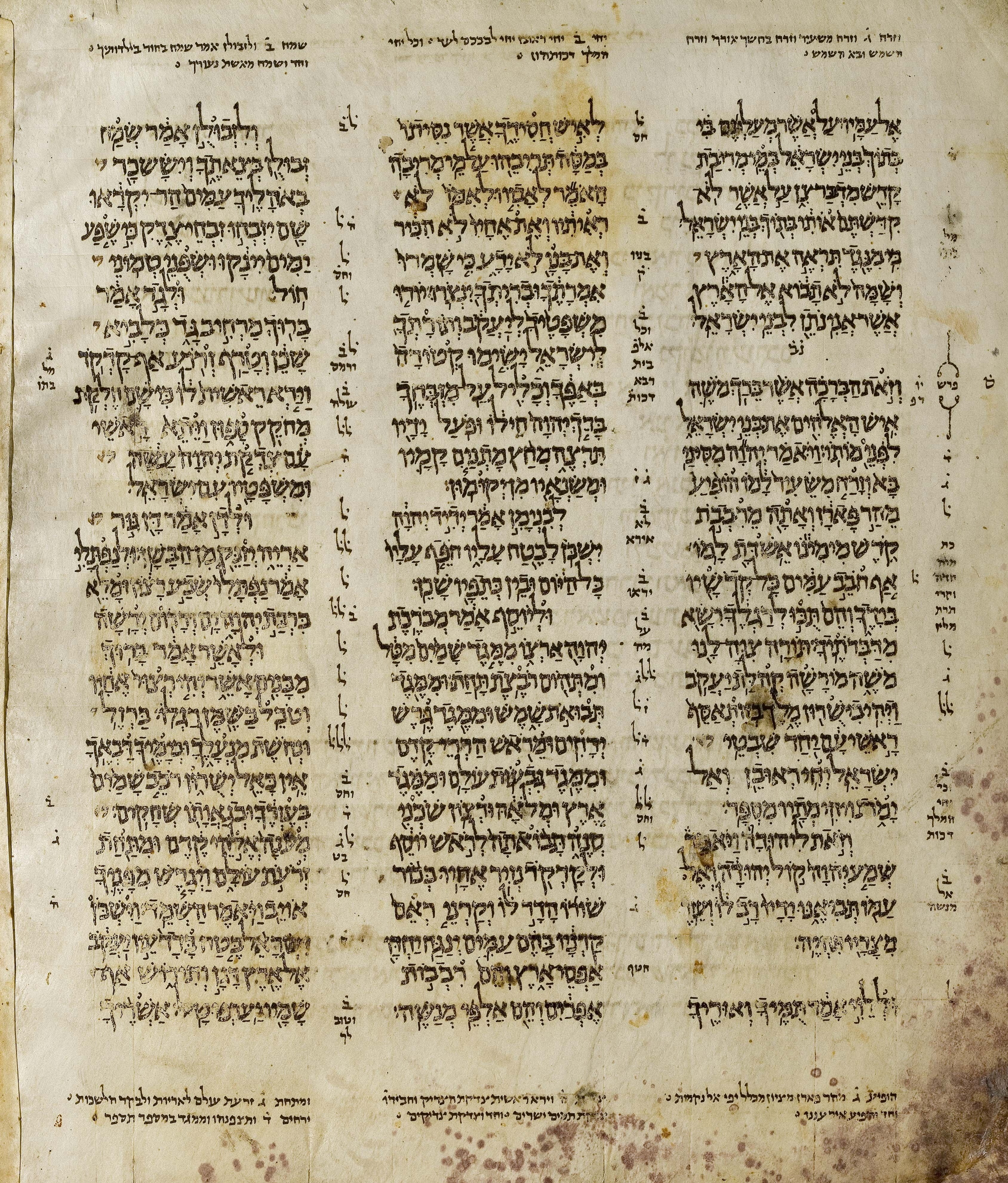
Actual page from the Aleppo Codex showing biblical text with Tiberian vocalization (Israel Museum, Shrine of the Book)
Actual folio from the Aleppo Codex (Joshua 1) — Israel Museum, Shrine of the Book, Jerusalem
Date & Place: Completed 1008 or 1009 CE in Fustat (Old Cairo) by the scribe Samuel ben Jacob.
Physical description: Complete 24-book Tanakh on high-quality parchment. 491 folios in a large, clear square script with full Tiberian pointing and a very rich Masoretic apparatus. The colophon at the end gives precise information about the date and the scribe’s work.
Significance: The oldest complete Hebrew Bible manuscript in existence. It follows the Ben Asher tradition very closely (the colophon claims it was corrected according to the most accurate texts of Aaron ben Asher). It has served as the base text for the Biblia Hebraica Stuttgartensia (BHS), the ongoing Biblia Hebraica Quinta, and most modern scholarly editions. Its completeness makes it indispensable: where the Aleppo Codex has lost most of the Torah, Leningrad supplies the full consonantal and pointed text.
Masoretic richness: The outer margins contain extensive Masorah Magna; inner margins carry Parva notes. Rubricated initial words, ornamental layouts at major divisions, and precise column formatting make it both a liturgical resource and a scholarly monument.
Current location: National Library of Russia, St. Petersburg (formerly Leningrad). It is fully digitized and widely studied; the Westminster Hebrew Institute maintains a machine-readable transcription used across biblical studies software.
All 24 books of the Tanakh • 491 folios • 1008/1009 CE
Codex Sassoon • S1 (Sassoon 1053)
ANU – Museum of the Jewish People, Tel Aviv
Date & Place: Late 9th or early 10th century CE (c. 900), likely in the Levant, Egypt, or Syria region. Written by an unknown scribe on parchment from several hundred sheepskins.
Physical description: Nearly complete Hebrew Bible (all 24 books of the Tanakh) in 792 pages. Only about 12 leaves missing (plus some partial damage). Large format, bound in leather; the volume weighs approximately 12 kg (26 lbs). Features full Tiberian vocalization, cantillation, and extensive Masoretic notes (both Parva and Magna).
Significance: One of the earliest and most complete surviving Masoretic codices, roughly contemporary with the Aleppo Codex and a century older than the Leningrad. It serves as a vital witness for the Tiberian Masoretic tradition and offers scholars important variants in book order, orthography, and punctuation for textual criticism. It forms a crucial bridge between the Dead Sea Scrolls and the standardized medieval text.
Modern History & Current Location: Long held in private collections, including that of the great bibliophile David Solomon Sassoon (1880–1942), after whom it is named. In 2023 it was sold at Sotheby’s for a record $38.1 million and acquired for the public by the ANU – Museum of the Jewish People in Tel Aviv through a generous donation by Ambassador Alfred H. Moses and family. It is now on permanent public display.
Nearly complete (missing ~12 leaves) • c. 900 CE
792 pages
DEEP DIVE ESSAYS
THE CROWN

Keter Aram Tzova

The Crown of Aleppo — created by Aaron ben Moses ben Asher in Tiberias, guarded in the Great Synagogue for centuries, damaged in 1947, and now at the Shrine of the Book.

Full essay
THE ACCIDENTAL ARCHIVE

Cairo Genizah & Schechter

In 1896, Solomon Schechter opened the Ben Ezra Genizah in Fustat — recovering Tiberian, Palestinian, and Babylonian biblical fragments from the very centuries of the Masoretes.

SACRED ARCHITECTURE

The Great Synagogues of Aleppo & Cairo

Seven arks and Me'arat Eliyahu in Aleppo; the Ben Ezra Genizah in Cairo — the buildings that sheltered the Crown and the archive that Schechter emptied.

Read the Full Essay
SECTARIAN HISTORY & THE SHARED TEXT

Rabbanites, Karaites, and the Masoretic Text

The Masoretes worked in an age when Judaism was no longer a landscape of warring Second Temple sects — Pharisees, Sadducees, Essenes — but had become a pair of rival yet intertwined legal cultures: Rabbanite (rabbinic) Judaism, heir to the Pharisaic tradition of written plus oral Torah, and Karaite Judaism, which rejected rabbinic oral law while insisting on independent biblical exegesis. What makes the Masoretic tradition historically remarkable is that both movements ultimately accepted the same consonantal Bible and the same Tiberian pointing — even as they fought bitterly over what that Bible meant.

From Pharisees to Rabbis

After 70 CE, the rabbinic movement gathered at Yavneh and gradually transformed Pharisaic legal culture into the Judaism of the Mishnah and Talmud. Shaye J. D. Cohen argues that Yavneh's enduring achievement was not sectarian triumphalism but the creation of a society that could tolerate vigorous internal dispute without splintering into separate churches of Israel. Sectarianism as such largely ceased until the rise of Karaism in the 9th century.

On the textual front, Emanuel Tov shows that already around the turn of the era the proto-rabbinic (Pharisaic) movement accepted the consonantal proto-Masoretic text as authoritative Scripture, while other Jewish groups used competing Hebrew traditions (and, in the Greek-speaking world, the Septuagint). By the first century CE, textual plurality collapsed: the proto-MT stream became the Bible of virtually all surviving Jewish communities. See Tov's ten-part series on the proto-Masoretic text for the full argument.

The Karaite Challenge

In the early Islamic period, non-rabbinic Jewish groups coalesced into Karaism — a parallel Judaism based on Scripture rather than the Talmud. Daniel J. Lasker stresses that Karaites were not simple literalists; they developed their own traditions of transmission (sevel ha-yerushah) and sophisticated biblical exegesis. The real dividing line was halakhah: calendar, dietary law, marriage, and ritual practice diverged because each side read the same verses differently.

Yet Karaites and Rabbanites remained entangled — sharing neighborhoods, marrying under negotiated agreements, and competing for communal prestige in Cairo, Jerusalem, and Babylonia. The great Geonic polemics — especially Saadia Gaon against Anan and his successors — were fought with the Masoretic codex as common ground.

Why Both Sides Needed the Masoretes

Karaite theology rejected the authority of rabbinic oral Torah, which made the written biblical text exponentially more important. A fully vocalized, accented, statistically checked codex was not a luxury but a necessity: without niqqud and te'amim, Hebrew had become a learned language, and every exegetical dispute turned on how a consonantal string should be read. Rabbanites, meanwhile, needed the same precision for liturgical reading, Talmudic argument, and the legal force of Scripture cited in halakhah.

The irony — documented by Tov and explored in studies of the Ben Asher controversy — is that Karaite communities treasured some of the greatest Masoretic manuscripts. The Aleppo Codex was kept in a Karaite synagogue; the Cairo Codex of the Prophets (895 CE) remains in Karaite custody. Maimonides endorsed the Ben Asher tradition as the standard for Torah scrolls — a ruling that bound Rabbanites while vindicating a Masoretic school whose finest products Karaite patrons had helped preserve.

Modern linguists such as Geoffrey Khan have reconstructed the Tiberian pronunciation tradition from these very manuscripts, treating the Masoretes as empirical philologists whose work both movements inherited. Tov on the scribes of proto-MT and his essay on socio-religious stabilization explain when the consonantal base was fixed; Khan and Yeivin explain how the medieval superstructure of vowels and accents was built atop it — a superstructure that Karaites and Rabbanites alike treated as authoritative even while disagreeing over nearly every law derived from it.

Shared Scripture

Both movements quote the same proto-Masoretic consonants in their polemical literature. Textual deviation between Karaite and Rabbanite Bibles is negligible; legal divergence is vast.

Divided Halakhah

Lasker shows that calendar, kashrut, tefillin, and marriage law — not theology per se — constituted the real boundary between the communities.

Masoretic Patronage

Karaite elites in Tiberias and Cairo commissioned and guarded the codices that modern scholarship treats as the gold standard of the Masoretic Text.

Read the Full Scholarly Essay Extended treatment with bibliography • Rabbanite origins • Karaite emergence • Masoretic origins
ACROSS THE JEWISH WORLD

Biblical Scholarship in Every Community

The Masoretes worked in Tiberias, but their Masoretic Text became the shared Scripture of Jewish communities from Spain to Poland, from Cairo to Yemen. Sages and travellers — Maimonides legislating which codex to copy, Benjamin of Tudela mapping where Torah was taught — reveal a diaspora united by one biblical text and divided by a thousand interpretive traditions.

Maimonides (1138–1204)

From Córdoba to Cairo — the philosopher-jurist who endorsed the Aleppo Codex tradition of Aaron ben Moses ben Asher as the standard for Torah scrolls, and whose Guide for the Perplexed offered philosophical readings of the entire Bible.

Read the full essay

Benjamin of Tudela (c. 1169–1173)

The merchant-scholar whose Travels map Jewish learning from Zaragoza to Baghdad — recording scholars, academies, and the communities that sustained the Masoretic Text across three continents.

Read the full essay
Explore All Diaspora Essays 8 scholarly essays • Spain • Poland • Middle East • North Africa • Eastern Europe • Maimonides • Benjamin of Tudela
LANGUAGE & SURVIVAL

Hebrew and Aramaic That Refused to Die

The Masoretes did not merely preserve a text — they preserved a language. When spoken Hebrew faded and Aramaic yielded to Arabic, Yiddish, and Ladino in the street, both languages lived on in synagogue, academy, and scriptorium: Hebrew in the pointed Masoretic codex, Aramaic in the Targum and the Babylonian Talmud.

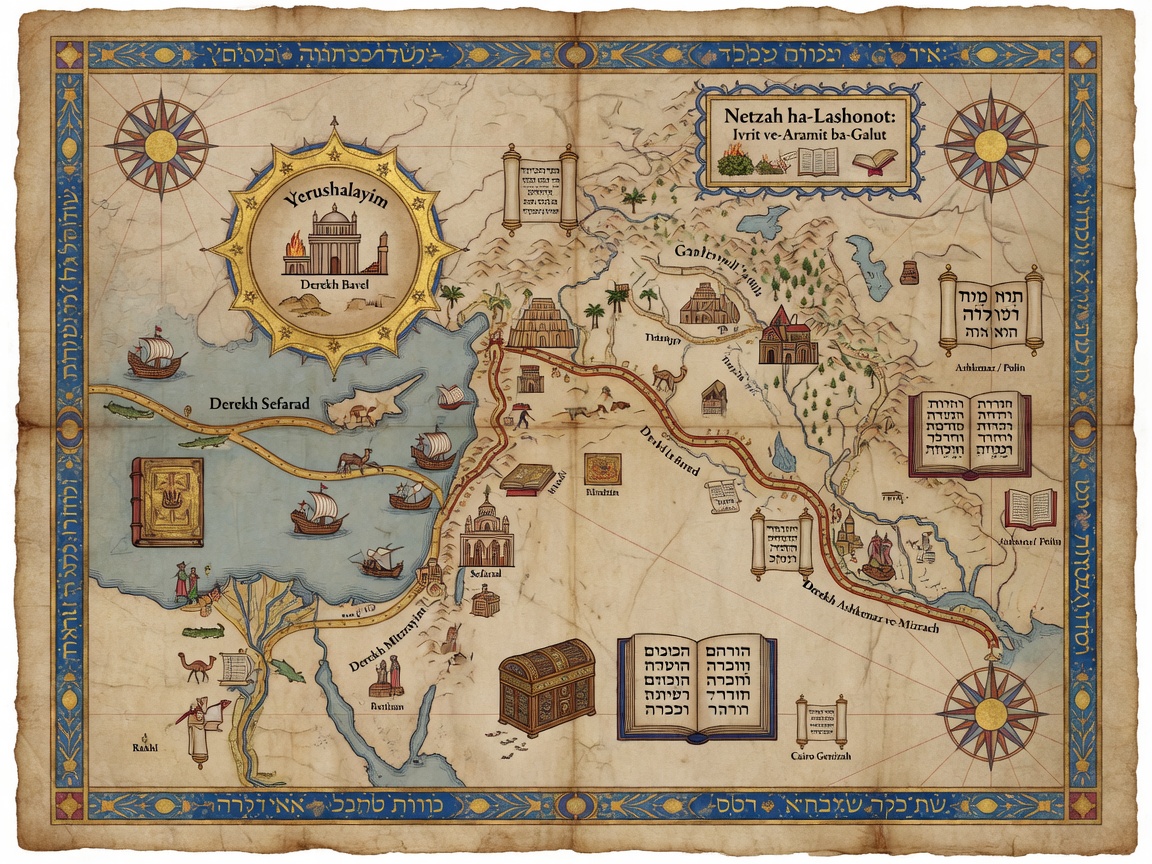
Illuminated map of Hebrew and Aramaic surviving across the Jewish diaspora
Hebrew and Aramaic carried across the diaspora — in codices, in prayer, and in every community that taught its children to read
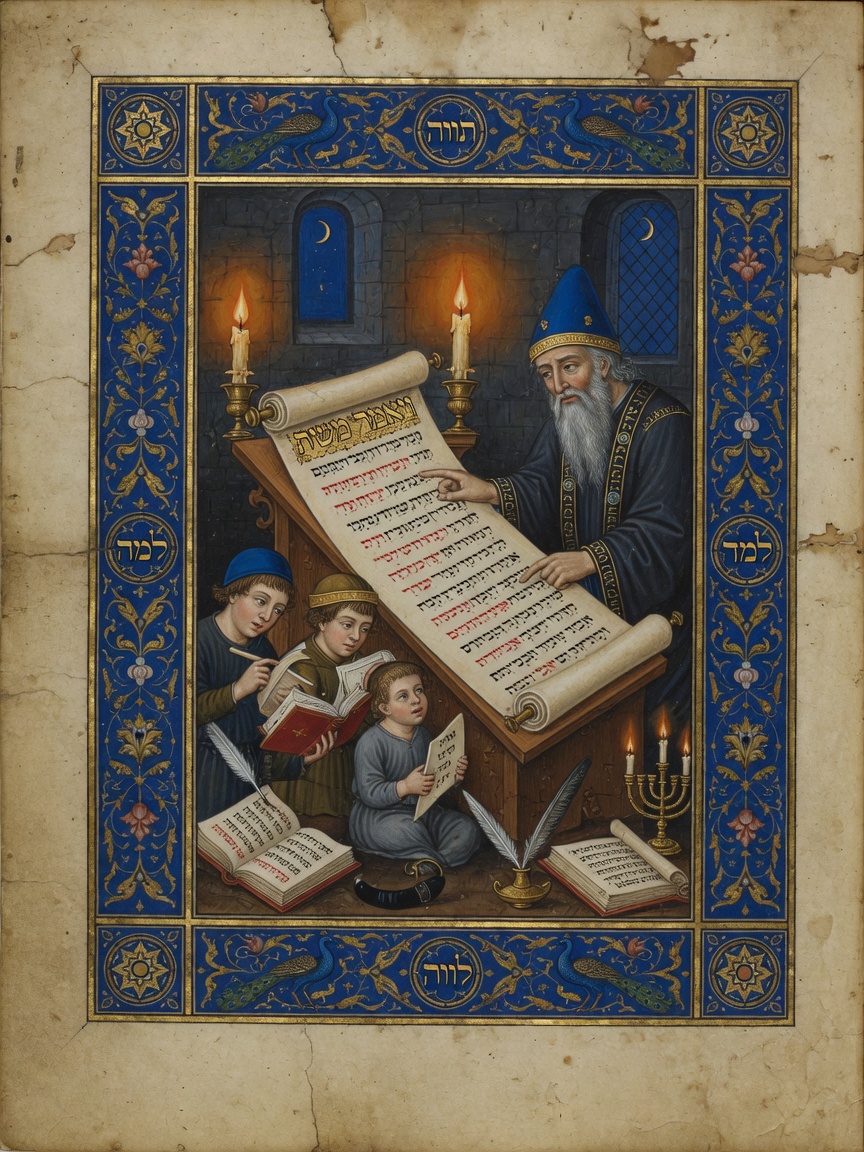
Medieval Jewish teacher instructing students in vocalized Hebrew
Hebrew taught from the pointed text — the Masoretic bridge to literacy
Hebrew Bible with Aramaic Targum on facing manuscript columns
Hebrew and Aramaic side by side — the bilingual synagogue tradition
Read All Language Essays 8 scholarly essays • Hebrew survival • Aramaic survival • Teaching Hebrew (hub + 4 regional essays) • Masoretic pointing & diglossia
WHY IT STILL MATTERS

What They Left Us

The Masoretes did not merely preserve a book; they established the form in which the Hebrew Bible would be read, sung, studied, translated, and debated for the next millennium. Every synagogue lectionary, every critical apparatus in a modern seminary edition, every debate over a variant vowel in Jeremiah descends from their codices and their margins.

The Authoritative Hebrew Bible

The Masoretic Text became — and remains — the standard Hebrew Bible for Rabbinic Judaism. Virtually every printed Hebrew Bible since the early 16th century descends directly from the work of the Tiberian Masoretes. Even manuscripts that predate them in consonants — such as many Dead Sea Scrolls — are now read through the lens of Masoretic chapter and verse division, vocalization, and cantillation when scholars prepare modern editions. Overview →

Extraordinary Textual Fidelity

The accuracy is astonishing. When scholars compare the Aleppo and Leningrad Codices (900s–1000s) with the first printed editions (1500s) and modern critical editions, the differences are minuscule and almost always well-documented. Frank Moore Cross and others noted that many Qumran biblical scrolls already align closely with the proto-Masoretic tradition, suggesting that the Masoretes codified rather than invented much of the consonantal base. Where the MT differs from Qumran or the Septuagint — as in Jeremiah's shorter or longer forms, or variant psalm superscriptions — textual critics debate whether the Masoretic form represents deliberate standardization or faithful preservation of one ancient branch. Read the full essay →

Foundation of Modern Translations & Scholarship

The King James Version, most contemporary Protestant Bibles (ESV, NIV, NASB, etc.), and many Catholic translations since 1943 are based on the Masoretic Text. Jewish translations such as the JPS Tanakh and others are direct heirs. Textual critics still use the Masoretic tradition as the primary point of comparison with the Dead Sea Scrolls, Septuagint, and Samaritan Pentateuch. When translators choose between "young woman" and "virgin" in Isaiah 7:14, or between different divine names, they are often adjudicating between the MT and ancient versions — but the MT remains the default.

Digital Continuation of the Masoretic Project

Projects such as the Westminster Leningrad Codex database, the Hebrew University Bible Project, and high-resolution digitization of the Aleppo and Sassoon codices extend the Masoretic impulse into the twenty-first century: every letter imaged, every variant tagged, every statistic verified. The technology has changed; the obsession with precision has not.

Important Modern Editions
A Living Tradition
The niqqud and te'amim the Masoretes standardized are still used every Shabbat and holiday in synagogues around the world. The chanting you hear in Jerusalem, New York, London, or Melbourne today follows the same system they perfected more than a thousand years ago — transmitted through cantorial training, printed humashim with trope, and the unbroken practice of public Torah reading. A bar or bat mitzvah chanting from a pointed book is, in a direct sense, a student of Tiberias.
FOR THE SERIOUS READER

How Scholars Evaluate the Masoretic Achievement

1. The MT is both a text and a technology

Textual critics distinguish the consonantal substrate of the Hebrew Bible from the Masoretic superstructure of vowels, accents, and notes. Consonants transmit the lexical tradition; pointing transmits phonology and liturgy. When modern editions print a verse with niqqud and te'amim, they reproduce not merely an ancient book but a medieval scholarly synthesis — one that may preserve pronunciations and readings older than the pointing itself, transmitted orally until the Masoretes inscribed them.

2. Variants do exist — and the Masorah documents them

It is a misconception that the Masoretes believed no variation had ever existed. Their qere/ketiv apparatus, their lists of "changed" forms, and their statistical notes presuppose awareness of alternatives. What they achieved was selection and documentation: one reading elevated to public recitation, others preserved in writing or in marginal record. Comparing the MT to the Dead Sea Scrolls shows that many consonantal variants were already circulating before the Masoretic period; the Masoretes inherited a relatively stable stream and froze it in a form suitable for global Jewish use.

3. The great codices are not clones

Aleppo, Leningrad, Sassoon, and Cairo Prophets agree overwhelmingly but not absolutely. Editions such as BHS mark points of disagreement with sigla in the critical apparatus. Studying those apparatus notes teaches how medieval scribes handled ambiguity: sometimes following one master codex, sometimes harmonizing, sometimes preserving a difficult form because the Masorah demanded it.

4. Why Tiberias mattered geographically

Tiberias in the 8th–10th centuries was home to a dense cluster of Hebrew grammarians working in a Jewish community that had long treated Galilee as a center of learning. Under early Islamic rule, Jews often experienced greater internal communal autonomy and continued access to Palestine's rabbinic heritage. The city's scribes had institutional memory, patronage, and competition — the Ben Asher and Ben Naphtali schools spurred one another to ever greater precision. Babylonian Jewry remained intellectually dominant in law (halakhah), but Tiberias became dominant in miqra — the recited, pointed, chanted biblical text.

5. What Ink magazine gets right — and what specialists still nuance

In Ink magazine (the in-house publication of Tyndale House, Cambridge, now titled World of the Bible), research fellow Kim Phillips offers an accessible but serious account of the Masoretes. His central insight — that biblical transmission ran on two parallel strands, a written consonantal line and an oral reading tradition later inscribed as niqqud and te'amim — aligns closely with the consensus of specialists such as Israel Yeivin, Paul Kahle, and Geoffrey Khan. Phillips is also right to stress the shift from scroll to codex: ritual Torah scrolls remained unpointed, while study Bibles became the laboratories where the full apparatus could be displayed.

Where academic discussion goes further is in chronology and social context. Phillips dates the rise of systematic Masoretic work to seventh-century Tiberias under early Islamic rule — a plausible framing of the broader "textualization" of oral culture in the Near East, though many scholars would extend the prehistory of vocalization back to supralinear Palestinian and Babylonian systems in the preceding centuries. Likewise, his courtroom-witness analogy for comparing manuscript traditions (the MT alongside the Septuagint and the Vulgate) is pedagogically effective, but textual critics would add that the Dead Sea Scrolls already show that the consonantal stream was not perfectly uniform before the Masoretes selected and stabilized one line of descent. On balance, Phillips's article is a reliable bridge between synagogue literacy and university textual criticism: it explains why the dotted page matters without treating the Masoretic Text as though it had dropped unchanged from the age of the prophets.

Key Modern Scholars
  • Geoffrey Khan — Tiberian phonology
  • Israel Yeivin — Masorah & accentuation
  • Paul Kahle — vocalization history
  • Ellis Brotzman & Bruce Waltke — scribal transmission
  • Emanuel Tov — Qumran vs. MT
Primary Medieval Sources
Questions Still Debated
  • How uniform was the consonantal text before the Masoretes?
  • Did Ben Asher influence exceed his contemporaries during his lifetime?
  • How much Palestinian/Babylonian pointing survives outside Genizah fragments?
  • Which qere readings reflect ancient euphemism vs. later piety?
“They didn’t rewrite the Bible.
They just made absolutely sure nobody could mess it up.”
— What the Masoretes were really good at